Hims & Hers Health (NYSE: HIMS) stock is trading near seven-month lows after its third-quarter earnings report. Revenue jumped 49% to $890.4 million. That was not enough to offset the number investors fixated on.
Subscribers fell by about 103,000 from the prior quarter to roughly 2.79 million. It was the company’s first sequential subscriber decline.
Management offered a tidy explanation. The company deliberately reduced U.S. weight-loss marketing. It is also migrating acquired international brands onto the Hims & Hers platform.
That explanation sounds a lot like a retailer blaming the weather. It may be technically true. It also places the cause somewhere comfortable for management.
The company’s 10-Q filing tells a more nuanced story. The marketing pullback was real, but modest. The subscriber loss that followed was surprisingly large.
That gap matters. It suggests subscriber growth was masking a churn problem. Once the company eased off the accelerator, the leak became visible.
Meanwhile, the profit outlook keeps shrinking. Management has cut full-year adjusted EBITDA guidance three times in 2026. The current range is $257 million to $277 million. In January, it was $300 million to $375 million.
For investors, the question is not whether HIMS stock looks cheap after the drop. It is whether the market has priced in a business that must keep spending to stand still.
What the 10-Q Shows About Marketing
Customer acquisition costs were $214.1 million in the third quarter. That was up from $202.6 million a year earlier. Total marketing expenses rose 7% year over year to $247.3 million.
The sequential comparison is more telling. Second-quarter customer acquisition costs were $229.5 million. That means third-quarter spending fell by roughly $15 million, or about 7%.
Some of that spending went to Eucalyptus. Hims owned the Australian telehealth company for a full quarter for the first time. So the U.S. cut was likely deeper than 7%. Still, it was a trim, not a shutdown.
The 10-Q’s own explanation does not mention a U.S. weight-loss pullback. It cites higher search and affiliate spending, partly offset by more efficient channels.
HIMS Subscriber Losses Expose a Bigger Churn Problem
Here is the problem. A roughly 7% cut in acquisition spending coincided with a 3.6% drop in subscribers.
Healthy subscription businesses do not lose 100,000 customers when marketing dips modestly. Their existing base carries them. Hims appears to need a steady stream of new sign-ups to replace those who leave.
The 10-Q hints at why some customers may be leaving. In March, Hims shifted its U.S. weight-loss business toward branded GLP-1 drugs. Those cost more than the compounded versions many customers used before.
The filing’s risk factors acknowledge that some customers “may be unwilling or unable” to make that switch. They also warn of “increased churn” during the transition.
Competition is tightening, too. Novo Nordisk (NYSE: NVO) and Eli Lilly (NYSE: LLY) now sell Wegovy and Zepbound directly to cash-pay patients. Through TrumpRx, Zepbound starts at $299 per month. That erodes the price advantage that drew many customers to telehealth.
Hims Brand Growth Is Falling Behind the Hers Business
There is another quiet signal in the filing. The Hers brand made up about 45% of U.S. revenue in the quarter. A year ago, it was about 40%.
Applied to U.S. revenue, that implies Hers grew roughly 36%. The men’s Hims brand grew only about 11%. Those are estimates based on rounded percentages.
The Hims brand houses sexual health and hair-loss treatments. Many consumers view those as discretionary. If household budgets tighten, this is where weakness would likely show first.
The company does not disclose subscribers by brand or specialty. That makes the next two quarters especially important to watch.
HIMS Stock Chart Signals More Downside Risk
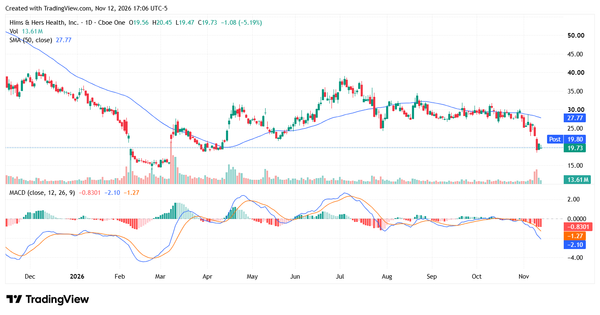
The technical picture confirms the negative sentiment. HIMS closed at $19.73 on Nov. 12, down 5.2% on the day. The post-earnings selloff came on the heaviest volume since spring.
HIMS stock sits well below its 50-day simple moving average of $27.77. That average is sloping downward.
The MACD line sits at -2.10, below its signal line at -1.27. The histogram is widening. That shows bearish momentum is accelerating, not fading.
Price is now testing the April lows near $19. If that level breaks, the next support zone is $15 to $17. That is where the stock consolidated in February and March.
An Options Trade for the Bearish Case
A long position looks premature. The trend is down and momentum is worsening. Management also guided to another quarter of subscriber headwinds. Buying now means betting on a bottom with no evidence of one.
Investors who share the bearish view can consider a bear put spread instead. It avoids short selling and caps the maximum loss.
One possible structure uses the January 15, 2027, expiration. Buy the $20 put and sell the $15 put. The $20 strike sits just above the current price. The $15 strike aligns with the bottom of the February-March support zone.
The trade profits if HIMS falls below $20 minus the net debit paid. Maximum profit comes at $15 or lower. It equals $5 per share minus the premium paid. The maximum loss is the net debit, known before the trade is placed.
The spread structure matters because HIMS options are expensive. Over the past year, 30-day implied volatility has ranged from 58% to nearly 122%. Selling the $15 put offsets part of that cost.
The January expiration also falls before the fourth-quarter report. That keeps the trade focused on the technical setup rather than another earnings gamble.
Set a clear exit. A close back above $23 would suggest the selloff was overdone. At that point, closing the spread to preserve remaining premium makes sense.
HIMS Stock: Subscriber Retention Is the Next Test
Hims & Hers still has real strengths. Revenue is accelerating, and international expansion adds scale. But the subscriber decline exposed how much the model depends on paid acquisition.
Management’s explanation is not false. It is incomplete. The real story is what the marketing pullback revealed.
Until subscribers stabilize and margins stop shrinking, the burden of proof sits with management. For now, the market appears to agree.