Among the worst-performing large-cap players recently, communication services specialist Bilibili (NASDAQ: BILI) offers a compelling contrarian opportunity. However, the technical profile doesn’t naturally lend itself to that conclusion. After all, BILI stock is down more than 45% on a year-to-date basis, with little discernible evidence that it could be a rebound candidate.
It raises an obvious question: why bother dealing with such a poor equity? The answer comes down to a possible mean-reversion opportunity.
Let’s consider the basic premise behind Bilibili stock. As the premier cultural hub and video-sharing community for China’s younger generations, the underlying company is both relevant and commands a compelling growth narrative. According to Google Finance’s summary sheet, Bilibili enjoys a massive, high-engagement user base numbering over 376 million monthly active users.
Fundamentally, it’s quite possible that the current malaise impacting BILI stock could be a correction against prior overexuberance. But the contrarian argument would be that the digestion of bad news has gone too far. Potentially, this dynamic creates fertile ground for a countervailing reaction northward.
Typically for top-tier enterprises, an excessive sentiment imbalance forces a continued move in the dominant direction to be justified with adequately supportive news. In this case, Bilibili stock would likely need strong bearish catalysts to continue pushing the share price lower. But this could also lead to a diminishing-returns problem, which may bode well for contrarian bulls.
While traders may instinctively understand the mean-reversion concept, it may not always be prudent to act on this emotion. Instead, we can instead rely on data and mathematics to provide an intelligent framework before we commit to any one decision.
Why ‘EV’ is the Most Important Metric for BILI Stock Options Trading
If we were to approach Bilibili stock as a potential long-term investment idea, the process may be quite tricky. Because its performance has been all over the map these past few years, there’s always a risk of compounded variability. Therefore, a time-limited options strategy may be better suited for some speculators.
In that pursuit, I would argue that the single-most important metric for BILI stock (or any other debit-based options strategy) is the expected value (EV) calculator. That might run counter to those who focus on unusual options, implied volatility, put/call ratios, or any number of fancy screeners. Don’t get me wrong — they all provide useful insights. However, the EV calculator stands above all.
Why? By calculating the holistic expectation of value, it forces the speculator to recognize debit-based options strategy as a three-dimensional affair. With EV, you’re not just single-mindedly focused on win frequency. Instead, you’re focused on the efficiency of success, which is a different concept than merely winning a lot.
In fact, mathematically speaking, it is very plausible to run a highly successful trading model that wins less than half the time. So long as your money-at-risk (i.e., the wager) is low enough and that the potential payout is robust enough to make up for the many times you do lose.
That’s the dirty little secret behind the EV calculator. By actually running the numbers, you can better understand whether a trade is actually worth your time (or not).
Here’s where it gets interesting for BILI stock. As a volatile security, traders may be turned off without even doing an EV calculation. But if you actually plug the data into the formula, you’ll notice that the options market is currently being very generous for the risk on tap.
That doesn’t mean you’ll win with Bilibili stock. In fact, you’ll probably lose. But because the average wager required is so small while the average payout is quite massive, there is a mathematical incentive to consider taking a shot.
Initial Looks Can Be Deceiving
At first glance, my statement above seems irrational, perhaps delusional. Let’s consider the kooky idea that I’m considering: the 16/18 bull call spread expiring Dec. 18. Already, I can hear groans. With a second-leg strike of $18 versus a current spot price of $13.50, Bilibili stock would need to rise more than 33% over the next five weeks for this spread to be fully profitable.
A fair question: what am I smoking?
I’m smoking quality EV. Right now, the above $18 bull spread requires a net debit (wager) of $28. Should BILI stock rise through and trigger the second-leg strike at expiration, the maximum payout would be a stunning 614.29%. That would be considered the “American-style odds” of a sports wager.
So, what’s remaining in the EV calculation is win probability (or win frequency). According to OptionCharts.io’s Probability Distribution screener, the probability of BILI stock hitting $18 on Dec. 18 is only 4.13%. Admittedly, that’s terrible and would ultimately lead to a negative EV of $19.74 or a return on capital (ROC) of -70.5%.
That means Bilibili stock is out for the count, right? Not quite.
Lab Conditions for Bilibili Stock vs. Reality
If we assumed laboratory conditions for BILI stock — risk neutrality, no external volatility shocks — then we would not be incentivized to take this trade as presented. However, we’re not trading BILI in lab conditions; we’re trading in real life.
In the real market, I would argue that trading does not occur randomly. Instead, participants look at prior valuations to perceive states of excess greed or fear. Regarding Bilibili stock, it’s quite obvious that the ticker is mired in an extremely bearish state. Specifically, we know that in the last 10 weeks, BILI only managed to print two positive weekly candlesticks.
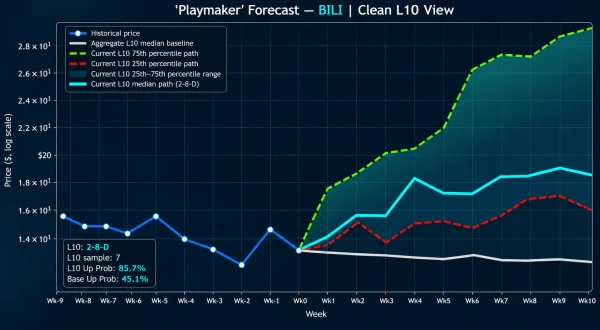
Stated differently, the ratio of bearish-to-bullish weekly candlesticks currently sits at eight-to-two. Over the past five years, whenever this rare ratio materialized in the charts, BILI stock typically saw a surge in the share price. If the same pattern were to occur again, we would expect the probability of BILI hitting $18 on Dec. 18 to land between 28.6% and 57.1%.
Of course, that implies a wide confidence interval, but here’s the takeaway point. Even at the lowest-expected probability, the aforementioned $18 spread would be calculated to have an EV of $29.20 or an ROC of 104.28%.
Looking at the Bigger Picture
To be crystal-freaking-clear, such a sky-high ROC does not mean you’re guaranteed to win. As I said earlier, you’ll probably lose. BILI stock is an incredibly volatile and risky name. It’s just that because the wager is so small and the payout so massive, those who have already decided to take great risks are incentivized to consider Bilibili’s unique proposition.
In short, you’re getting the possibility of a GARGANTUAN reward for a relative pittance in risk. That’s why the ROC is shooting to the moon. At worst, you lose $28 per spread. At best, that $28 bet can turn into $172 if it just happens to be your day.