Intuitive Machines (NASDAQ: LUNR) lost two cents per share in the third quarter, narrowing its loss from six cents a year earlier, while revenue surged 31% sequentially to $269.3 million. Satellite manufacturing now accounts for most of its sales, and a $1.87 billion backlog gives the company a much larger pipeline of contracted work.
Most investors could conclude that LUNR is becoming a broader space business, and they’ll be correct. However, its earnings results show how much work remains before that expansion translates into dependable earnings and cash generation.
How Lanteris Changed The Underlying Business.
The clearest evidence of LUNR’s transformation is where its revenue now comes from. Product sales contributed $215.1 million in Q3, roughly 80% of the $269.3 million total, while services generated $54.1 million. A year ago, quarterly revenue was just $52.4 million, with no product revenue recorded. The shift reflects the January acquisition of Lanteris, which brought satellite manufacturing capabilities and commercial and national security programs into the business
That acquisition makes the growth story more complicated, but it also gives LUNR a broader customer base. Awards for the AMDT3 constellation, Hartford platforms and NASA’s EAGLE-VSWIR program have expanded its manufacturing pipeline. Backlog reached $1.87 billion at September’s end, compared with $213.1 million at the end of 2025. Lanteris contributed $612.8 million and Goonhilly another $31.7 million, alongside $1.77 billion in new awards, before recognized revenue and contract adjustments reduced the total.
I like the direction because LUNR is building a business that can sell spacecraft and related capabilities to several customer groups, rather than relying on lunar missions alone. The backlog gives that expansion visibility, but the company still has to manufacture, deliver, and collect on the work at attractive margins. Its gross-profit improvement is the next place to look.
LUNR’s 26% Gross Margin Needs a Closer Look
Gross profit reached approximately $69 million, producing a reported margin of 26%, compared with roughly 11% a year earlier. Higher satellite production volume and a larger manufacturing contribution helped drive the improvement. However, management also disclosed favorable one-time program and estimate-at-completion adjustments in the quarter’s result.
Those adjustments were worth roughly $19 million. Excluding them for an illustrative comparison leaves around $50 million in gross profit and a margin near 18.6%. That is still a considerable improvement on last year’s level, but I would not use 26% as the baseline for valuing LUNR until subsequent quarters demonstrate that manufacturing can sustain it.
Operating expenses remain substantial. LUNR recorded a $34.2 million operating loss, even as adjusted EBITDA reached positive $8.3 million from a loss of $13.2 million a year earlier. The adjusted figure excludes, among other items, $9.6 million in acquisition and integration costs, $10.3 million in non-recurring legal expenses and $10.6 million in share-based compensation. Manufacturing is improving, but the costs of absorbing acquisitions and scaling production still weigh on the results.
LUNR’s Altus Satellite Program Faces a Cash Flow Test
LUNR generated $66.2 million in operating cash flow during Q3 and spent $32.7 million on capital expenditure, leaving $33.5 million in positive free cash flow. Across the first nine months, however, operating cash flow was negative $45.7 million and free cash flow was negative $112.3 million. Working-capital movements helped the quarterly result, including $74.1 million from higher contract liabilities and $54.2 million from accounts payable and accrued expenses. I want to see this improvement sustained before treating it as a new cash-generation profile… especially now that the company enters another heavy investment phase.
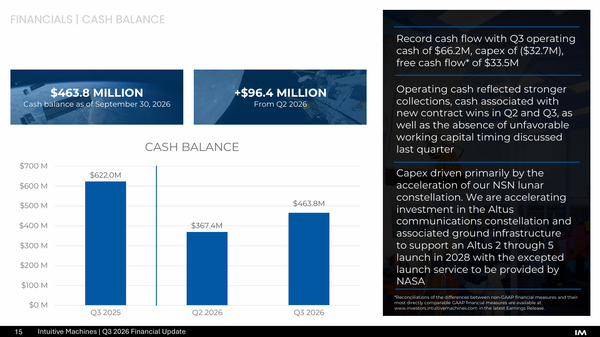
Management said Q4 and Q1 2027 capital expenditure could remain around Q3 levels or run somewhat higher as it procures hardware for Altus-2 through Altus-5. The first Altus satellite is targeted to launch with IM-3 in March or April 2027, while the remaining four are expected to deploy together in 2028. Altus could eventually give LUNR a continuing services business built around lunar communications and data infrastructure, extending its economics beyond manufacturing spacecraft.
Goonhilly also expands its ground communications and mission-support capabilities. But management has not quantified Altus’s revenue potential, so I would treat it as a developing opportunity rather than an earnings stream today.
The $1.87 Billion Backlog Must Translate Into Profits
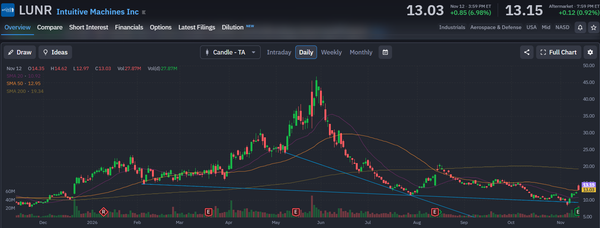
LUNR’s valuation already reflects expectations that its expanded manufacturing operation and infrastructure ambitions will translate into a much larger business. The stock has recovered above its 20-day and 50-day moving averages, around $10.92 and $12.95, respectively, but remains below its 200-day average near $19.34.
The short-term structure has improved, with the shares recovering from their recent lows and reclaiming both shorter-term averages. That gives buyers a better foothold, although the 50-day average is only just being cleared and the 200-day remains considerably higher. The latter is an important overhead level to watch because a sustained move back above it would provide stronger evidence that the longer-term downtrend is losing control. For now, volume and follow-through on any further advance will matter more than a single strong session.
Why LUNR Stock Isn’t a Buy at Current Levels
All told, I would keep LUNR on my watchlist rather than buy it at this level. The acquisitions, expanding backlog, and improving gross margin give the company a stronger foundation than it had a year ago, but that foundation still needs to produce repeatable operating profits and free cash flow. I want to see those results through the next investment cycle before paying ahead for Altus and the broader infrastructure opportunity.