Baidu (NASDAQ: BIDU) generated $4.60 billion in third-quarter revenue, down 1% year over year, while non-GAAP diluted earnings fell 35% to $1.01 per ADS. The 94% growth in AI Cloud Infra exposes the challenge. Baidu is gaining ground in a fast-growing AI market while the advertising business that financed its expansion is losing sales, forcing the company to build a new earnings engine before the old one has finished weakening.
Baidu Is Capturing A New Market Amidst China’s AI Boom
It’s no news anymore that China’s AI boom is moving at the speed of light; in fact, its generative AI user base exceeded 700 million in the first half of 2026. This means that Baidu is entering an established market. And based on its Q3 earnings report, that broader demand is already reaching its cloud operations.
AI Cloud Infra generated RMB 8.2 billion in Q3 revenue, up 94% year over year, while GPU Cloud revenue rose 191% and external customer token usage on Qianfan’s MaaS platform increased 1,159%. Baidu also reported more diversified customers, higher prepayments, and longer-term contracts, evidence of deeper customer commitments
Even with that acceleration, cloud is carrying almost the entire transition while other parts of the AI portfolio struggle to grow. AI Applications revenue was flat at RMB 2.6 billion, AI-native Marketing Services fell 15% to RMB 2.4 billion, and Legacy Business contracted 24%. AI-powered business now accounts for 53% of Baidu General Business revenue, but that share is rising partly because older operations are shrinking.
The Advertising Decline Is Swallowing Much Of The AI Growth
Baidu General Business revenue increased just 1% to RMB 25.0 billion, while Online Marketing Services fell 22% to RMB 11.9 billion. Advertising now represents 48% of General Business revenue, down from 62% a year earlier. Management attributes the pressure to macroeconomic weakness, competitive changes, and its decision to prioritize user experience over near-term monetization during the AI Search transition
Though shrinking, management’s strategy may protect search’s long-term relevance, but the company is changing the advertising model that has funded its business while cloud is still scaling into a major earnings contributor. Revenue across Baidu Inc. fell 1% to RMB 30.8 billion, and cost of revenue rose 9% to RMB 19.9 billion as cloud costs and traffic acquisition expenses increased. Operating income dropped from RMB 3.02 billion in Q2 to RMB 626 million in Q3, while non-GAAP operating income fell from RMB 3.79 billion to RMB 1.71 billion
The return to GAAP profitability needs context because Q3 2025 included a RMB 16.19 billion impairment charge. The year-over-year recovery looks dramatic, but sequential deterioration is less flattering. I would put more weight on the latter when judging how quickly the new business is improving Baidu’s earnings power.
Alibaba And The Industry’s Cash Burn Show What Baidu Still Has To Prove
Alibaba (NYSE: BABA) is a useful comparison because its June 2026 quarter showed cloud growth producing earnings. AI Cloud and Compute Services revenue rose 45% to RMB 48.4 billion, while adjusted EBITA increased 133% to RMB 5.63 billion, an 11.6% margin. Baidu’s cloud growth is faster, but it has not disclosed comparable segment profitability. Baidu needs to show similar economics before 94% growth proves much.
The industry’s financing figures make the need for that proof more urgent, because Baidu is not investing in isolation. Rhodium Group estimates Chinese AI infrastructure capex will rise 103% in 2026 to RMB 932 billion, while Alibaba, Tencent (HKEX: 0700) and Baidu together recorded negative RMB 16 billion in free cash flow in the first half of 2026.
Baidu’s Q3 operating cash flow was positive RMB 2.78 billion, but capital expenditure reached RMB 7.35 billion, leaving free cash flow negative RMB 4.57 billion. Its RMB 276.6 billion in cash and investments provides a buffer, but demand alone does not guarantee returns.
Investors Are Still Waiting For Proof
The immediate reaction to the results was telling. Baidu reported before the U.S. market opened, and its shares initially edged up 0.19% to $78.22 in premarket trading, only for the reaction to reverse, as shares fell down 1% in premarket trading. Investors were weighing the cloud growth against the advertising decline and earnings pressure rather than simply rewarding the headline AI numbers.
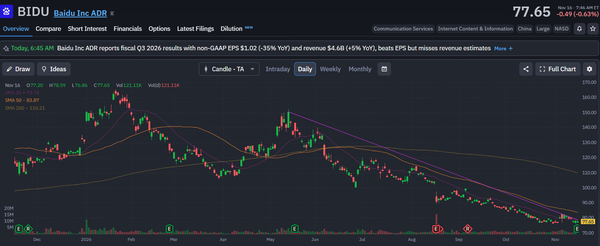
Technically, the 20-day average at $78.74 is the first level BIDU needs to reclaim, followed by the 50-day at $83.87. Both are below the declining 200-day average, which remains more than $32 above the share price. That separation reflects the damage done during the broader selloff.
The chart’s recent trading around 76-80 places the stock close to its 52-week low of $75.80, making that area an important support zone. A decisive break below it would expose the shares to another leg lower, while a sustained recovery above the 50-day average would improve the intermediate-term picture. The 200-day average is a much larger hurdle, and the stock has considerable ground to recover before its long-term trend can be considered repaired.
I would keep BIDU on the watchlist. Its AI opportunity is substantial, and I see genuine opportunity there, but the earnings release has yet to give investors a reason to overlook shrinking advertising revenue, weaker sequential profitability, and heavy infrastructure spending.