ajax loader

Loading...


Ride-the-Wave Strategy – Best for Stock Traders

Ride-the-Wave targets multi-day price momentum following a company’s earnings announcement (EA). With this strategy:

  1. Buy a stock one day post-EA if a stock reacts positively post-earnings:
    1. Near the close of trading the EA-day for a pre-market-EA
    2. Near the close of the following day for a post-market-EA
  2. Sell-to-close after 7-10 days, or possibly earlier if a desired price target is reached

Similarly,

  1. short a stock one day post-EA if a stock reacts negatively post-earnings:
    1. near the close of trading the EA-day for a premarket-EA
    2. near the close of the following day for a post-market-EA
  2. then buy-to-close after 7-10 days, or possibly earlier if a desired price target is reached

Important: Ride-the-Wave is predicated on significant price momentum triggered by an EA. The 7-10 day scenario is the maximum trade hold-time. If you see post EA-momentum is halted or reversed by a significant opposite move, re-evaluate your presence in the trade.

This popular StockEarnings screen below will give you a list of stocks that historically exhibit significant price momentum following an EA for the next seven days:

  1. Stocks exhibiting positive post-EA price moves are buy-candidates
  2. Stocks exhibiting negative post-EA price moves are sell/short-candidates

The screen includes those stocks whose Earnings just came out in last two days.

Screen criteria:

  1. Earnings Date Start Date : Current Date + -1 Day
  2. Earnings Date End Date : Current Date + -2 Days
  3. Predicted Move (Next Day) Max : 7%
  4. Predicted Move (On 7th Day) Min : 7%

Strategy Guideline:

  1. Buy the stock if stock has reacted positively. Short the stock if stock has reacted negatively (see above).
  2. Close the position in 7-10 days, or possibly earlier based on price move.

Volatility Crush Strategy - Best for Options Traders

The Volatility Crush strategy is used with stocks that typically experience relatively low-to-moderate price moves (≤4%) following their Earnings Announcements (EA). The basic trade idea is to sell put or call options right before the EA, collecting a credit when options premium is very high due to elevated implied volatility (IV). You then close the position right after the EA by buying the option back much cheaper due to the significant drop in IV that occurs after the mystery of the EA disappears. In assessing this trade, you need to do your homework to ensure you collect sufficient premium to make the trade worthwhile.

This trade is practical due to the low-to-moderate price-move after the EA, which generally won’t significantly affect the options price, unlike an “action” stock, which experience great price moves post-EA. With these symbols, if you’re on the right side of the price move, that’s a great thing. But if you’re on the wrong side of the move, not so great. Consequently, by minimizing the effect of the post-EA price move, you have a much better chance to profit from the reduction in IV without it being ruined by a violent price move.

For this trade, open the position either (1) the night before the EA when the company announces earnings or (2) during the EA day when it announces post-market, generally capturing IV at or close to its peak.

For this trade, open the position either (1) the night before the EA when the company announces earnings or (2) during the EA day when it announces post-market, generally capturing IV at or close to its peak.

This popular stockearnings screen will give you a list of stocks which do not react more than 4% fpost-EA. It includes only those stocks whose earnings are releasing next day.

Screen criteria:

  1. Earnings Date Start Date : Current Date + 1
  2. Earnings Date End Date : Current Date + 1
  3. Predicted Move (Next Day) Max : 4%
  4. Options Type: Weekly

Strategy Guideline:

  1. Options Strategy: Sell Call and Put
  2. Options Strike Price: Current Stock Price – (% Predicated Move x 2)
  3. Expiration Date: It should generally be the closest expiry immediately after the EA.
  4. Buy Insurance: Buying back Call and Put at Strike price which 10% lower than Sell Strike Price is optional but recommended.

Watch Video for More Detail

Volatility Rush Strategy - Best for Options Traders

The Volatility Rush takes advantage of increasing options premiums into earnings announcements (EA) caused by an anticipated rise in Implied Volatility (IV). With this strategy, Buy a Call and Put at-the-money (a long straddle) 2-3 weeks before the EA when IV is lower. Sell the position either (1) the night before the EA when the company announces earnings pre-market, or (2) during the EA day when it announces post-market, generally capturing IV at or close to its peak.

This popular screen will give you a list of stocks whose Options premiums tend to rise into Earnings. It includes only those stocks whose Earnings are at least two weeks away from today.

Screen criteria:

  1. Earnings Date Start Date : Current Date + 15 Days
  2. Earnings Date End Date : Current Date + 30 Days
  3. Predicted Move (Next Day) Min : 5%
  4. Options Type: Weekly or Monthly if that lines up with the two to three-week lead-time for entering the trade

Strategy Guideline:

  1. Buy a Straddle at or close to the money two to three weeks pre-EA.
  2. Sell the position either the night before the EA when the company announces earnings pre-market, or during the EA day when it announces post-market.
  3. Expiration date should generally be the closest expiry immediately after the EA.
  4. Straddle price should not be more 60% of predicted move.

Predicted Move (Volatility)

Similar to Implied Volatility in Options. Expected volatility % based on our Proprietary Volatility Predication Model. We are expecting that stock price will likely to reach % in either direction by the end of next trading session after Earnings are released and not necessarily the closing volatility %.

Why is it important?

    This indicator helps

  1. Knowing expected volatility in stocks after Earnings helps to decide trading stocks before Earnings Announcement.
  2. Taking Advantage of volatility collapse following Earnings Results by using Advance Options strategies such as Spread and Straddles.

Since Last Earnings

Change in share price since last Earnings release.

Why is it Important?

When share has gained more than 10% since it's last Earning release, it tends to over react to minor bad news and give up some gains if not all. So, it contains more downside volatility than upside When share has dropped more than 10% since it's last Earning release, it tends to over react to minor good news and recover some drops if not all. So, it contains more upside volatility than downside.

EPS Surprise (%)

Occurs when a company's reported quarterly or annual profits are above or below analysts' expectations. Here is the formula to derive % EPS Surprice:

Actual EPS - Estimated EPS
------------------------------------- x 100
Estimated EPS

Why is it Important?

Earnings surprises can have a huge impact on a company's stock price. Several studies suggest that positive earnings surprises not only lead to an immediate hike in a stock's price, but also to a gradual increase over time. Hence, it's not surprising that some companies are known for routinely beating earning projections. A negative earnings surprise will usually result in a decline in share price.

Next Day Price Change (%)

Next Regular trading session Closing price following Earnings result.

For After Market Close Earnings, It is a next trading day closing price. For Before Market Open Earnings, It is the same trading day closing price.

Why is it Important?

Next Day price change is a reaction of Earnings result.

Baidu’s Search Engine Is Starting To Look Like Dead Weight

Posted on May 18, 2026 by Grayson Cavern

Baidu’s Search Engine Is Starting To Look Like Dead Weight

Baidu Inc ADR (NYSE: BIDU) released its Q1 2026 earnings report with a revenue of RMB32.45 billion ($4.47 billion) while adjusted EPS came in at RMB12.06 ($1.66) per ADS, both ahead of expectations.

But as you’ll discover, this quarter had nothing to do with the revenue beat.

Baidu’s advertising business – the engine that built the company into China’s dominant search platform – fell from roughly RMB16 billion to approximately RMB12.6 billion ($1.74 billion) during the quarter.

At the same time, the company’s AI-powered business surged 49% year-over-year to roughly RMB13.6 billion ($1.87 billion). And understanding this crossover, including why and how it happened, could change how you value BIDU going forward.

Investors Still Value Baidu Like A Search Engine


For years, Baidu operated one of the cleanest internet business models in China; traffic came in, advertisers followed, and cash poured out. 

That machine now looks far less reliable.

Weak consumer demand across China continues to pressure advertiser spending, while competition inside the country’s internet economy continues to intensify. The search-driven advertising system that has carried Baidu for years no longer appears strong enough to remain the company’s long-term growth engine by itself.

And the company’s own numbers are starting to expose that reality.

In fact, for the first time ever, AI-powered business contributed more than half of Baidu’s core revenue mix. That figure alone exposes a company that had already begun to shift its center of gravity, even as everyone was still talking about Baidu as “China’s Google.” And now the company has morphed into a full-scale AI infrastructure that is getting more and more difficult to ignore.

Baidu Is Building The Layer Underneath China’s AI Boom

The most important figure that explains this transition better is the AI cloud revenue, which surged 79% year-over-year to roughly RMB8.8 billion ($1.21 billion). 

I chose this number because while Chatbots attract attention, infrastructure changes the economics of AI completely.

Normally, the companies supplying GPU access, enterprise AI systems, cloud compute, and AI infrastructure are those that sit underneath the broader AI economy itself.

That is where recurring enterprise demand starts forming, where long-term spending cycles begin compounding, and most importantly, where Baidu is determined to position itself before weakness inside China’s internet economy drags the old advertising business down further.

This is evident in China’s transportation industry, where Baidu continues to aggressively scale Apollo Go, a ride-hailing and robotaxi platform, as it pushes deeper into autonomous driving infrastructure. In this quarter alone, Apollo Go has provided more than 1.4 million rides, while cumulative rides have surpassed 11 million.

Then, in cloud computing, its AI model, ERNIE, is powering the next generation of search, cloud, enterprise AI, and generative AI products.

And instead of keeping ERNIE trapped inside a chatbot like ChatGPT, Baidu is embedding it across its infrastructure and monetizable AI systems to drive cloud demand, enterprise adoption, and AI-powered services.

As you can see, this is why the AI-cloud revenue is the most important figure this quarter: more than any other figure, it shows how radically different the business model is from the one investors still associate with Baidu.

Now, before you leave, another thing to consider is the speed of this entire transition.

Usually, companies drag their feet as they shift from their former legacy to a new one. Not Baidu. As a matter of fact, Baidu Core generated roughly RMB7 billion in operating cash flow during the quarter, while the company returned approximately $172 million to shareholders through share repurchases.

This means two things;

One is that the AI business is becoming large enough financially to reshape how the entire company is valued.

Two, the company is not funding this AI transition from weakness.

And once investors stop viewing Baidu primarily through advertising revenue (old legacy) and start viewing it through AI infrastructure growth, the company’s valuation can shift violently.

A Technical Breakout Attempt

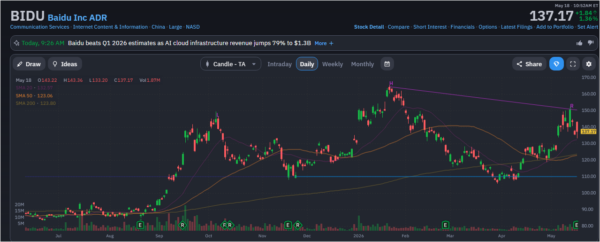
Despite its profits falling like a sack of bricks, BIDU ripped higher after earnings as investors aggressively repriced the company around its accelerating AI infrastructure story. The stock pushed toward the $145-$150 resistance zone after AI cloud revenue surged 79% to roughly $1.21 billion, while AI-powered revenue climbed 49%.

Technically, BIDU reclaimed both its 20-day moving average near $132 and its 50-day moving average near $123 following the earnings gap higher. Volume also expanded sharply as momentum returned to the chart after months of weakness.

The key battleground now sits around the descending trendline near $145-$150. A clean breakout above that region could shift momentum aggressively toward the January highs near $160.

The larger setup now looks less like a weak internet stock and more like a company attempting a full AI-driven rerating underneath the surface.
baidu - StockEarnings

Old Things Shall Pass Away

Net income attributable to Baidu fell sharply from RMB7.72 billion to approximately RMB3.45 billion ($475 million).

A profit collapse that severe normally dominates investor attention.

Yet, this quarter, the bulls locked onto AI cloud growth, AI-powered revenue, and the company’s accelerating transition underneath the surface.

That reaction says a lot about how the company is no longer clinging on to an old empire with deteriorating corners. In what now seems to be the right, strategic, and timely move.


Join over 1.2M+ investors/traders who receive daily and weekly notable earnings alerts with predicted move