NVIDIA (NASDAQ: NVDA) faces a major test this week. Investors want to know whether demand for its artificial intelligence chips remains strong and whether the company can maintain its momentum following Jensen Huang’s untimely departure. While NVIDIA’s reports routinely attract attention, this one brings an additional question: Can management reassure shareholders during an unexpected leadership transition?
Strong results would help. But investors will also want clear answers about future sales, product deliveries, and the search for a permanent chief executive.
For NVDA stock, what comes next could matter more than what happened last quarter.
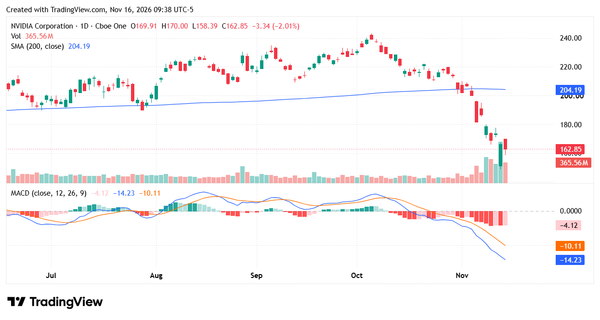
NVIDIA Stock Breaks Below Its 200-Day Moving Average
NVDA stock is showing significant technical weakness heading into earnings. Shares closed at $162.85 on November 16, down 2.01% on the session, after a sharp decline that pushed the stock well below its 200-day simple moving average of $204.19. Heavy trading volume of 365.56 million shares suggests the selling pressure is substantial.
Momentum indicators also remain bearish. The MACD line is at -14.23, well below its signal line at -10.11, while the negative histogram indicates that downward momentum remains elevated. NVIDIA stock could find initial support around $158 to $160, although a sustained break below that area would expose shares to additional downside.
On the upside, investors should watch $175 to $180 as an initial resistance zone, followed by the psychologically important $200 level and the 200-day moving average. A strong earnings report could help stabilize shares, but the technical picture suggests investors will need convincing evidence before declaring the selloff over.
Wall Street Expects Another Huge Quarter
Analysts expect earnings of about $2.47 per share on revenue of $108.72 billion. That compares with NVIDIA’s own revenue guidance of $108 billion, plus or minus 2%. The company reported $96.2 billion in sales during the previous quarter. Revenue near current expectations would represent roughly 13% sequential growth, a substantial increase.
Still, simply beating the company’s guidance may not be enough to send the shares higher.
NVIDIA announced Huang’s resignation on November 12 and appointed longtime Chief Financial Officer Colette Kress as interim CEO. Kress will retain her finance responsibilities while the board considers internal and external candidates for the permanent position. Having served as CFO since 2013, she understands Nvidia’s finances, customers, and operating demands.
But investors will want evidence that the broader leadership team can keep the company moving forward. That means explaining who is responsible for major strategic decisions, whether customer commitments remain unchanged, and how the executive search will proceed. The board has said it expects operations, customer commitments and the product roadmap to continue without interruption. Tuesday’s call gives management an opportunity to support that message with concrete details.
Investors do not necessarily need a permanent CEO announcement this week. They do need confidence that uncertainty at the top is not creating uncertainty throughout the business.
AI Demand and Product Deliveries Remain Critical
Beyond the leadership headlines, NVIDIA’s investment case still depends on customers buying its technology. The central question is whether spending on AI infrastructure can continue at a pace that supports Wall Street’s growth expectations. Investors should listen for commentary about new orders, customer spending plans, and the timing of major deployments.
Product execution will be especially important.
In its previous quarterly release, Nvidia said its Vera Rubin platform was ramping into full production, with systems running at partners including Core Weave, Google Cloud, Microsoft Azure, Oracle Cloud Infrastructure, and Nebius. Updates on that rollout could help investors judge whether future growth is progressing as expected.
What Could Move NVDA Stock?
The most encouraging outcome would combine better-than-expected results, a strong sales outlook, and credible reassurance about leadership. That would help investors focus on NVIDIA’s business performance and the strength of customer demand. A weaker outcome would involve disappointing guidance, pressure on profitability, or vague answers about execution. Even impressive historical growth might struggle to offset concerns about the next several quarters.
Huang’s departure does not automatically erase NVIDIA’s technology, workforce, or customer relationships. It does, however, make management’s ability to demonstrate continuity more important. For investors, Tuesday’s report is ultimately a test of confidence. NVIDIA needs to show that its growth engine remains healthy and that the people now steering the company can keep delivering.
In short, NVIDIA doesn’t need to answer every question this week, but it does need to give investors a clearer picture of the road ahead. If management delivers a strong outlook, confirms healthy customer demand and shows that product launches remain on schedule, the report could help rebuild confidence in NVDA stock.