ajax loader

Loading...


Ride-the-Wave Strategy – Best for Stock Traders

Ride-the-Wave targets multi-day price momentum following a company’s earnings announcement (EA). With this strategy:

  1. Buy a stock one day post-EA if a stock reacts positively post-earnings:
    1. Near the close of trading the EA-day for a pre-market-EA
    2. Near the close of the following day for a post-market-EA
  2. Sell-to-close after 7-10 days, or possibly earlier if a desired price target is reached

Similarly,

  1. short a stock one day post-EA if a stock reacts negatively post-earnings:
    1. near the close of trading the EA-day for a premarket-EA
    2. near the close of the following day for a post-market-EA
  2. then buy-to-close after 7-10 days, or possibly earlier if a desired price target is reached

Important: Ride-the-Wave is predicated on significant price momentum triggered by an EA. The 7-10 day scenario is the maximum trade hold-time. If you see post EA-momentum is halted or reversed by a significant opposite move, re-evaluate your presence in the trade.

This popular StockEarnings screen below will give you a list of stocks that historically exhibit significant price momentum following an EA for the next seven days:

  1. Stocks exhibiting positive post-EA price moves are buy-candidates
  2. Stocks exhibiting negative post-EA price moves are sell/short-candidates

The screen includes those stocks whose Earnings just came out in last two days.

Screen criteria:

  1. Earnings Date Start Date : Current Date + -1 Day
  2. Earnings Date End Date : Current Date + -2 Days
  3. Predicted Move (Next Day) Max : 7%
  4. Predicted Move (On 7th Day) Min : 7%

Strategy Guideline:

  1. Buy the stock if stock has reacted positively. Short the stock if stock has reacted negatively (see above).
  2. Close the position in 7-10 days, or possibly earlier based on price move.

Volatility Crush Strategy - Best for Options Traders

The Volatility Crush strategy is used with stocks that typically experience relatively low-to-moderate price moves (≤4%) following their Earnings Announcements (EA). The basic trade idea is to sell put or call options right before the EA, collecting a credit when options premium is very high due to elevated implied volatility (IV). You then close the position right after the EA by buying the option back much cheaper due to the significant drop in IV that occurs after the mystery of the EA disappears. In assessing this trade, you need to do your homework to ensure you collect sufficient premium to make the trade worthwhile.

This trade is practical due to the low-to-moderate price-move after the EA, which generally won’t significantly affect the options price, unlike an “action” stock, which experience great price moves post-EA. With these symbols, if you’re on the right side of the price move, that’s a great thing. But if you’re on the wrong side of the move, not so great. Consequently, by minimizing the effect of the post-EA price move, you have a much better chance to profit from the reduction in IV without it being ruined by a violent price move.

For this trade, open the position either (1) the night before the EA when the company announces earnings or (2) during the EA day when it announces post-market, generally capturing IV at or close to its peak.

For this trade, open the position either (1) the night before the EA when the company announces earnings or (2) during the EA day when it announces post-market, generally capturing IV at or close to its peak.

This popular stockearnings screen will give you a list of stocks which do not react more than 4% fpost-EA. It includes only those stocks whose earnings are releasing next day.

Screen criteria:

  1. Earnings Date Start Date : Current Date + 1
  2. Earnings Date End Date : Current Date + 1
  3. Predicted Move (Next Day) Max : 4%
  4. Options Type: Weekly

Strategy Guideline:

  1. Options Strategy: Sell Call and Put
  2. Options Strike Price: Current Stock Price – (% Predicated Move x 2)
  3. Expiration Date: It should generally be the closest expiry immediately after the EA.
  4. Buy Insurance: Buying back Call and Put at Strike price which 10% lower than Sell Strike Price is optional but recommended.

Watch Video for More Detail

Volatility Rush Strategy - Best for Options Traders

The Volatility Rush takes advantage of increasing options premiums into earnings announcements (EA) caused by an anticipated rise in Implied Volatility (IV). With this strategy, Buy a Call and Put at-the-money (a long straddle) 2-3 weeks before the EA when IV is lower. Sell the position either (1) the night before the EA when the company announces earnings pre-market, or (2) during the EA day when it announces post-market, generally capturing IV at or close to its peak.

This popular screen will give you a list of stocks whose Options premiums tend to rise into Earnings. It includes only those stocks whose Earnings are at least two weeks away from today.

Screen criteria:

  1. Earnings Date Start Date : Current Date + 15 Days
  2. Earnings Date End Date : Current Date + 30 Days
  3. Predicted Move (Next Day) Min : 5%
  4. Options Type: Weekly or Monthly if that lines up with the two to three-week lead-time for entering the trade

Strategy Guideline:

  1. Buy a Straddle at or close to the money two to three weeks pre-EA.
  2. Sell the position either the night before the EA when the company announces earnings pre-market, or during the EA day when it announces post-market.
  3. Expiration date should generally be the closest expiry immediately after the EA.
  4. Straddle price should not be more 60% of predicted move.

Predicted Move (Volatility)

Similar to Implied Volatility in Options. Expected volatility % based on our Proprietary Volatility Predication Model. We are expecting that stock price will likely to reach % in either direction by the end of next trading session after Earnings are released and not necessarily the closing volatility %.

Why is it important?

    This indicator helps

  1. Knowing expected volatility in stocks after Earnings helps to decide trading stocks before Earnings Announcement.
  2. Taking Advantage of volatility collapse following Earnings Results by using Advance Options strategies such as Spread and Straddles.

Since Last Earnings

Change in share price since last Earnings release.

Why is it Important?

When share has gained more than 10% since it's last Earning release, it tends to over react to minor bad news and give up some gains if not all. So, it contains more downside volatility than upside When share has dropped more than 10% since it's last Earning release, it tends to over react to minor good news and recover some drops if not all. So, it contains more upside volatility than downside.

EPS Surprise (%)

Occurs when a company's reported quarterly or annual profits are above or below analysts' expectations. Here is the formula to derive % EPS Surprice:

Actual EPS - Estimated EPS
------------------------------------- x 100
Estimated EPS

Why is it Important?

Earnings surprises can have a huge impact on a company's stock price. Several studies suggest that positive earnings surprises not only lead to an immediate hike in a stock's price, but also to a gradual increase over time. Hence, it's not surprising that some companies are known for routinely beating earning projections. A negative earnings surprise will usually result in a decline in share price.

Next Day Price Change (%)

Next Regular trading session Closing price following Earnings result.

For After Market Close Earnings, It is a next trading day closing price. For Before Market Open Earnings, It is the same trading day closing price.

Why is it Important?

Next Day price change is a reaction of Earnings result.

5 Consumer Staples Stocks Under 15x Earnings Worth Buying Before 2027

Posted on Nov 17, 2026 by Chris Markoch

5 Consumer Staples Stocks Under 15x Earnings Worth Buying Before 2027

Consumer staples stocks are supposed to be the safe trade when the economy wobbles. Lately, they haven’t felt that way. Many investors expect the sector to stay weak into 2027. Shoppers are trading down, volumes are flat, and pricing power has faded.

There’s plenty of data to support that outlook. But it treats an entire sector as a single trade. Inside the group, some consumer staples stocks now trade under 15x earnings while their underlying businesses are improving.

A stock screener of consumer staples names highlights several of them. The five consumer staples stocks in this article share three traits:

  • Each trades at a trailing price-to-earnings (P/E) ratio below 15x.
  • Each carries a Buy or Moderate Buy consensus rating.
  • Each has a consensus price target implying double-digit upside.

To be fair, a low valuation alone doesn’t make a stock a buy. Sometimes cheap stocks are cheap for a reason. In these five cases, however, the gap between perception and fundamentals looks wide enough to matter.

The Andersons: Record Earnings, Bigger Bets


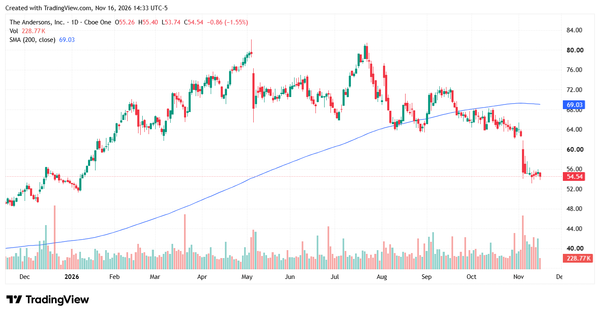
The Andersons (NASDAQ: ANDE) trades at about 9.2x trailing earnings, one of the lowest multiples among these consumer staples stocks. Its Buy rating is also the strongest in the group. The consensus price target of $95 implies roughly 73% upside from $54.85.

The fundamentals support that optimism. On Nov. 3, the agribusiness company reported record third-quarter net income of $46.4 million. Diluted EPS climbed to $1.36 from $0.59 a year earlier. Record results in the renewables segment drove the gain.

So why is the stock cheap? The company also agreed to acquire Harvestone Low Carbon Partners for $915 million. That deal adds leverage and leans further on ethanol tax credits. Investors are pricing in that risk. Management, however, still targets a $7 run-rate EPS by the end of 2028. Today’s price is less than 8x that goal.
consumer staples - StockEarnings

John B. Sanfilippo & Son: A Miss That May Be Overpriced

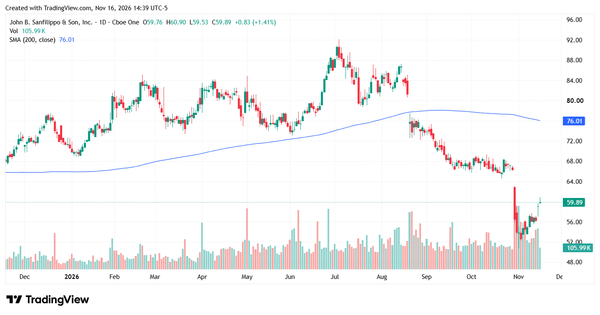
John B. Sanfilippo & Son (NASDAQ: JBSS), maker of Fisher and Orchard Valley Harvest nuts, trades at about 12.7x earnings. Analysts rate the stock a Moderate Buy. Their $100 consensus price target suggests roughly 65% upside.

The near-term news has been rough. Fiscal first-quarter EPS fell 30% to $1.11 and missed the $1.50 consensus. Lower selling prices, a weaker product mix, and lost business at some retailers weighed on profits. Protein bar shipments for a new customer were also pushed back.

Still, sales volume held steady for a third straight quarter. EPS rose more than 50% from the prior quarter, which absorbed recall-related costs. A new contract-manufacturing customer is also ramping up. Among consumer staples stocks, this selloff may reflect a bad quarter more than a broken business.
consumer staples - StockEarnings

Darling Ingredients: Cash Flow Is Doing the Talking

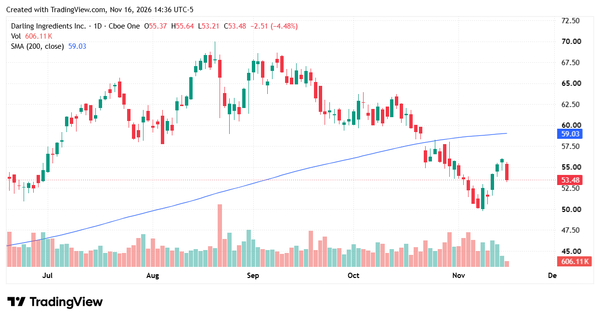
Darling Ingredients (NYSE: DAR) turns animal by-products and used cooking oil into feed, food ingredients, and renewable fuel. It trades at about 10.1x earnings. Its Moderate Buy rating comes with a $73.80 price target, or roughly 38% upside.

The third quarter was strong. Darling earned $1.67 per share, up from $0.12 a year earlier. Combined adjusted EBITDA more than doubled to $514.3 million. The quarter did include a $63.5 million gain on business sales, which flattered the bottom line.

What matters more is cash. Darling cut net debt by about $420 million and repurchased $75.9 million of stock. It also reaffirmed 2026 combined adjusted EBITDA guidance of $2.2 billion to $2.3 billion. Policy uncertainty around renewable fuels remains the key risk. Darling does not pay a dividend.
consumer staples - StockEarnings

Herbalife: Growth Is Back; Margins Need to Follow

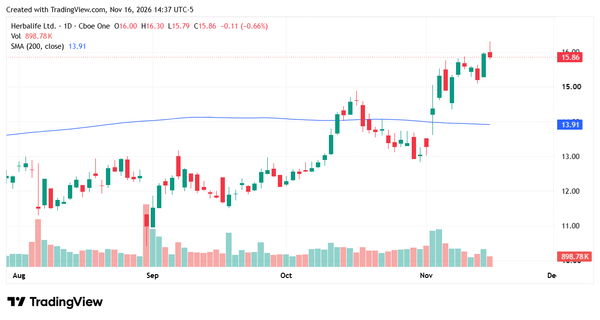
Herbalife (NYSE: HLF) trades at about 9.5x earnings. Analysts rate the nutrition company a Moderate Buy, with an $18.86 price target implying about 18% upside. That’s the smallest upside in this group. Still, the turnaround story is gaining traction.

Third-quarter net sales rose 6% to $1.35 billion. It was the company’s fifth straight quarter of year-over-year sales growth. Management raised full-year sales growth guidance for the third time, to a range of 4.9% to 5.9%.

The bottom line was weaker. Adjusted EPS of $0.64 missed the $0.73 consensus, and fourth-quarter guidance implies lower margins. The company is also operating under an interim CEO. On the plus side, net leverage fell to 2.0x, and the board authorized a $250 million buyback. If margins catch up to sales, today’s multiple looks too low.
consumer staples - StockEarnings

Natural Grocers: A Small-Cap Grocer Still Growing

Natural Grocers by Vitamin Cottage (NYSE: NGVC) trades at about 14x earnings. That’s the highest multiple here, but still under 15x earnings. The stock carries a Moderate Buy rating and yields about 2.1%. Its $37.50 price target implies roughly 30% upside.

The company operates 175 stores in 22 states. In its fiscal third quarter, net sales rose 1.8% to $334.7 million. Comparable-store sales grew 1.2%, accelerating from 0.5% in the prior quarter. EPS slipped to $0.48 from $0.50.

Shoppers are visiting slightly less often but spending more per trip. The company’s loyalty program now accounts for 84% of sales. Management is targeting 4% to 5% annual unit growth. The next test comes on Nov. 19, when Natural Grocers reports fiscal fourth-quarter results.
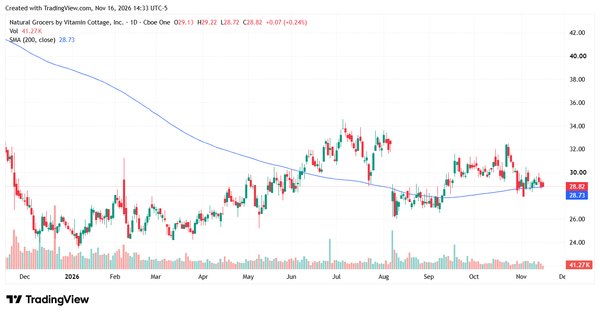
consumer staples - StockEarnings

Cheap Consumer Staples Stocks Still Need a Catalyst

A weak 2027 outlook for consumer staples stocks is already reflected in many share prices. That’s what makes this group interesting. Each of these five trades under 15x earnings, yet each has a driver the market may be underweighting. For The Andersons and Darling, it’s earnings power and cash generation. For Herbalife and Natural Grocers, it’s steady sales growth. For John B. Sanfilippo, it’s recovery from a bad quarter. None is risk-free. But when sentiment is this poor, these stocks don’t need perfection. They only need to beat low expectations.


A former marketing copywriter turned freelance financial writer and market analyst. I have a passion for delivering insights to investors. I write regularly about stocks for StockEarnings and MarketBeat. Posts are not advice.

Join over 1.2M+ investors/traders who receive daily and weekly notable earnings alerts with predicted move