What if you completed a merger and investors didn’t seem to care? Or worse yet, your stock moved lower after the announcement. That’s the situation with Skydance Corp. (NYSE: SKYD). If the name and ticker aren’t familiar to you, that’s because it’s the new company formed after the $110 billion merger of Paramount Skydance (NASDAQ: PSKY) and Warner Bros. Discovery (NASDAQ: WBD). At one point, SKYD was down over 4.4% in the session after the deal officially closed.
The combined company brings together Paramount Pictures and Warner Bros., along with CBS, CNN, HBO and a deep bench of cable networks. Its library includes Harry Potter, Game of Thrones, the DC Universe, Top Gun and Mission: Impossible.
On paper, that’s a content powerhouse. In the market, it’s a balance sheet question.
To be fair, investors have been sizing up the deal for months. The key objection comes down to debt. Specifically, Warner Bros. Discovery is bringing a significant debt load into the new company. In its most recent quarter, the company reported $33.1 billion in gross debt, $29.7 billion in net debt, and net leverage of 3.4x.
The deal financing added to that burden. On Oct. 1, the company priced $41.4 billion of senior secured notes and an $8.5 billion term loan. PSKY fell 10% that day. One week earlier, S&P Global cut the company’s credit rating to BB from BB+, citing higher leverage at closing.
That means Skydance will have to navigate net debt of approximately $80 billion. This comes at a time when investors will be watching to see how the company invests in new content and new technology. Or maybe the better question is: will it be able to make those investments?
That question matters because newly appointed chief executive officer (CEO) Davide Ellison has set ambitious goals. He plans to combine Paramount+ and HBO Max into a single streaming platform. He has also promised 15 theatrical releases per year. Both require heavy, sustained spending. Investors will want to see how the company balances those commitments against its interest payments.
Targeting $6 Billion of Cost Efficiencies
Ellison has said he anticipates $6 billion of cost efficiencies. In investor parlance, that usually means job cuts are coming. Skydance confirmed as much on the day the merger was finalized.
Investors have seen this playbook before. After Skydance merged with Paramount Global in August 2025, the company targeted $2 billion in savings. Roughly 2,000 layoffs followed, about 10% of its workforce. The new target is three times larger, and the integration is far more complex.
Ellison will remain chairman and CEO, with former Mattel CEO Ynon Kreiz joining as co-CEO. Announcing cost cuts is the easy part. Making them without damaging the studios and brands that made the deal attractive is much harder.
The company may also find savings by cutting or suspending its dividend. Before the merger, Paramount Skydance paid a dividend of about 10 cents per share annually. That was only about 1.45% of cash flow. But cash flow is precisely what investors are concerned about as the company navigates its debt load.
Suspending a small dividend wouldn’t save much money. But it would send a clear signal that debt reduction comes first. Some investors might actually welcome that message.
Could Netflix Be the Surprise Winner?
Given Skydance’s debt burden, Netflix Inc. (NASDAQ: NFLX) may win the award for the best deal never made. Investors will remember that it was Netflix that was originally in line to purchase Warner Bros. Discovery. Having access to that gigantic, and in some cases iconic, content library would have been a feather in the cap for the streaming giant.
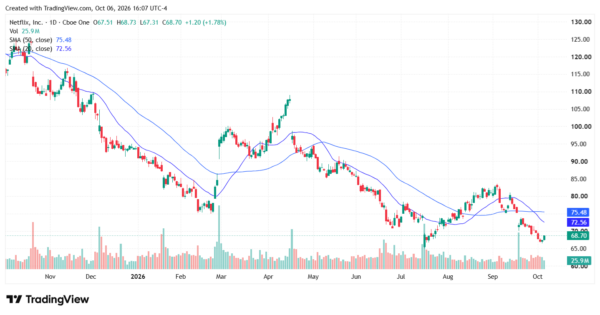
But investors didn’t like it. In fact, NFLX had a relief rally after the news broke that Warner Bros. Discovery was going with Paramount’s offer. The stock has come under pressure since then, largely due to concerns about the opacity of the company’s subscriber numbers with a valuation that’s on par with some technology stocks.
Now that Paramount+ and HBO Max are part of the same streaming family, what will that mean for subscriber costs and subscriber numbers? A combined service could be a stronger competitor. But integrations are messy. Price changes, app migrations, and overlapping content can push subscribers to cancel rather than consolidate.
Time will tell, but “streaming fatigue” is real, NFLX looks more attractive at 19x forward earnings, and analysts are also signaling that the sell-off may be overdone.
Momentum Is on the Side of the Skeptics
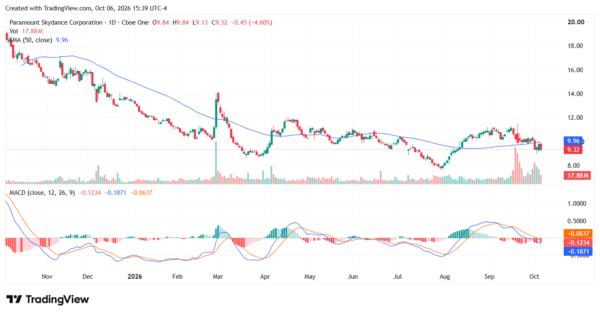
SKYD pared its losses slightly before the market closed on Oct. 6. However, the chart suggests that bullish investors need to proceed with caution. A “sell the news” reaction isn’t uncommon, which means a drop of around 2.7% is nothing to panic about.
However, the day before the close, PSKY rallied but failed to reclaim either its 20-day or 50-day simple moving average. At a bare minimum, investors will want to see a close above one or both averages before thinking the stock is ready to reverse its trend.
The analyst picture offers little cushion either. Heading into the close, the consensus price target sat around $10. That was only about 6% above PSKY’s Oct. 1 close.
Execution Has to Win Over Perception
Skydance owns one of the deepest content libraries in Hollywood. That’s the story bulls will tell. The story the market is telling right now is about leverage. Until the company shows real progress on cost savings and debt reduction, the market’s story is likely to win. Patient investors may get a better entry point once the post-merger dust settles.