The AI trade has become so concentrated that it is easy to forget how much money has to be spent before an AI model can answer a single prompt. Nvidia (NASDAQ: NVDA) supplies the GPUs, while other mega-cap technologies are building enormous computing capacity and driving the market higher at the same time.
But under the hood, the physical AI buildout creates problems software cannot solve. More GPUs mean more heat. More AI infrastructure means more electricity. Thousands of accelerators also need to be integrated, deployed, and managed before they generate anything for a customer…
Thereby putting three much smaller companies in very different parts of the same AI trade: Modine (NYSE: MOD), Penguin Solutions (NASDAQ: PENG) and Powell Industries (NASDAQ: POWL).
As of this moment, MOD is worth $9.71 billion, PENG $3.11 billion, and POWL $7.21 billion. Their market caps have climbed 25.4%, 113.9%, and 96.4%, respectively, over the past year.
MOD Is Selling Into AI’s Heat Problem
The more computing power you pack into a data center, the harder thermal management becomes. That gives Modine (MOD) a direct way to participate in the AI buildout without selling a single GPU.
Modine’s latest quarterly results? show how quickly that business is scaling. Q1 fiscal 2027 revenue reached $874.1 million, up 28% year over year, while EPS rose 44%. Data Center revenue was the standout, jumping 90% year over year.
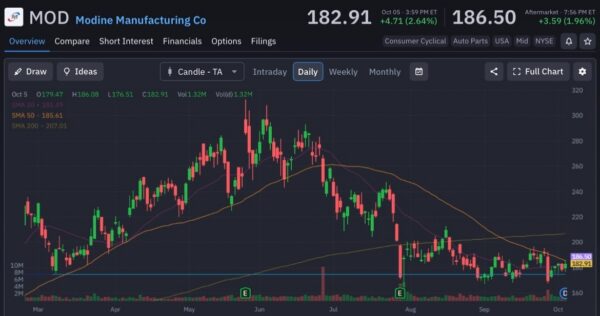
MOD closed at $182.91 on October 5, sitting just above its 20-day SMA at $181.49 but below its 50-day at $185.61 and well below its 200-day at $207.01. After falling from above $300 earlier in the year, the stock found buyers around $170-$175 in September and has started forming a higher-low structure.
A move through $186 would put the 50-day average back underneath the stock, while $200-$207 is the much bigger test. Until then, MOD is recovering from a major drawdown rather than sitting in a confirmed long-term uptrend.
That makes the operating growth particularly important. Modine already shows a business seeing substantial demand from data-center customers, while the cooling problem only becomes more demanding as computing density rises.
PENG Is Moving From Hardware To AI Factories
Penguin Solutions (PENG) sits closer to the point where AI hardware becomes a functioning system.
The company reported record Q3 fiscal 2026 revenue of $478.7 million, up 48% year over year. GAAP operating income jumped 417%, while non-GAAP EPS increased 79%. Management subsequently raised its full-year outlook as demand strengthened across its Integrated Memory and AI Infrastructure businesses.
Then comes the Nvidia relationship. Penguin became an NVIDIA AI Factory Specialized Partner?, covering the design, deployment, and management of full-stack Nvidia-based AI infrastructure.
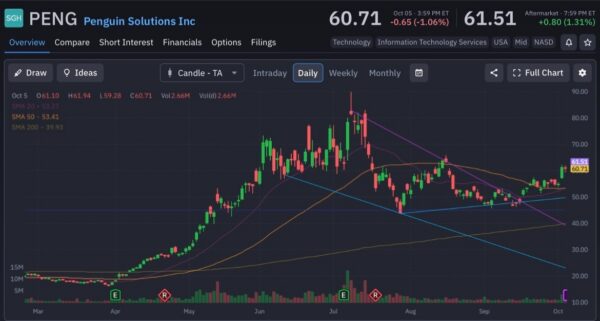
The stock chart is considerably stronger than MOD’s. PENG closed at $60.71, more than $7 above both its 20-day and 50-day SMAs, which sit around $53.37 and $53.41. The 200-day SMA is down at $39.93. More importantly, PENG has broken above the descending trendline that had capped the stock since its July peak near $80.
The next hurdle is around $62, followed by the $70 area. Holding above $53-$54 would preserve the current breakout structure. For me, that combination of accelerating revenue and a technical breakout makes PENG the most aggressive momentum setup of the three.
POWL Is Selling The Electricity Behind AI
Powell Industries (POWL) takes the thesis further down the physical supply chain.
Powell makes engineered equipment for the management, control, and distribution of electrical energy. Its Q3 fiscal 2026 results showed $934 million of new orders, up 158%, pushing backlog to $2.4 billion, up 69%. Book-to-bill reached 3.0x. In fact, Powell also secured a data-center project worth more than $400 million.
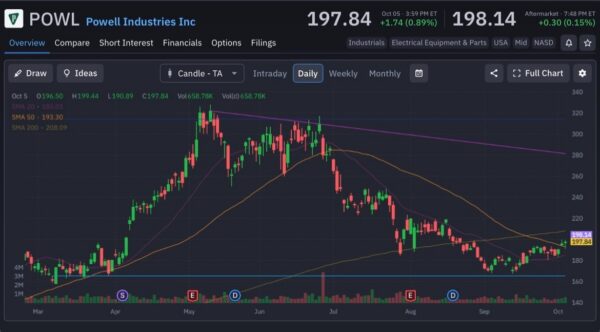
And the chart has now started recovering too. POWL closed at $197.84, above its 20-day SMA at $185.03 and 50-day at $193.30, after bouncing from the $165-$175 area in September. The 200-day SMA sits at $208.09, making $200-$208 the immediate technical ceiling.
A clean break through that zone would put POWL back above its long-term average for the first time since its summer decline. Failure there leaves the stock trapped between roughly $175 support and $208 resistance.
The AI Trade Has a Much Bigger Supply Chain
This is where I think the opportunity gets interesting for investors who already own the obvious AI winners.
Nvidia, Microsoft, Amazon, and Alphabet have captured the attention because their products sit at the center of the AI revolution. But just as you’ve seen, MOD, PENG, and POWL sit further down the chain, where the physical constraints of that revolution are becoming increasingly expensive to solve.
None of these companies needs to become the next Nvidia for the thesis to work. They need AI capital spending to keep flowing into data centers, and their recent financial results suggest that spending is already reaching their businesses. Getting exposed to this basket of 3 smaller companies, sitting underneath the same multitrillion-dollar AI spending cycle, each attacking a physical bottleneck the Mag 7 cannot simply wish away…is almost a no-brainer for me.