ajax loader

Loading...


Ride-the-Wave Strategy – Best for Stock Traders

Ride-the-Wave targets multi-day price momentum following a company’s earnings announcement (EA). With this strategy:

  1. Buy a stock one day post-EA if a stock reacts positively post-earnings:
    1. Near the close of trading the EA-day for a pre-market-EA
    2. Near the close of the following day for a post-market-EA
  2. Sell-to-close after 7-10 days, or possibly earlier if a desired price target is reached

Similarly,

  1. short a stock one day post-EA if a stock reacts negatively post-earnings:
    1. near the close of trading the EA-day for a premarket-EA
    2. near the close of the following day for a post-market-EA
  2. then buy-to-close after 7-10 days, or possibly earlier if a desired price target is reached

Important: Ride-the-Wave is predicated on significant price momentum triggered by an EA. The 7-10 day scenario is the maximum trade hold-time. If you see post EA-momentum is halted or reversed by a significant opposite move, re-evaluate your presence in the trade.

This popular StockEarnings screen below will give you a list of stocks that historically exhibit significant price momentum following an EA for the next seven days:

  1. Stocks exhibiting positive post-EA price moves are buy-candidates
  2. Stocks exhibiting negative post-EA price moves are sell/short-candidates

The screen includes those stocks whose Earnings just came out in last two days.

Screen criteria:

  1. Earnings Date Start Date : Current Date + -1 Day
  2. Earnings Date End Date : Current Date + -2 Days
  3. Predicted Move (Next Day) Max : 7%
  4. Predicted Move (On 7th Day) Min : 7%

Strategy Guideline:

  1. Buy the stock if stock has reacted positively. Short the stock if stock has reacted negatively (see above).
  2. Close the position in 7-10 days, or possibly earlier based on price move.

Volatility Crush Strategy - Best for Options Traders

The Volatility Crush strategy is used with stocks that typically experience relatively low-to-moderate price moves (≤4%) following their Earnings Announcements (EA). The basic trade idea is to sell put or call options right before the EA, collecting a credit when options premium is very high due to elevated implied volatility (IV). You then close the position right after the EA by buying the option back much cheaper due to the significant drop in IV that occurs after the mystery of the EA disappears. In assessing this trade, you need to do your homework to ensure you collect sufficient premium to make the trade worthwhile.

This trade is practical due to the low-to-moderate price-move after the EA, which generally won’t significantly affect the options price, unlike an “action” stock, which experience great price moves post-EA. With these symbols, if you’re on the right side of the price move, that’s a great thing. But if you’re on the wrong side of the move, not so great. Consequently, by minimizing the effect of the post-EA price move, you have a much better chance to profit from the reduction in IV without it being ruined by a violent price move.

For this trade, open the position either (1) the night before the EA when the company announces earnings or (2) during the EA day when it announces post-market, generally capturing IV at or close to its peak.

For this trade, open the position either (1) the night before the EA when the company announces earnings or (2) during the EA day when it announces post-market, generally capturing IV at or close to its peak.

This popular stockearnings screen will give you a list of stocks which do not react more than 4% fpost-EA. It includes only those stocks whose earnings are releasing next day.

Screen criteria:

  1. Earnings Date Start Date : Current Date + 1
  2. Earnings Date End Date : Current Date + 1
  3. Predicted Move (Next Day) Max : 4%
  4. Options Type: Weekly

Strategy Guideline:

  1. Options Strategy: Sell Call and Put
  2. Options Strike Price: Current Stock Price – (% Predicated Move x 2)
  3. Expiration Date: It should generally be the closest expiry immediately after the EA.
  4. Buy Insurance: Buying back Call and Put at Strike price which 10% lower than Sell Strike Price is optional but recommended.

Watch Video for More Detail

Volatility Rush Strategy - Best for Options Traders

The Volatility Rush takes advantage of increasing options premiums into earnings announcements (EA) caused by an anticipated rise in Implied Volatility (IV). With this strategy, Buy a Call and Put at-the-money (a long straddle) 2-3 weeks before the EA when IV is lower. Sell the position either (1) the night before the EA when the company announces earnings pre-market, or (2) during the EA day when it announces post-market, generally capturing IV at or close to its peak.

This popular screen will give you a list of stocks whose Options premiums tend to rise into Earnings. It includes only those stocks whose Earnings are at least two weeks away from today.

Screen criteria:

  1. Earnings Date Start Date : Current Date + 15 Days
  2. Earnings Date End Date : Current Date + 30 Days
  3. Predicted Move (Next Day) Min : 5%
  4. Options Type: Weekly or Monthly if that lines up with the two to three-week lead-time for entering the trade

Strategy Guideline:

  1. Buy a Straddle at or close to the money two to three weeks pre-EA.
  2. Sell the position either the night before the EA when the company announces earnings pre-market, or during the EA day when it announces post-market.
  3. Expiration date should generally be the closest expiry immediately after the EA.
  4. Straddle price should not be more 60% of predicted move.

Predicted Move (Volatility)

Similar to Implied Volatility in Options. Expected volatility % based on our Proprietary Volatility Predication Model. We are expecting that stock price will likely to reach % in either direction by the end of next trading session after Earnings are released and not necessarily the closing volatility %.

Why is it important?

    This indicator helps

  1. Knowing expected volatility in stocks after Earnings helps to decide trading stocks before Earnings Announcement.
  2. Taking Advantage of volatility collapse following Earnings Results by using Advance Options strategies such as Spread and Straddles.

Since Last Earnings

Change in share price since last Earnings release.

Why is it Important?

When share has gained more than 10% since it's last Earning release, it tends to over react to minor bad news and give up some gains if not all. So, it contains more downside volatility than upside When share has dropped more than 10% since it's last Earning release, it tends to over react to minor good news and recover some drops if not all. So, it contains more upside volatility than downside.

EPS Surprise (%)

Occurs when a company's reported quarterly or annual profits are above or below analysts' expectations. Here is the formula to derive % EPS Surprice:

Actual EPS - Estimated EPS
------------------------------------- x 100
Estimated EPS

Why is it Important?

Earnings surprises can have a huge impact on a company's stock price. Several studies suggest that positive earnings surprises not only lead to an immediate hike in a stock's price, but also to a gradual increase over time. Hence, it's not surprising that some companies are known for routinely beating earning projections. A negative earnings surprise will usually result in a decline in share price.

Next Day Price Change (%)

Next Regular trading session Closing price following Earnings result.

For After Market Close Earnings, It is a next trading day closing price. For Before Market Open Earnings, It is the same trading day closing price.

Why is it Important?

Next Day price change is a reaction of Earnings result.

GM Joins the Hybrid Race, but Toyota and Honda May Be Better Bets

Posted on Oct 06, 2026 by Chris Markoch

GM Joins the Hybrid Race, but Toyota and Honda May Be Better Bets

General Motors (NYSE: GM) is finally coming around on hybrid vehicles. On Monday, the Detroit automaker confirmed it will add hybrids to its U.S. lineup.

Mike Anderson, GM’s vice president of propulsion engineering, confirmed the plans to CNBC but did not give exact dates. Said Anderson, “We’re not tone deaf to our customers.”

That’s a notable admission. GM has spent most of this decade on the sidelines of the hybrid market, putting its investment into all-electric ambitions instead. Today it sells just one hybrid, a version of the Chevrolet Corvette.

Details remain thin. Anderson declined to discuss specific products or timing for GM’s first new hybrid. AutoForecast Solutions expects GM plug-in hybrids, including the Equinox and Silverado, starting in late 2027 or early 2028.

The perception is that GM is pivoting toward demand. The fundamentals tell a different story. GM is arriving late to a market others already dominate. For consumers and investors alike, the established hybrid leaders may offer a better deal.

Why Hybrid Vehicles Are Gaining U.S. Market Share


Hybrids are no longer a niche product. Hybrids made up around 5% of the market in 2023. By mid-2026, their share hit an all-time high of 16.3%, according to Cox Automotive.

Electric vehicles are moving the other way. In July, EV retail share was 7.0%, down 3.3 percentage points from a year earlier.

Several forces are driving the shift. The U.S. war in Iran, which began in late February, has strained oil supplies and kept gas prices elevated. Analysts say that has pushed buyers toward fuel-efficient hybrids. The end of the federal EV tax credit has also reshaped buying decisions.

Hybrids also solve practical problems. Drivers get better fuel economy without worrying about charging stations or range. Two powertrains add cost and complexity, but many consumers appear willing to pay for that as hybrid sales keep rising.

The Bull Case for GM Stock Despite a Late Hybrid Start

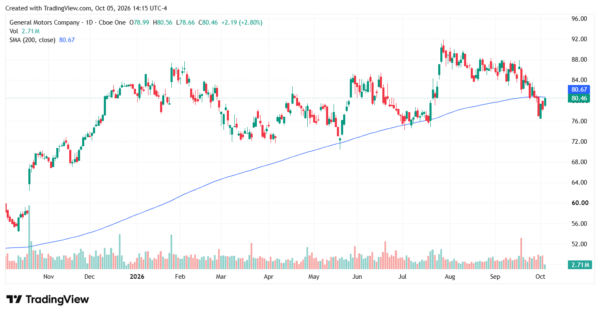
GM isn’t entering the hybrid market from a position of weakness. The company posted its 16th consecutive earnings beat in the second quarter. Adjusted earnings of $3.57 per share rose 41.3% year over year. GM also raised its full-year adjusted EPS guidance to between $12 and $14.

The profit engine is trucks and big SUVs. GM is on pace to lead the full-size pickup segment for a seventh straight year, with roughly 42% share. It has done so with incentives averaging 4.7% of MSRP, below the industry’s 6.3%.

Shareholders are being rewarded, too. GM has $3.5 billion remaining under its repurchase authorization and expects to keep buying back shares.

Hybrids could protect that franchise. A hybrid Silverado or Equinox keeps loyal buyers from defecting. Anderson said GM’s approach will blend in-house and outside technology depending on cost, segment, and product. That could shorten the timeline.

The risk is execution. GM has absorbed $7.2 billion in total EV-related charges so far this year. One forecaster noted past technology missteps have made GM slow to commit to plug-in hybrids.
gm - StockEarnings

Toyota Stock Is the Hybrid Leader for Consumers and Investors

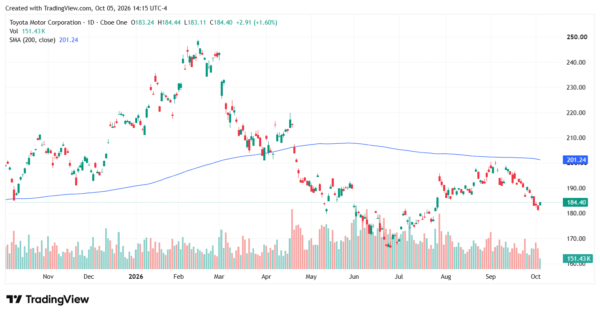
If GM is the newcomer, Toyota Motor (NYSE: TM) is the incumbent. Toyota owned 44% of the U.S. hybrid market, according to Cox Automotive. Honda was at 17%. S&P Global Mobility found Toyota’s hybrid sales exceed those of Honda, Hyundai, Ford, Mazda, Stellantis, Mercedes-Benz, and Subaru combined.

The latest numbers show that lead is widening. Electrified models made up a record 61% of Toyota’s U.S. sales mix in the third quarter. Of 633,223 vehicles sold, 363,367 were electrified, up 28.5% year over year. Most of those were conventional hybrids.

That matters because total sales were essentially flat. The growth came from mix. Hybrids are taking a bigger share of Toyota’s showroom traffic.

For consumers, Toyota offers decades of hybrid refinement across nearly every segment. Its sixth-generation RAV4 is now sold only as a hybrid.

For investors, Toyota’s patience is paying off. The company never fully committed to an EV-only roadmap. That multi-powertrain approach once looked cautious, even outdated. Now it looks prescient. Toyota’s hybrid lineup has pushed its overall U.S. volumes closer to top seller GM.

GM is still planning its hybrids. Toyota is already scaling them. Investors should note that TM trades as an ADR, which adds currency exposure to the yen.
gm - StockEarnings

Honda Moves Hybrid Production to North America

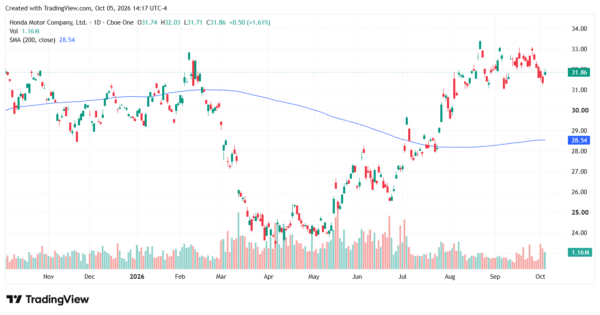
Honda Motor (NYSE: HMC) is the clear No. 2 in hybrids. Hybrids account for 31% of American Honda’s sales, and the company set a U.S. hybrid sales record in the first half of 2026.

What makes Honda interesting is where it’s building. The company will reallocate all excess capacity at its Ohio plants to gas and hybrid vehicles. It will also make every North American auto plant capable of building hybrids.

The supply chain is moving too. Honda and LG Energy Solution will convert part of their joint EV battery lines to hybrid battery production. Honda also plans to boost local content of motor and inverter components more than fourfold, partly to blunt U.S. tariffs.

Last year, Honda shifted its U.S.-bound five-door Civic hybrid from Japan to Indiana. The Nikkei now reports Honda is near final plans for a new Ohio hybrid plant. The investment could reach $2.53 billion, with production starting in 2030.

The product pipeline is aggressive. Honda plans 15 next-generation hybrid models globally by its fiscal year ending March 2030, primarily for North America. It aims to cut the cost of its next-generation hybrid system by more than 30%.

There are risks. A senior executive warned Honda might not build the new plant unless a key trade deal is extended. Still, Honda’s hybrid commitment is far more concrete than GM’s.
gm - StockEarnings

Is GM, Toyota or Honda the Best Hybrid Stock to Buy?

GM’s hybrid announcement is the right move. But it is a reaction, not a lead. The company has strong earnings, a dominant truck business, and aggressive buybacks. Hybrids may simply defend that position.

Meanwhile, Toyota and Honda are playing offense. Toyota owns the market and is still gaining share. Honda is reshaping its North American footprint around hybrid demand.

For consumers, the proven options are already on dealer lots. GM is trying to sell investors on the idea that it’s catching up. The fundamentals suggest the leaders may keep pulling away.


A former marketing copywriter turned freelance financial writer and market analyst. I have a passion for delivering insights to investors. I write regularly about stocks for StockEarnings and MarketBeat. Posts are not advice.

Join over 1.2M+ investors/traders who receive daily and weekly notable earnings alerts with predicted move