Premium hotel stocks have a perception problem, and it isn’t the one you might expect. The fundamentals are strong. Hilton, Marriott, and Hyatt all raised their 2026 RevPAR guidance after the second quarter. Luxury travelers kept spending. The FIFA World Cup delivered a bigger boost than planned.
Yet the stocks tell a more cautious story. All three peaked in June and spent the summer giving back gains. Marriott and Hilton dipped below their 200-day moving averages in September before recovering. Hyatt is still below its own.
That gap between performance and price action is the story for the fourth quarter. The market is looking past a strong 2026 toward a slower 2027. CoStar and Tourism Economics now forecast 4.4% U.S. RevPAR growth this year. Their 2027 forecast falls to just 2.1%.
For that reason, hotel stocks may not be the best place for new money in Q4 2026. The easy comparisons are fading. The event-driven tailwinds are behind them. Meanwhile, valuations still assume premium growth.
But here’s why investors building positions for 2027 and beyond should pay attention to hotel stocks now. These are asset-light businesses with record pipelines and heavy capital returns. The question is which name, and at what price. Here’s how Hilton (NYSE: HLT), Marriott (NASDAQ: MAR) and Hyatt (NYSE: H) stack up.
Why Q4 Could Be a Soft Patch
To be clear, it’s not smooth sailing for hotel stocks. Several headwinds converge in the final quarter. First, the World Cup lift is gone. Marriott said the tournament added about 45 basis points to full-year global RevPAR. That beat its own estimate, but it won’t repeat.
Second, Hilton’s guidance points to a slowdown. It expects roughly 4% RevPAR growth in Q3. Its full-year range of 3% to 3.5% implies low-single-digit growth in Q4. Management sees the underlying run rate at just 2% to 2.5% once event noise is stripped out.
Third, the Middle East conflict remains a drag. Marriott noted the region enters its peak tourism season in October. That gives the conflict more weight in Q4 than in Q3. Hyatt has also flagged softness in Mexico’s all-inclusive resorts.
None of this, however, breaks the long-term thesis. When consumer discretionary stocks turn around, hotel stocks will be among the winners. But the headwinds just make the near-term setup less compelling.
Hyatt: The Priciest Name May Be the Best Short-Term Value
Hyatt carries the richest multiple of the group. It trades around 45 times forward earnings. That compares to roughly 34 for Hilton and 28 for Marriott.
At first glance, that looks like a red flag. But the multiple reflects a company in transition. Hyatt sold the Playa real estate portfolio for about $2 billion. It now expects roughly 90% of adjusted EBITDA to come from asset-light sources.
Growth backs up the price. Hyatt posted 5.9% system-wide RevPAR growth in Q2, the best of the three. It raised full-year RevPAR guidance to 3.5% to 4.5%. Adjusted EBITDA guidance calls for 13% to 18% growth. By several measures, its PEG ratio sits below 1.0.
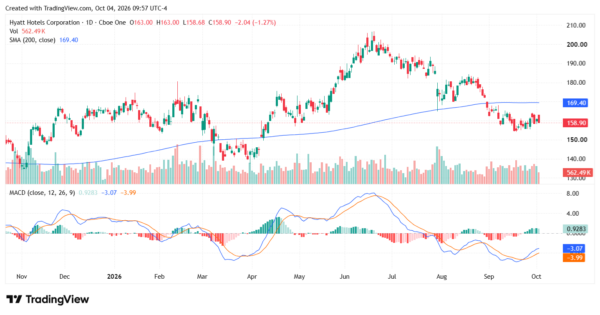
The stock hasn’t gotten credit for any of it. Shares fell 6.7% after Q2 despite an earnings beat. At about $159, Hyatt trades roughly 23% below its June high near $207. Hilton and Marriott sit only 11% to 13% off their peaks.
There’s a caveat. Hyatt is the only one of the three still below its 200-day SMA, near $169. Its MACD has crossed bullish, but from below zero. Short-term buyers should want to see the stock reclaim that line. Until it does, the value case is running ahead of the chart.
Marriott: A Core Holding, but Not at Any Price
Marriott is the scale player. Its system holds roughly 1.8 million rooms, with a record pipeline of nearly 629,000 more. U.S. and Canada RevPAR rose 5% in Q2, its best showing in 13 quarters. Luxury RevPAR climbed more than 9%.
Marriott also returns a lot of cash. It returned about $2.6 billion to shareholders in the first half. New co-branded credit card deals should add meaningful fee income by 2028.
It has the lowest multiple of the three. The catch is that the multiple has expanded. Marriott’s forward P/E was near 22 a year ago. Today it’s closer to 28.
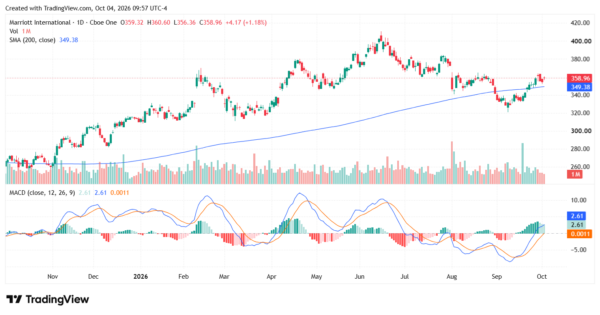
The chart looks healthy. Shares closed near $359, above the 200-day SMA around $349. The MACD just crossed back above zero. But with the stock only about 3% above that average, there’s little cushion. A meaningful dip would be a retest of the September lows near $320. That’s where Marriott shifts from Hold to Buy.
Hilton: Quality Comes at a Premium
Hilton may be the highest-quality operator of the three. Its 6% to 7% net unit growth guidance leads the group. It plans to return about $3.5 billion to shareholders in 2026. Business transient RevPAR jumped 5.7% in Q2.
Management is also leaning into 2027. It cited AI-related spending and infrastructure investment as drivers of above-trend growth next year. That’s a constructive signal for long-term holders.
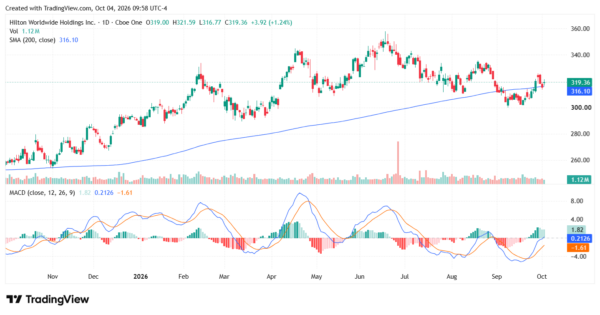
The problem is price. At roughly 34 times forward earnings, Hilton costs more than Marriott. Shares sit near $319, barely 1% above the 200-day SMA around $316. The MACD has turned positive, but the stock already bounced hard off its lows. A pullback toward the September lows near $300 would offer a far better entry.
Hotel Stocks: Which Name Offers the Best Opportunity?
Hotel stocks are creating a classic perception-versus-fundamentals setup. The fundamentals are still strong. But the market is already pricing in a slower 2027, and Q4 offers few catalysts to change that view.
For short-term investors, Hyatt offers the most upside if the asset-light story earns a rerating. Waiting for it to reclaim its 200-day SMA would be the prudent move.
For buy-and-hold investors, Marriott and Hilton remain names to own. At current prices, though, they look like Holds. A meaningful dip toward their September lows would turn patience into opportunity.