Micron Technology (NASDAQ: MU) delivered the kind of earnings report investors usually like to see: stronger-than-expected profits and revenue. But the memory chipmaker’s stock slipped in the initial reaction, showing that even impressive financial results don’t always translate into immediate gains on Wall Street.
For its fiscal fourth quarter, Micron reported adjusted earnings of $33.42 per share on revenue of $54.23 billion. Analysts expected earnings of $31.61 per share and revenue of $51.07 billion.
The results provide evidence that its business continues to benefit from substantial demand. Revenue exceeded Wall Street’s forecast by $3.16 billion, while adjusted earnings topped estimates by $1.81 per share.
“Micron delivered record fiscal 2026 results, and we expect an even stronger fiscal 2027,” added Sanjay Mehrotra, Chairman and CEO, as quoted in a company press release. “AI is becoming Super Intelligence, and memory enhances this intelligence and the competitiveness of our customers’ platforms. We are increasing our investments in technology, products and manufacturing to help drive SI forward with our customers, and our Strategic Customer Agreements provide added confidence in the durability of Micron’s financial performance.”
AI Demand Is Driving Micron’s Growth
Micron’s opportunity is closely tied to the expansion of artificial intelligence infrastructure. The company supplies memory and storage products, putting it in a position to benefit as customers build the systems needed to support increasingly demanding applications. The company’s management described memory as increasingly central to AI in its earnings announcement.

For investors, the appeal goes beyond excitement about a single product launch. Building an AI business requires sustained spending on infrastructure. That creates opportunities for suppliers whose components remain essential as customers expand their capabilities.
The investment question is how consistently Micron can turn that opportunity into profitable growth. Strong demand is encouraging, but shareholders ultimately need to see that demand translate into earnings and cash generation over time.
The Outlook Offers Another Encouraging Signal
Micron’s forecast suggests management expects momentum to continue.
For the first quarter of fiscal 2027, the company projected revenue of $61.5 billion, plus or minus $1.5 billion. It also forecast adjusted earnings of $38.15 per share, plus or minus $1. Both midpoint figures would represent an increase from the fourth quarter. That gives investors something concrete to evaluate. The company is outlining expectations for additional growth.
The biggest challenge for investors is deciding how long exceptional conditions can last.
Memory manufacturing requires substantial investment. Expanding production can support future sales, but it also increases the importance of getting demand forecasts right. Capacity that looks necessary during a boom can become a burden if buying slows.
“We expect fiscal 2027 to be even better. Industry demand has strengthened since our last earnings call, and we expect memory and storage supply-demand conditions to be much tighter in fiscal 2027 and 2028 than they were in 2026,” added Mehrotra, as quoted by Seeking Alpha.
MU Stock Faces Key Technical Levels
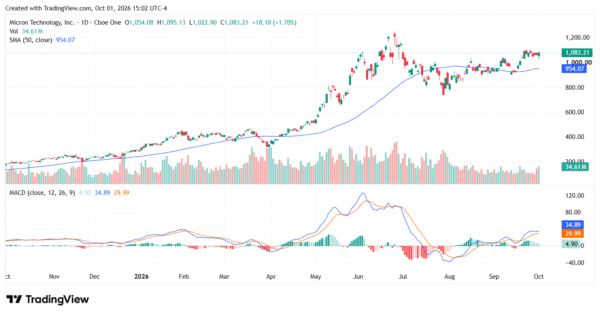
MU stock remains in a powerful long-term uptrend, but recent trading shows that investors are becoming more selective after the stock’s enormous run. MU closed at $1,065.11 on Sept. 30, while recent trading established a near-term range between roughly $1,032 and $1,109.
A move above the $1,100 area would put the recent highs back in focus, while a break below $1,030 could signal additional short-term weakness. The stock’s ability to hold above the $1,000 level is also important psychologically. With MU still trading well above its earlier 2026 levels, the technical setup suggests investors should watch whether the stock can consolidate its gains and establish a new base rather than simply chase the rally.
What Micron’s Earnings Mean for MU Stock
Micron’s latest earnings report gives investors plenty to watch. AI infrastructure demand is supporting the company’s memory business, while management expects fiscal 2027 to be stronger than fiscal 2026. The first-quarter outlook also points to another substantial increase in revenue and adjusted earnings.
Still, the stock’s reaction shows why strong earnings alone aren’t enough. MU has already experienced a dramatic rally, raising the bar for future results. Investors will need to see sustained demand, tight supply conditions, and strong profitability to justify the stock’s elevated expectations.
For MU stock, the key question is no longer whether Micron is benefiting from AI. It is whether the company can sustain that growth while managing capacity investments and navigating the cyclical nature of the memory market.