ajax loader

Loading...


Ride-the-Wave Strategy – Best for Stock Traders

Ride-the-Wave targets multi-day price momentum following a company’s earnings announcement (EA). With this strategy:

  1. Buy a stock one day post-EA if a stock reacts positively post-earnings:
    1. Near the close of trading the EA-day for a pre-market-EA
    2. Near the close of the following day for a post-market-EA
  2. Sell-to-close after 7-10 days, or possibly earlier if a desired price target is reached

Similarly,

  1. short a stock one day post-EA if a stock reacts negatively post-earnings:
    1. near the close of trading the EA-day for a premarket-EA
    2. near the close of the following day for a post-market-EA
  2. then buy-to-close after 7-10 days, or possibly earlier if a desired price target is reached

Important: Ride-the-Wave is predicated on significant price momentum triggered by an EA. The 7-10 day scenario is the maximum trade hold-time. If you see post EA-momentum is halted or reversed by a significant opposite move, re-evaluate your presence in the trade.

This popular StockEarnings screen below will give you a list of stocks that historically exhibit significant price momentum following an EA for the next seven days:

  1. Stocks exhibiting positive post-EA price moves are buy-candidates
  2. Stocks exhibiting negative post-EA price moves are sell/short-candidates

The screen includes those stocks whose Earnings just came out in last two days.

Screen criteria:

  1. Earnings Date Start Date : Current Date + -1 Day
  2. Earnings Date End Date : Current Date + -2 Days
  3. Predicted Move (Next Day) Max : 7%
  4. Predicted Move (On 7th Day) Min : 7%

Strategy Guideline:

  1. Buy the stock if stock has reacted positively. Short the stock if stock has reacted negatively (see above).
  2. Close the position in 7-10 days, or possibly earlier based on price move.

Volatility Crush Strategy - Best for Options Traders

The Volatility Crush strategy is used with stocks that typically experience relatively low-to-moderate price moves (≤4%) following their Earnings Announcements (EA). The basic trade idea is to sell put or call options right before the EA, collecting a credit when options premium is very high due to elevated implied volatility (IV). You then close the position right after the EA by buying the option back much cheaper due to the significant drop in IV that occurs after the mystery of the EA disappears. In assessing this trade, you need to do your homework to ensure you collect sufficient premium to make the trade worthwhile.

This trade is practical due to the low-to-moderate price-move after the EA, which generally won’t significantly affect the options price, unlike an “action” stock, which experience great price moves post-EA. With these symbols, if you’re on the right side of the price move, that’s a great thing. But if you’re on the wrong side of the move, not so great. Consequently, by minimizing the effect of the post-EA price move, you have a much better chance to profit from the reduction in IV without it being ruined by a violent price move.

For this trade, open the position either (1) the night before the EA when the company announces earnings or (2) during the EA day when it announces post-market, generally capturing IV at or close to its peak.

For this trade, open the position either (1) the night before the EA when the company announces earnings or (2) during the EA day when it announces post-market, generally capturing IV at or close to its peak.

This popular stockearnings screen will give you a list of stocks which do not react more than 4% fpost-EA. It includes only those stocks whose earnings are releasing next day.

Screen criteria:

  1. Earnings Date Start Date : Current Date + 1
  2. Earnings Date End Date : Current Date + 1
  3. Predicted Move (Next Day) Max : 4%
  4. Options Type: Weekly

Strategy Guideline:

  1. Options Strategy: Sell Call and Put
  2. Options Strike Price: Current Stock Price – (% Predicated Move x 2)
  3. Expiration Date: It should generally be the closest expiry immediately after the EA.
  4. Buy Insurance: Buying back Call and Put at Strike price which 10% lower than Sell Strike Price is optional but recommended.

Watch Video for More Detail

Volatility Rush Strategy - Best for Options Traders

The Volatility Rush takes advantage of increasing options premiums into earnings announcements (EA) caused by an anticipated rise in Implied Volatility (IV). With this strategy, Buy a Call and Put at-the-money (a long straddle) 2-3 weeks before the EA when IV is lower. Sell the position either (1) the night before the EA when the company announces earnings pre-market, or (2) during the EA day when it announces post-market, generally capturing IV at or close to its peak.

This popular screen will give you a list of stocks whose Options premiums tend to rise into Earnings. It includes only those stocks whose Earnings are at least two weeks away from today.

Screen criteria:

  1. Earnings Date Start Date : Current Date + 15 Days
  2. Earnings Date End Date : Current Date + 30 Days
  3. Predicted Move (Next Day) Min : 5%
  4. Options Type: Weekly or Monthly if that lines up with the two to three-week lead-time for entering the trade

Strategy Guideline:

  1. Buy a Straddle at or close to the money two to three weeks pre-EA.
  2. Sell the position either the night before the EA when the company announces earnings pre-market, or during the EA day when it announces post-market.
  3. Expiration date should generally be the closest expiry immediately after the EA.
  4. Straddle price should not be more 60% of predicted move.

Predicted Move (Volatility)

Similar to Implied Volatility in Options. Expected volatility % based on our Proprietary Volatility Predication Model. We are expecting that stock price will likely to reach % in either direction by the end of next trading session after Earnings are released and not necessarily the closing volatility %.

Why is it important?

    This indicator helps

  1. Knowing expected volatility in stocks after Earnings helps to decide trading stocks before Earnings Announcement.
  2. Taking Advantage of volatility collapse following Earnings Results by using Advance Options strategies such as Spread and Straddles.

Since Last Earnings

Change in share price since last Earnings release.

Why is it Important?

When share has gained more than 10% since it's last Earning release, it tends to over react to minor bad news and give up some gains if not all. So, it contains more downside volatility than upside When share has dropped more than 10% since it's last Earning release, it tends to over react to minor good news and recover some drops if not all. So, it contains more upside volatility than downside.

EPS Surprise (%)

Occurs when a company's reported quarterly or annual profits are above or below analysts' expectations. Here is the formula to derive % EPS Surprice:

Actual EPS - Estimated EPS
------------------------------------- x 100
Estimated EPS

Why is it Important?

Earnings surprises can have a huge impact on a company's stock price. Several studies suggest that positive earnings surprises not only lead to an immediate hike in a stock's price, but also to a gradual increase over time. Hence, it's not surprising that some companies are known for routinely beating earning projections. A negative earnings surprise will usually result in a decline in share price.

Next Day Price Change (%)

Next Regular trading session Closing price following Earnings result.

For After Market Close Earnings, It is a next trading day closing price. For Before Market Open Earnings, It is the same trading day closing price.

Why is it Important?

Next Day price change is a reaction of Earnings result.

McCormick Stock Falls After Q3 Beat as Unilever Deal Clouds Outlook

Posted on Oct 02, 2026 by Chris Markoch

McCormick Stock Falls After Q3 Beat as Unilever Deal Clouds Outlook

McCormick & Company (NYSE: MKC) stock is sliding after the company’s fiscal third-quarter earnings report. Shares fell more than 5.5% following the release, trading near $44. That marked a fresh 52-week low for the spice and flavor giant.

On paper, the quarter looked solid. McCormick beat Wall Street estimates on both revenue and adjusted earnings. Management also reaffirmed its full-year outlook.

But investors are looking past the headline beat. GAAP earnings fell sharply from a year ago. Special charges tied to the pending Unilever Foods combination did much of the damage. Management also warned of rising costs and more margin pressure heading into 2027.

That leaves McCormick stock in an uncomfortable spot. The core business is holding up. Yet the market is focused on what comes next. That includes a transformational merger that isn’t expected to close until mid-2027.

The fundamentals show a company still growing sales and expanding margins. The perception is that McCormick is entering a long, expensive transition with few near-term catalysts.

The stock was already down about 30% this year heading into the report. Now investors must decide whether this selloff creates value or signals more pain ahead.

Adjusted Earnings Beat, GAAP Earnings Tumble


McCormick reported net sales of $2.02 billion for the quarter ended Aug. 31. That was up 17.4% year-over-year and ahead of the $1.98 billion consensus. Most of that growth came from the McCormick de Mexico acquisition, which added roughly 14 points.

Organic sales growth was a more modest 1.9%. Pricing contributed 2.2%, while volume and mix slipped 0.3%. In other words, McCormick is still leaning on price to drive growth.

Margins were a bright spot. Gross margin expanded 190 basis points to 39.3%. Adjusted operating income jumped 22% to $358.5 million.

Adjusted earnings per share (EPS) came in at $0.86. That beat estimates of $0.76 and edged past last year’s $0.85. A higher tax rate of 22.6%, up from 16.1%, absorbed most of the operating gains.

The GAAP picture was far less flattering. Diluted EPS fell to $0.36 from $0.84 a year earlier. GAAP operating income dropped about 25% to $217 million.

The culprit was $141.5 million in special charges, or $0.50 per share. Those included transaction and integration costs for the Unilever deal. They also included an impairment tied to exiting a pepper sourcing project in Malaysia.

Why the Unilever Deal Is Weighing on Sentiment

McCormick announced its plan to combine with Unilever’s Foods business in March. The deal would create a flavor-focused company with about $20 billion in annual revenue. Unilever (NYSE: UL) will receive $15.7 billion in cash. McCormick shareholders would own 35% of the combined company.

Management says the deal is on track. Regulatory filings have been submitted on schedule. The future leadership team and operating model are in place. McCormick still expects significant EPS accretion after closing.

The problem is timing. Deal costs hit the income statement now. The benefits don’t arrive until after a mid-2027 close. Until then, GAAP earnings will likely stay noisy.

Financing is another worry. McCormick expects net leverage of up to 4.0x at closing. Interest rates have risen since the deal was announced. That raises questions about how much accretion survives higher borrowing costs.

On the call, the CFO said the company can still deliver its accretion and deleveraging targets. The plan includes mixing euro and dollar debt, balancing fixed and floating rates and staggering maturities. Management aims to cut leverage to 3.0x within two years of closing.

Analysts also flagged that Unilever Foods has grown more slowly than expected since the announcement. McCormick can’t control that business until the deal closes. That adds another layer of uncertainty.

Rising Costs and a Cautious Tone on 2027

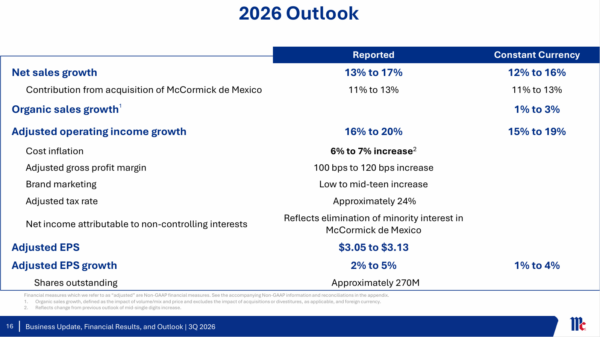
The deal isn’t the only overhang. McCormick raised its full-year cost inflation forecast to 6% to 7%. It previously expected a mid-single-digit increase.
mccormick - StockEarnings

Management now expects gross margins to compress year-over-year in the fourth quarter. Higher commodity and freight costs are the main drivers. A packaging supply issue could also trim total volume growth by up to one point.

The U.S. consumer business remains soft. Consumer organic sales in the Americas were flat. Price gains offset lower volumes as shoppers stayed value-conscious.

Perhaps most important, management said it expects more headwinds for margins and EPS in 2027. A formal outlook is coming in January. That kind of early warning tends to cap enthusiasm for a defensive stock.

There were positives, too. EMEA consumer volumes grew for the 11th straight quarter. Year-to-date operating cash flow rose to about $600 million from $420 million. Leverage stood at roughly 2.9x, giving McCormick some cushion ahead of the deal.

What the MKC Chart Is Saying

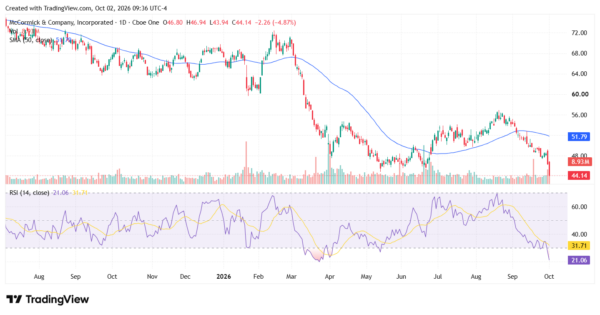
The technical picture reflects the sour mood. MKC is trading well below its 50-day simple moving average near $51.79. The stock has also broken below its prior 52-week low.

The 14-day relative strength index (RSI) sits near 21. That’s deeply oversold territory. The last comparable reading came in late March.

That episode offers a useful lesson. The stock bounced in April, but the rally faded within weeks. A stronger recovery didn’t arrive until summer. Oversold conditions can spark relief rallies. They don’t guarantee a lasting bottom.
McCormick - StockEarnings

Is McCormick Stock a Buy After the Selloff?

McCormick delivered a solid quarter. Adjusted earnings beat estimates, margins expanded, and the full-year outlook held. The GAAP decline was largely driven by deal costs, not a collapse in the core business.

Still, investors aren’t wrong to be cautious. Inflation is rising, the consumer is stretched, and 2027 already looks tougher. The Unilever deal adds financing risk and integration complexity on top of that.

For long-term investors, the selloff may offer a better entry point into a durable consumer staples franchise. But patience will be required. The next real catalyst may not come until January’s 2027 outlook.

Until then, perception may continue to outweigh fundamentals for McCormick stock.

A former marketing copywriter turned freelance financial writer and market analyst. I have a passion for delivering insights to investors. I write regularly about stocks for StockEarnings and MarketBeat. Posts are not advice.

Join over 1.2M+ investors/traders who receive daily and weekly notable earnings alerts with predicted move