ajax loader

Loading...


Ride-the-Wave Strategy – Best for Stock Traders

Ride-the-Wave targets multi-day price momentum following a company’s earnings announcement (EA). With this strategy:

  1. Buy a stock one day post-EA if a stock reacts positively post-earnings:
    1. Near the close of trading the EA-day for a pre-market-EA
    2. Near the close of the following day for a post-market-EA
  2. Sell-to-close after 7-10 days, or possibly earlier if a desired price target is reached

Similarly,

  1. short a stock one day post-EA if a stock reacts negatively post-earnings:
    1. near the close of trading the EA-day for a premarket-EA
    2. near the close of the following day for a post-market-EA
  2. then buy-to-close after 7-10 days, or possibly earlier if a desired price target is reached

Important: Ride-the-Wave is predicated on significant price momentum triggered by an EA. The 7-10 day scenario is the maximum trade hold-time. If you see post EA-momentum is halted or reversed by a significant opposite move, re-evaluate your presence in the trade.

This popular StockEarnings screen below will give you a list of stocks that historically exhibit significant price momentum following an EA for the next seven days:

  1. Stocks exhibiting positive post-EA price moves are buy-candidates
  2. Stocks exhibiting negative post-EA price moves are sell/short-candidates

The screen includes those stocks whose Earnings just came out in last two days.

Screen criteria:

  1. Earnings Date Start Date : Current Date + -1 Day
  2. Earnings Date End Date : Current Date + -2 Days
  3. Predicted Move (Next Day) Max : 7%
  4. Predicted Move (On 7th Day) Min : 7%

Strategy Guideline:

  1. Buy the stock if stock has reacted positively. Short the stock if stock has reacted negatively (see above).
  2. Close the position in 7-10 days, or possibly earlier based on price move.

Volatility Crush Strategy - Best for Options Traders

The Volatility Crush strategy is used with stocks that typically experience relatively low-to-moderate price moves (≤4%) following their Earnings Announcements (EA). The basic trade idea is to sell put or call options right before the EA, collecting a credit when options premium is very high due to elevated implied volatility (IV). You then close the position right after the EA by buying the option back much cheaper due to the significant drop in IV that occurs after the mystery of the EA disappears. In assessing this trade, you need to do your homework to ensure you collect sufficient premium to make the trade worthwhile.

This trade is practical due to the low-to-moderate price-move after the EA, which generally won’t significantly affect the options price, unlike an “action” stock, which experience great price moves post-EA. With these symbols, if you’re on the right side of the price move, that’s a great thing. But if you’re on the wrong side of the move, not so great. Consequently, by minimizing the effect of the post-EA price move, you have a much better chance to profit from the reduction in IV without it being ruined by a violent price move.

For this trade, open the position either (1) the night before the EA when the company announces earnings or (2) during the EA day when it announces post-market, generally capturing IV at or close to its peak.

For this trade, open the position either (1) the night before the EA when the company announces earnings or (2) during the EA day when it announces post-market, generally capturing IV at or close to its peak.

This popular stockearnings screen will give you a list of stocks which do not react more than 4% fpost-EA. It includes only those stocks whose earnings are releasing next day.

Screen criteria:

  1. Earnings Date Start Date : Current Date + 1
  2. Earnings Date End Date : Current Date + 1
  3. Predicted Move (Next Day) Max : 4%
  4. Options Type: Weekly

Strategy Guideline:

  1. Options Strategy: Sell Call and Put
  2. Options Strike Price: Current Stock Price – (% Predicated Move x 2)
  3. Expiration Date: It should generally be the closest expiry immediately after the EA.
  4. Buy Insurance: Buying back Call and Put at Strike price which 10% lower than Sell Strike Price is optional but recommended.

Watch Video for More Detail

Volatility Rush Strategy - Best for Options Traders

The Volatility Rush takes advantage of increasing options premiums into earnings announcements (EA) caused by an anticipated rise in Implied Volatility (IV). With this strategy, Buy a Call and Put at-the-money (a long straddle) 2-3 weeks before the EA when IV is lower. Sell the position either (1) the night before the EA when the company announces earnings pre-market, or (2) during the EA day when it announces post-market, generally capturing IV at or close to its peak.

This popular screen will give you a list of stocks whose Options premiums tend to rise into Earnings. It includes only those stocks whose Earnings are at least two weeks away from today.

Screen criteria:

  1. Earnings Date Start Date : Current Date + 15 Days
  2. Earnings Date End Date : Current Date + 30 Days
  3. Predicted Move (Next Day) Min : 5%
  4. Options Type: Weekly or Monthly if that lines up with the two to three-week lead-time for entering the trade

Strategy Guideline:

  1. Buy a Straddle at or close to the money two to three weeks pre-EA.
  2. Sell the position either the night before the EA when the company announces earnings pre-market, or during the EA day when it announces post-market.
  3. Expiration date should generally be the closest expiry immediately after the EA.
  4. Straddle price should not be more 60% of predicted move.

Predicted Move (Volatility)

Similar to Implied Volatility in Options. Expected volatility % based on our Proprietary Volatility Predication Model. We are expecting that stock price will likely to reach % in either direction by the end of next trading session after Earnings are released and not necessarily the closing volatility %.

Why is it important?

    This indicator helps

  1. Knowing expected volatility in stocks after Earnings helps to decide trading stocks before Earnings Announcement.
  2. Taking Advantage of volatility collapse following Earnings Results by using Advance Options strategies such as Spread and Straddles.

Since Last Earnings

Change in share price since last Earnings release.

Why is it Important?

When share has gained more than 10% since it's last Earning release, it tends to over react to minor bad news and give up some gains if not all. So, it contains more downside volatility than upside When share has dropped more than 10% since it's last Earning release, it tends to over react to minor good news and recover some drops if not all. So, it contains more upside volatility than downside.

EPS Surprise (%)

Occurs when a company's reported quarterly or annual profits are above or below analysts' expectations. Here is the formula to derive % EPS Surprice:

Actual EPS - Estimated EPS
------------------------------------- x 100
Estimated EPS

Why is it Important?

Earnings surprises can have a huge impact on a company's stock price. Several studies suggest that positive earnings surprises not only lead to an immediate hike in a stock's price, but also to a gradual increase over time. Hence, it's not surprising that some companies are known for routinely beating earning projections. A negative earnings surprise will usually result in a decline in share price.

Next Day Price Change (%)

Next Regular trading session Closing price following Earnings result.

For After Market Close Earnings, It is a next trading day closing price. For Before Market Open Earnings, It is the same trading day closing price.

Why is it Important?

Next Day price change is a reaction of Earnings result.

Micron Stock Could Rise 187%, D.A. Davidson Says

Posted on Oct 07, 2026 by Ian Cooper

Micron Stock Could Rise 187%, D.A. Davidson Says

Micron Technology (NASDAQ: MU) has already delivered a remarkable rally, but D.A. Davidson believes the artificial intelligence boom could push the memory chipmaker’s stock even higher.

In fact, the firm just raised its 12-month price target to $3,000 from $2,100, an increase of roughly 43%, while maintaining a Buy rating. Compared with MU stock’s October 6 closing price of $1,045.56, that suggests potential upside of about 187%. 

Still, analyst Gil Luria believes investors haven’t fully recognized how much AI could change Micron’s business. Following meetings with management, he argued that stronger demand and more predictable revenue could persuade Wall Street to value the company more generously.

Making Micron even more attractive, it will pay a dividend of 15 cents per share on October 29 to shareholders of record as of October 14.

AI Is Driving Micron’s Memory Demand


When investors think about artificial intelligence, attention often goes straight to the processors powering it. But those processors are only part of the picture. AI systems also need memory to keep information available while they work. As models become more demanding and handle larger amounts of information, their memory requirements can grow.

More memory can help an AI system work with more information at once. That matters when applications need to process lengthy documents, follow extended conversations or handle complicated requests. Luria argues that greater memory capacity can support better performance and longer context windows, meaning the amount of information a model can consider at one time.

Plus, improvements in AI are creating reasons for customers to buy more memory. Fueling more upside, D.A. Davidson expects demand to exceed supply in both 2027 and 2028. If that forecast holds, Micron could benefit from customers competing for available production.

Tight Memory Supply Could Boost Micron Stock

In addition, according to analysts at Citi, NAND memory supply will remain tight through 2028, which could be another positive. As noted by a Yahoo Finance article, “’During Micron’s fiscal 2026 earnings call, Micron CEO and chair Sanjay Mehrotra told investors that the company has already committed most of the memory it expects to make, according to The Register. He said customers should expect ‘much higher prices.’”

The article added: Micron also signaled that the shortage is not likely to ease soon. “In calendar 2027 as well as 2028, we see demand exceeding supply,” he said. “In fact, we see greater tightness in the industry in 2027 and in 2028 versus 2026. Overall, supply-demand environment is only getting tighter.”

What Investors Should Watch for MU Stock

The excitement around Micron is understandable. After a major rally, expectations can become difficult to satisfy. Even healthy results may disappoint if investors were counting on something better. Supply also deserves attention. Today’s shortages can encourage manufacturers to expand production. Over time, additional capacity could ease shortages and pressure pricing.

Investors should watch whether customer agreements translate into sustained sales, whether profitability remains strong, and whether AI spending continues to support demand.

D.A. Davidson’s $3,000 target offers a striking view of what might be possible. It remains an analyst’s forecast.

The company’s opportunity is compelling because memory is becoming increasingly important to AI. The next test is whether the company can turn that demand into durable earnings growth. For investors considering the stock after its surge, that evidence matters more than the size of any price target.
micron - StockEarnings

Can MU Stock Keep the AI Rally Going?

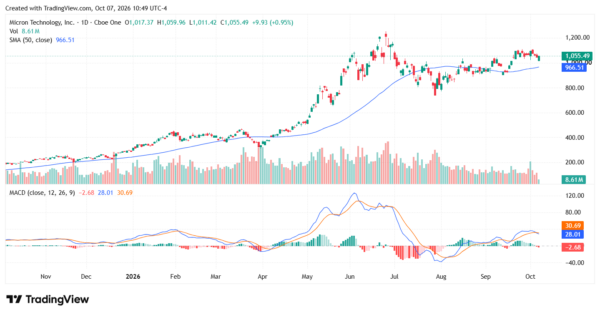
MU stock remains in a powerful long-term uptrend, with shares closing at $1,045.56 on Oct. 6 and trading well above the 50-day moving average near $966.51 shown on the chart. That creates an important technical support zone around $965–$970 if the stock pulls back. The psychological $1,000 level is another area investors will likely watch closely.

The bigger question is whether MU can regain momentum toward its recent highs. Shares recently approached the $1,100 area, which now represents near-term resistance. A decisive move above that level could put the stock on a path toward its prior peak near $1,200. However, momentum has started to cool. The MACD line is slightly below its signal line, producing a small negative histogram. That suggests some consolidation may be needed before another major advance. As long as MU remains above its 50-day average, the broader bullish trend remains intact.

Micron’s AI Growth Story Faces Its Next Test

Micron’s next chapter will depend on how well it turns AI demand into lasting financial results. If memory remains in short supply and customers continue spending, the company could have room to grow into Wall Street’s increasingly optimistic expectations.

But investors don’t need to assume a 187% rally to see the potential here. The more useful question is whether Micron can keep growing profits at a pace that supports its share price. Strong demand is encouraging. Consistently delivering on that demand is what could give the rally staying power. 

Over the last 26 years, he’s taught thousands of investors how to trade news flow and herd mentality using a unique blend of technical and fundamental analysis. Cooper was among the few analysts to spot the financial crisis of 2008, the top of subprime and Alt-A, the death of Lehman Brothers, Bear Stearns, and New Century Financial, and even the Dow’s collapse to 6,500, as well as its recovery. He even called for gold to rally well above $1.500 when it traded under $600. At the moment, Cooper makes use of technical, fundamental and news analysis, to help individual investors grow their wealth. He’s a firm believer that hard work and thorough research will lead to investment success.

Join over 1.2M+ investors/traders who receive daily and weekly notable earnings alerts with predicted move