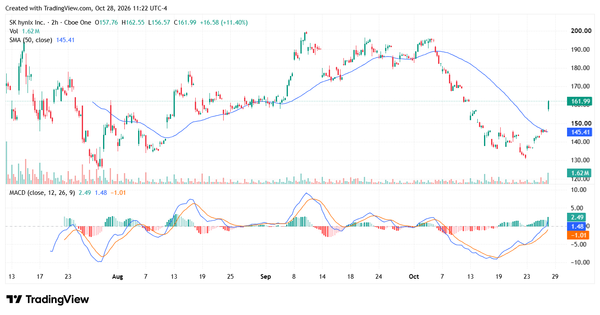
SK Hynix (NASDAQ: SKHY) just gave investors two reasons to stay interested in the artificial intelligence boom: soaring profits and a bigger share of the proceeds. Topping the list, third-quarter results topped expectations. Second, management announced another round of dividends and share repurchases.
Behind the rally is a business benefiting from strong demand for the memory that powers AI infrastructure. Customers need more advanced chips, supplies remain tight, and SK Hynix is turning that imbalance into stronger sales and earnings.
The question now is how long those favorable conditions can last.
Earnings Give Investors Plenty to Work With
Third-quarter revenue reached 104.62 trillion won, or about $78.86 billion, surpassing the 98.34 trillion won estimate. Operating profit came in at 83.33 trillion won, beating expectations of 76.72 trillion won. That puts revenue roughly 6.4% above forecasts and operating profit about 8.6% ahead of estimates. Those are meaningful beats, particularly for a company already facing substantial expectations tied to AI spending.
The comparisons with last year were even stronger. Revenue increased 327.9%, while operating profit surged 632.1%. Growth also remained powerful sequentially, with revenue climbing 31.9% and operating profit rising 37.6% from the second quarter.
For investors, the important point is that profit grew faster than sales. Higher prices and a richer mix of advanced memory products helped SK Hynix generate more operating earnings from its expanding revenue base.
The company reported an operating margin of about 80%, underscoring just how favorable the current environment has become. Sustaining that level of profitability, however, will be a much tougher test than delivering one exceptional quarter.
Shareholders Get a Larger Slice
SK Hynix is putting some of that financial strength directly into shareholders’ hands.
The board approved a third-quarter cash dividend totaling 14 trillion won, including a special payment tied to gains from its investment in Japanese chipmaker Kioxia. It also authorized another 20 trillion won in share repurchases.
There is an important distinction within that buyback. According to the company, 10 trillion won of the newly repurchased shares will be canceled, while approximately 10 trillion won will be used for employee compensation. That latter portion is excluded from the company’s shareholder-return total.
Cancellation matters because it reduces the share count, increasing remaining shareholders’ proportional ownership. Shares held for employee compensation do not provide the same lasting reduction. The new authorization follows a previously announced 40 trillion won buyback completed last week, with those shares due to be canceled shortly. For 2026, management outlined 100 trillion won in total shareholder returns, including at least 30 trillion won in cash dividends and at least 60 trillion won in repurchases and cancellations.
That gives investors another reason to follow the story beyond earnings growth: how much cash ultimately reaches shareholders.
Advanced Memory Drives the Next Chapter
The next major operating milestone is the transition toward HBM4. High-bandwidth memory, or HBM, works alongside AI processors to move large amounts of data quickly. As AI systems become more demanding, memory performance becomes increasingly important to how efficiently those systems operate.
SK Hynix expects HBM4 to exceed the previous-generation HBM3E in both shipments and revenue during the fourth quarter. To support that shift, it is increasing production at its M15X facility in Cheongju, South Korea.
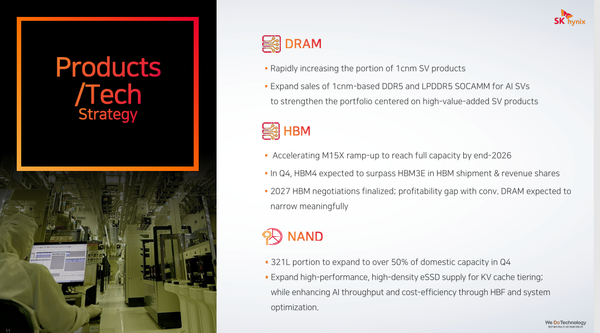
The benefits are already showing up in pricing. Average selling prices for DRAM increased by a percentage in the high twenties from the previous quarter, supported by stronger conventional memory prices and a growing contribution from higher-priced HBM4.
Demand also extends beyond HBM. Shipments of server DDR5 memory rose more than 40% sequentially, according to the earnings call.
Management Expects Memory Demand to Exceed Supply Through 2030
It has also secured long-term agreements with 14 major customers covering more than half its production capacity for 2027 and 2028. Those commitments improve visibility as the company prepares to increase investment significantly next year. They do not, however, eliminate the risks of changing customer budgets, competitive advances, or an eventual expansion in industry supply.
For now, the investment case rests on execution: converting customer commitments into profitable shipments while funding expansion and returning cash. The fourth-quarter HBM4 ramp will provide the next useful test of whether this extraordinary earnings momentum has more room to run.