ajax loader

Loading...


Ride-the-Wave Strategy – Best for Stock Traders

Ride-the-Wave targets multi-day price momentum following a company’s earnings announcement (EA). With this strategy:

  1. Buy a stock one day post-EA if a stock reacts positively post-earnings:
    1. Near the close of trading the EA-day for a pre-market-EA
    2. Near the close of the following day for a post-market-EA
  2. Sell-to-close after 7-10 days, or possibly earlier if a desired price target is reached

Similarly,

  1. short a stock one day post-EA if a stock reacts negatively post-earnings:
    1. near the close of trading the EA-day for a premarket-EA
    2. near the close of the following day for a post-market-EA
  2. then buy-to-close after 7-10 days, or possibly earlier if a desired price target is reached

Important: Ride-the-Wave is predicated on significant price momentum triggered by an EA. The 7-10 day scenario is the maximum trade hold-time. If you see post EA-momentum is halted or reversed by a significant opposite move, re-evaluate your presence in the trade.

This popular StockEarnings screen below will give you a list of stocks that historically exhibit significant price momentum following an EA for the next seven days:

  1. Stocks exhibiting positive post-EA price moves are buy-candidates
  2. Stocks exhibiting negative post-EA price moves are sell/short-candidates

The screen includes those stocks whose Earnings just came out in last two days.

Screen criteria:

  1. Earnings Date Start Date : Current Date + -1 Day
  2. Earnings Date End Date : Current Date + -2 Days
  3. Predicted Move (Next Day) Max : 7%
  4. Predicted Move (On 7th Day) Min : 7%

Strategy Guideline:

  1. Buy the stock if stock has reacted positively. Short the stock if stock has reacted negatively (see above).
  2. Close the position in 7-10 days, or possibly earlier based on price move.

Volatility Crush Strategy - Best for Options Traders

The Volatility Crush strategy is used with stocks that typically experience relatively low-to-moderate price moves (≤4%) following their Earnings Announcements (EA). The basic trade idea is to sell put or call options right before the EA, collecting a credit when options premium is very high due to elevated implied volatility (IV). You then close the position right after the EA by buying the option back much cheaper due to the significant drop in IV that occurs after the mystery of the EA disappears. In assessing this trade, you need to do your homework to ensure you collect sufficient premium to make the trade worthwhile.

This trade is practical due to the low-to-moderate price-move after the EA, which generally won’t significantly affect the options price, unlike an “action” stock, which experience great price moves post-EA. With these symbols, if you’re on the right side of the price move, that’s a great thing. But if you’re on the wrong side of the move, not so great. Consequently, by minimizing the effect of the post-EA price move, you have a much better chance to profit from the reduction in IV without it being ruined by a violent price move.

For this trade, open the position either (1) the night before the EA when the company announces earnings or (2) during the EA day when it announces post-market, generally capturing IV at or close to its peak.

For this trade, open the position either (1) the night before the EA when the company announces earnings or (2) during the EA day when it announces post-market, generally capturing IV at or close to its peak.

This popular stockearnings screen will give you a list of stocks which do not react more than 4% fpost-EA. It includes only those stocks whose earnings are releasing next day.

Screen criteria:

  1. Earnings Date Start Date : Current Date + 1
  2. Earnings Date End Date : Current Date + 1
  3. Predicted Move (Next Day) Max : 4%
  4. Options Type: Weekly

Strategy Guideline:

  1. Options Strategy: Sell Call and Put
  2. Options Strike Price: Current Stock Price – (% Predicated Move x 2)
  3. Expiration Date: It should generally be the closest expiry immediately after the EA.
  4. Buy Insurance: Buying back Call and Put at Strike price which 10% lower than Sell Strike Price is optional but recommended.

Watch Video for More Detail

Volatility Rush Strategy - Best for Options Traders

The Volatility Rush takes advantage of increasing options premiums into earnings announcements (EA) caused by an anticipated rise in Implied Volatility (IV). With this strategy, Buy a Call and Put at-the-money (a long straddle) 2-3 weeks before the EA when IV is lower. Sell the position either (1) the night before the EA when the company announces earnings pre-market, or (2) during the EA day when it announces post-market, generally capturing IV at or close to its peak.

This popular screen will give you a list of stocks whose Options premiums tend to rise into Earnings. It includes only those stocks whose Earnings are at least two weeks away from today.

Screen criteria:

  1. Earnings Date Start Date : Current Date + 15 Days
  2. Earnings Date End Date : Current Date + 30 Days
  3. Predicted Move (Next Day) Min : 5%
  4. Options Type: Weekly or Monthly if that lines up with the two to three-week lead-time for entering the trade

Strategy Guideline:

  1. Buy a Straddle at or close to the money two to three weeks pre-EA.
  2. Sell the position either the night before the EA when the company announces earnings pre-market, or during the EA day when it announces post-market.
  3. Expiration date should generally be the closest expiry immediately after the EA.
  4. Straddle price should not be more 60% of predicted move.

Predicted Move (Volatility)

Similar to Implied Volatility in Options. Expected volatility % based on our Proprietary Volatility Predication Model. We are expecting that stock price will likely to reach % in either direction by the end of next trading session after Earnings are released and not necessarily the closing volatility %.

Why is it important?

    This indicator helps

  1. Knowing expected volatility in stocks after Earnings helps to decide trading stocks before Earnings Announcement.
  2. Taking Advantage of volatility collapse following Earnings Results by using Advance Options strategies such as Spread and Straddles.

Since Last Earnings

Change in share price since last Earnings release.

Why is it Important?

When share has gained more than 10% since it's last Earning release, it tends to over react to minor bad news and give up some gains if not all. So, it contains more downside volatility than upside When share has dropped more than 10% since it's last Earning release, it tends to over react to minor good news and recover some drops if not all. So, it contains more upside volatility than downside.

EPS Surprise (%)

Occurs when a company's reported quarterly or annual profits are above or below analysts' expectations. Here is the formula to derive % EPS Surprice:

Actual EPS - Estimated EPS
------------------------------------- x 100
Estimated EPS

Why is it Important?

Earnings surprises can have a huge impact on a company's stock price. Several studies suggest that positive earnings surprises not only lead to an immediate hike in a stock's price, but also to a gradual increase over time. Hence, it's not surprising that some companies are known for routinely beating earning projections. A negative earnings surprise will usually result in a decline in share price.

Next Day Price Change (%)

Next Regular trading session Closing price following Earnings result.

For After Market Close Earnings, It is a next trading day closing price. For Before Market Open Earnings, It is the same trading day closing price.

Why is it Important?

Next Day price change is a reaction of Earnings result.

Palantir Earnings Preview: Wall Street Expects Big Growth on Nov. 2

Posted on Oct 27, 2026 by Ian Cooper

Palantir Earnings Preview: Wall Street Expects Big Growth on Nov. 2

Palantir Technologies (NASDAQ: PLTR) heads into its November 2 earnings report with Wall Street expecting another powerful quarter. Analysts anticipate earnings will nearly double, revenue will climb more than 80%, and demand from American businesses and government customers will remain strong.

That’s an impressive setup. It also leaves the AI giant with plenty to prove.

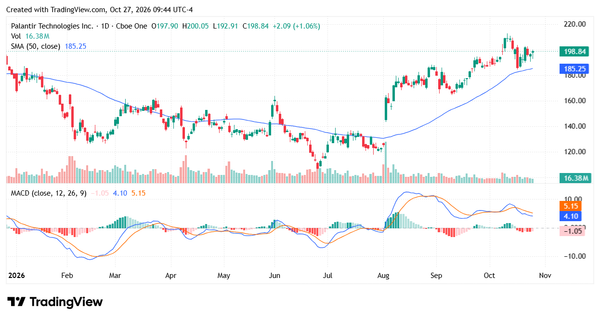
When expectations are this high, delivering strong growth may only be the starting point. Investors will want to see whether the company can outperform those forecasts and give them a reason to expect even more in the months ahead. Recent bullish calls from Rosenblatt and Citi suggest both firms believe Palantir can do just that.

What Wall Street Expects From Q3 Earnings


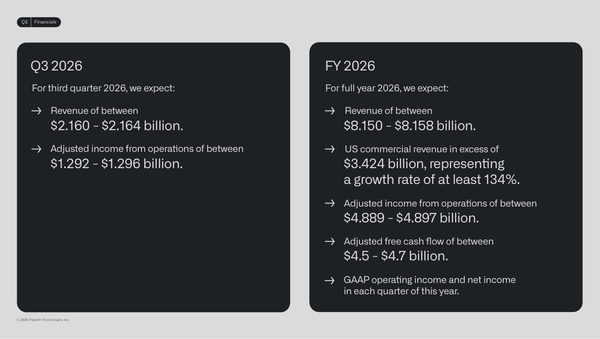
Palantir is expected to report third-quarter results after the market closes on Monday, November 2. The consensus is calling for adjusted earnings of $0.41 per share on revenue of approximately $2.18 billion. Compared with the year-earlier figures of $0.21 per share and $1.18 billion in revenue, those estimates imply earnings growth of roughly 95% and revenue growth of about 85%.

There is another useful comparison. The company previously guided for third-quarter revenue between $2.160 billion and $2.164 billion. The $2.18 billion consensus therefore already assumes the company will come in slightly above its own forecast.
palantir - StockEarnings

Why Rosenblatt Raised Its PLTR Price Target to $260

Rosenblatt analyst John McPeake maintained a Buy rating and raised his PLTR price target to $260 from $225 ahead of the report. According to the CNBC reporting, McPeake sees continued strong growth as companies move toward using artificial intelligence across their operations. His argument is that larger deployments should help Palantir attract new customers while expanding its business with existing ones.

Winning a customer gives Palantir an initial source of revenue. Getting that customer to use its software across additional departments and business functions creates opportunities for the relationship to become much more valuable.

Commercial and Government Demand Take Center Stage

Citi analysts are also optimistic. The firm maintained its Buy rating and increased its price target to $250 from $245, pointing to encouraging discussions with Palantir’s business partners.

For the U.S. commercial business, Citi expects revenue growth above 140%, even against a much tougher year-earlier comparison. It also anticipates improving growth in the international commercial business. On the government side, Citi’s research suggests healthy demand around the federal fiscal year-end. One specialized federal partner reported growth above 60% across its broader technology practice, with Palantir identified as a major beneficiary.

That figure describes the partner’s business, rather than Palantir’s own government revenue. Still, it helps explain Citi’s confidence. The firm also cautioned against reading too much into weaker contract-tracking data, arguing that delays in reporting Defense Department awards can obscure underlying activity. Investors should remember that contract announcements and recognized revenue follow different timelines.

2026 Guidance Could Drive the Next Move in PLTR Stock

Beyond the quarterly numbers, investors should pay close attention to management’s updated forecast. Following its second-quarter results, Palantir projected full-year revenue of roughly $8.15 billion, representing about 82% growth. Citi expects another substantial increase, potentially lifting the projected annual growth rate by around 10 percentage points. That is Citi’s expectation, not guidance Palantir has issued.

Profitability will also matter. Investors should watch whether the company can support larger customer deployments while controlling expenses and generating cash. Rapid sales growth becomes more valuable when it translates into durable financial gains.

Palantir has a clear opportunity on November 2. It needs to demonstrate that demand is expanding across customers, industries, and government agencies while strengthening its outlook. The strongest report would combine its earnings beat, continued customer expansion, and guidance that supports confidence beyond a single quarter. That would give investors something more useful than AI enthusiasm.
palantir - StockEarnings

Over the last 26 years, he’s taught thousands of investors how to trade news flow and herd mentality using a unique blend of technical and fundamental analysis. Cooper was among the few analysts to spot the financial crisis of 2008, the top of subprime and Alt-A, the death of Lehman Brothers, Bear Stearns, and New Century Financial, and even the Dow’s collapse to 6,500, as well as its recovery. He even called for gold to rally well above $1.500 when it traded under $600. At the moment, Cooper makes use of technical, fundamental and news analysis, to help individual investors grow their wealth. He’s a firm believer that hard work and thorough research will lead to investment success.

Join over 1.2M+ investors/traders who receive daily and weekly notable earnings alerts with predicted move