ajax loader

Loading...


Ride-the-Wave Strategy – Best for Stock Traders

Ride-the-Wave targets multi-day price momentum following a company’s earnings announcement (EA). With this strategy:

  1. Buy a stock one day post-EA if a stock reacts positively post-earnings:
    1. Near the close of trading the EA-day for a pre-market-EA
    2. Near the close of the following day for a post-market-EA
  2. Sell-to-close after 7-10 days, or possibly earlier if a desired price target is reached

Similarly,

  1. short a stock one day post-EA if a stock reacts negatively post-earnings:
    1. near the close of trading the EA-day for a premarket-EA
    2. near the close of the following day for a post-market-EA
  2. then buy-to-close after 7-10 days, or possibly earlier if a desired price target is reached

Important: Ride-the-Wave is predicated on significant price momentum triggered by an EA. The 7-10 day scenario is the maximum trade hold-time. If you see post EA-momentum is halted or reversed by a significant opposite move, re-evaluate your presence in the trade.

This popular StockEarnings screen below will give you a list of stocks that historically exhibit significant price momentum following an EA for the next seven days:

  1. Stocks exhibiting positive post-EA price moves are buy-candidates
  2. Stocks exhibiting negative post-EA price moves are sell/short-candidates

The screen includes those stocks whose Earnings just came out in last two days.

Screen criteria:

  1. Earnings Date Start Date : Current Date + -1 Day
  2. Earnings Date End Date : Current Date + -2 Days
  3. Predicted Move (Next Day) Max : 7%
  4. Predicted Move (On 7th Day) Min : 7%

Strategy Guideline:

  1. Buy the stock if stock has reacted positively. Short the stock if stock has reacted negatively (see above).
  2. Close the position in 7-10 days, or possibly earlier based on price move.

Volatility Crush Strategy - Best for Options Traders

The Volatility Crush strategy is used with stocks that typically experience relatively low-to-moderate price moves (≤4%) following their Earnings Announcements (EA). The basic trade idea is to sell put or call options right before the EA, collecting a credit when options premium is very high due to elevated implied volatility (IV). You then close the position right after the EA by buying the option back much cheaper due to the significant drop in IV that occurs after the mystery of the EA disappears. In assessing this trade, you need to do your homework to ensure you collect sufficient premium to make the trade worthwhile.

This trade is practical due to the low-to-moderate price-move after the EA, which generally won’t significantly affect the options price, unlike an “action” stock, which experience great price moves post-EA. With these symbols, if you’re on the right side of the price move, that’s a great thing. But if you’re on the wrong side of the move, not so great. Consequently, by minimizing the effect of the post-EA price move, you have a much better chance to profit from the reduction in IV without it being ruined by a violent price move.

For this trade, open the position either (1) the night before the EA when the company announces earnings or (2) during the EA day when it announces post-market, generally capturing IV at or close to its peak.

For this trade, open the position either (1) the night before the EA when the company announces earnings or (2) during the EA day when it announces post-market, generally capturing IV at or close to its peak.

This popular stockearnings screen will give you a list of stocks which do not react more than 4% fpost-EA. It includes only those stocks whose earnings are releasing next day.

Screen criteria:

  1. Earnings Date Start Date : Current Date + 1
  2. Earnings Date End Date : Current Date + 1
  3. Predicted Move (Next Day) Max : 4%
  4. Options Type: Weekly

Strategy Guideline:

  1. Options Strategy: Sell Call and Put
  2. Options Strike Price: Current Stock Price – (% Predicated Move x 2)
  3. Expiration Date: It should generally be the closest expiry immediately after the EA.
  4. Buy Insurance: Buying back Call and Put at Strike price which 10% lower than Sell Strike Price is optional but recommended.

Watch Video for More Detail

Volatility Rush Strategy - Best for Options Traders

The Volatility Rush takes advantage of increasing options premiums into earnings announcements (EA) caused by an anticipated rise in Implied Volatility (IV). With this strategy, Buy a Call and Put at-the-money (a long straddle) 2-3 weeks before the EA when IV is lower. Sell the position either (1) the night before the EA when the company announces earnings pre-market, or (2) during the EA day when it announces post-market, generally capturing IV at or close to its peak.

This popular screen will give you a list of stocks whose Options premiums tend to rise into Earnings. It includes only those stocks whose Earnings are at least two weeks away from today.

Screen criteria:

  1. Earnings Date Start Date : Current Date + 15 Days
  2. Earnings Date End Date : Current Date + 30 Days
  3. Predicted Move (Next Day) Min : 5%
  4. Options Type: Weekly or Monthly if that lines up with the two to three-week lead-time for entering the trade

Strategy Guideline:

  1. Buy a Straddle at or close to the money two to three weeks pre-EA.
  2. Sell the position either the night before the EA when the company announces earnings pre-market, or during the EA day when it announces post-market.
  3. Expiration date should generally be the closest expiry immediately after the EA.
  4. Straddle price should not be more 60% of predicted move.

Predicted Move (Volatility)

Similar to Implied Volatility in Options. Expected volatility % based on our Proprietary Volatility Predication Model. We are expecting that stock price will likely to reach % in either direction by the end of next trading session after Earnings are released and not necessarily the closing volatility %.

Why is it important?

    This indicator helps

  1. Knowing expected volatility in stocks after Earnings helps to decide trading stocks before Earnings Announcement.
  2. Taking Advantage of volatility collapse following Earnings Results by using Advance Options strategies such as Spread and Straddles.

Since Last Earnings

Change in share price since last Earnings release.

Why is it Important?

When share has gained more than 10% since it's last Earning release, it tends to over react to minor bad news and give up some gains if not all. So, it contains more downside volatility than upside When share has dropped more than 10% since it's last Earning release, it tends to over react to minor good news and recover some drops if not all. So, it contains more upside volatility than downside.

EPS Surprise (%)

Occurs when a company's reported quarterly or annual profits are above or below analysts' expectations. Here is the formula to derive % EPS Surprice:

Actual EPS - Estimated EPS
------------------------------------- x 100
Estimated EPS

Why is it Important?

Earnings surprises can have a huge impact on a company's stock price. Several studies suggest that positive earnings surprises not only lead to an immediate hike in a stock's price, but also to a gradual increase over time. Hence, it's not surprising that some companies are known for routinely beating earning projections. A negative earnings surprise will usually result in a decline in share price.

Next Day Price Change (%)

Next Regular trading session Closing price following Earnings result.

For After Market Close Earnings, It is a next trading day closing price. For Before Market Open Earnings, It is the same trading day closing price.

Why is it Important?

Next Day price change is a reaction of Earnings result.

2 Dividend Kings Give Investors Different Paths In Flight to Safety

Posted on Oct 27, 2026 by Chris Markoch

2 Dividend Kings Give Investors Different Paths In Flight to Safety

Dividend kings are getting a fresh look from investors this week. Coca-Cola (NYSE: KO) and Illinois Tool Works (NYSE: ITW) both report third-quarter earnings before the opening bell on Tuesday, October 27. Each has raised its dividend for more than 60 consecutive years.

The timing is interesting. Over the past two weeks, investors have been selling AI and large-cap growth names. But much of that money hasn’t left the market. It’s rotated into consumer staples, utilities, and other defensive sectors. That looks like a flight to safety. But it may also be a flight to quality.

Those are not the same thing. A flight to safety is about avoiding losses. A flight to quality is about owning businesses with durable cash flow, pricing power, and disciplined capital returns. Dividend kings sit where those two ideas overlap.

Still, these two stocks are set up very differently. Coca-Cola is up about 32% in 2026 and is on pace for its best year since 1996. Illinois Tool Works has posted a more modest gain and trades about 8% below its 52-week high. One looks like a momentum play. The other looks like a potential catch-up trade.

Why Dividend Kings Can Anchor Your Portfolio When Markets Wobble


A dividend king is a company that has raised its payout for at least 50 consecutive years. That is a short list. Getting on it means growing the dividend through recessions, oil shocks, a financial crisis, and a pandemic.

That track record matters because it reflects management behavior, not just results. A board that has raised the dividend for six decades treats the payout as a commitment. That discipline usually shows up in the balance sheet, capital allocation, and cost control.

For investors, the benefit is twofold. First, the dividend provides a cash return no matter what the stock price does. That income can be reinvested at lower prices during a pullback. Second, dividend kings tend to be less volatile than the broader market. That makes it easier to stay invested when headlines turn negative.

There is a behavioral advantage, too. Investors who own reliable dividend payers are less likely to sell at the wrong time. A rising income stream gives them a reason to hold. In a market where sentiment can flip in a single session, that patience is an edge.

The trade-off is that dividend kings rarely lead bull markets. But when leadership narrows, and growth stocks stumble, they start to look a lot more attractive.

Coca-Cola Delivers Defensive Income With Growth-Stock Momentum

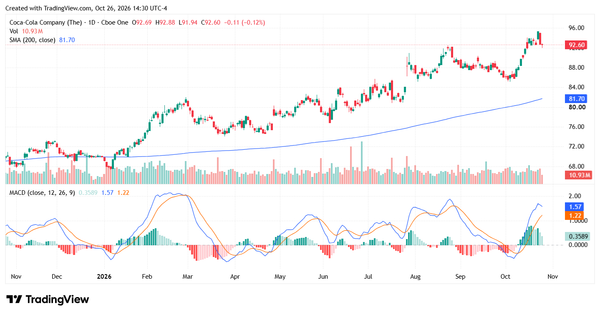
Coca-Cola is not supposed to be a momentum stock. But that is exactly what it has become in 2026. The shares are up about 32% this year and hit an all-time high above $95 last week.
dividend kings - StockEarnings

The chart shows an uptrend that has held all year. Coca-Cola has made a steady series of higher highs and higher lows. The stock sits well above its rising 200-day moving average, now near $81.70. The MACD remains above its signal line, so the trend is still intact.

The rally rests on real results. Second-quarter unit case volume rose 5%, and management raised full-year guidance. Coca-Cola has also beaten EPS estimates for six straight quarters. Analysts expect third-quarter EPS of about $0.88 on revenue near $12.9 billion.

There are early signs of fatigue, though. Shares slipped from last week’s high, and the MACD histogram is shrinking. The stock also trades near 29 times trailing adjusted earnings, up from about 23 at the end of 2025. Investors will want proof that volume held up after the World Cup boost.

Meanwhile, the dividend keeps compounding. Coca-Cola raised its payout for the 64th straight year in February, to 53 cents per quarter. That works out to $2.12 annually, or a yield near 2.3%. When investors go looking for safety, this is often where they start.

Illinois Tool Works Offers a Discounted Entry Into a Proven Compounder

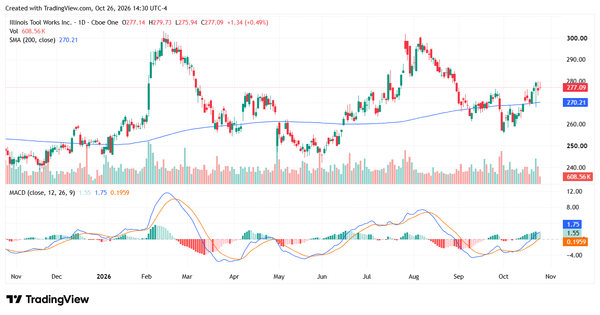
Illinois Tool Works tells a different story. The stock has posted a modest gain this year, well behind Coca-Cola. It trades about 8% below its 52-week high of $303.16. That gap is what makes ITW a potential catch-up trade.
dividend kings - StockEarnings

The chart supports that view. ITW has traded in a range between roughly $255 and $300 for most of the year. In October, it bounced off the low end and reclaimed its 200-day moving average near $270. The MACD has crossed above both its signal line and the zero line. That suggests momentum is turning higher.

The pullback reflects sentiment more than execution. On October 9, JPMorgan downgraded ITW to Neutral and cut its price target to $277 from $350. The firm worries manufacturing PMIs have limited room to improve. Wall Street’s consensus rating is Hold.

That caution contrasts with the fundamentals. Last quarter, revenue rose 6.1% to $4.30 billion, and EPS climbed 10.1%. Management raised full-year EPS guidance to $11.35 to $11.55. Analysts expect third-quarter EPS of about $2.97.

Shareholder returns are a big part of the appeal. In August, ITW raised its dividend 7% to $1.72 per quarter. That was its 63rd consecutive annual increase. The board also approved a new $6 billion share repurchase authorization. The forward yield is roughly 2.5%.

This is a classic gap between perception and fundamentals. A solid report could carry shares back toward the top of the range. A miss would likely send them back to test support near $255.

Two Ways to Own Quality in a Nervous Market

Coca-Cola and Illinois Tool Works offer investors two paths to the same destination. Both have more than 60 years of dividend growth. Both raised guidance this year. And both report on the same morning.

Coca-Cola is the momentum choice. The uptrend is intact, but the stock is extended, and expectations are high. Buying here is a bet that the rotation into consumer staples still has room to run.

Illinois Tool Works is the catch-up choice. Sentiment is cautious, but the chart is improving. A solid quarter could carry shares back toward the top of their range.

Whichever way earnings break, the dividends are not in question. In a market rotating toward safety, that reliability is the point. And if this flight to safety is really a flight to quality, dividend kings are exactly where investors should look.


A former marketing copywriter turned freelance financial writer and market analyst. I have a passion for delivering insights to investors. I write regularly about stocks for StockEarnings and MarketBeat. Posts are not advice.

Join over 1.2M+ investors/traders who receive daily and weekly notable earnings alerts with predicted move