Union Pacific Corp. (NYSE: UNP) reported third-quarter earnings on Oct. 22 that were strong by nearly every measure. The railroad company set records for freight revenue, operating revenue, operating income, and net income. Adjusted earnings per share (EPS) of $3.53 rose 15% from a year ago.
Operating revenue climbed 15% to $7.2 billion. Reported EPS of $3.49 grew 16%. Management also affirmed its full-year outlook for high-single-digit EPS growth.
Yet the stock slipped 1.75% on Friday after an earnings-day rally. Investors appear focused on a slightly higher adjusted operating ratio. Some are also weighing the pending Norfolk Southern merger and the upcoming departure of CFO Jennifer Hamann.
This leaves investors with a common dilemma. Do you follow perception or fundamentals? Union Pacific moved 6% more carloads than a year ago. Intermodal volume jumped 11%, and industrial volume set a record. Those aren’t numbers that a railroad delivers in a slowing economy.
The real headwind in the quarter was diesel. And even that is more about how the numbers look than what they earn.
Diesel Is Distorting an Otherwise Strong Report
Union Pacific’s fuel expense rose $424 million, or 69%, from the prior-year quarter. That one line item accounted for roughly 75% of the $559 million increase in total operating expenses.
But railroads pass most fuel costs to customers through surcharges. Union Pacific’s fuel surcharge revenue rose 95% to $1.17 billion. That’s an increase of nearly $570 million, more than covering the higher fuel bill.
The company’s own earnings bridge shows the net effect. Fuel prices actually added about 15 cents to EPS. However, they pushed the operating ratio 1.4 points higher. Core results improved the ratio by 1.1 points on their own.
In short, diesel inflates revenue and expenses at the same time. That makes margins look thinner even as profits grow. Management said as much, guiding for core operating ratio improvement while warning that the reported figure is challenged by high fuel prices.
Two items deserve a watchful eye. Price/mix was flat, likely because lower-revenue intermodal traffic grew fastest. Service performance indexes also fell six to seven points as the network absorbed more volume. Neither looks structural, but neither is due to higher diesel prices.
Freight Volumes Point to a Resilient Economy
Railroads offer a real-time read on the goods economy. Union Pacific’s quarter suggests that the U.S. economy is healthier than many headlines imply.
Premium volume, which includes intermodal and automotive, rose 9%. Industrial carloads grew 6%. Only bulk was flat, as lower coal shipments offset gains elsewhere.
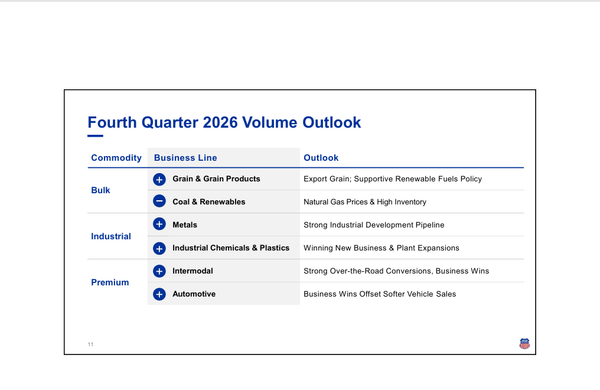
The Q4 outlook is just as encouraging. Management expects growth in grain, metals, industrial chemicals and plastics, intermodal and automotive. Coal is the lone expected decliner, pressured by natural gas prices and high inventories.
The metals call stands out. Union Pacific cited a strong industrial development pipeline. That points to sustained construction and manufacturing activity across its network.
To be fair, management still calls the economic forecast mixed. Some intermodal growth also reflects freight shifting from trucks. But share gains and a healthy freight economy can coexist.
The Charts Confirm the Breakout
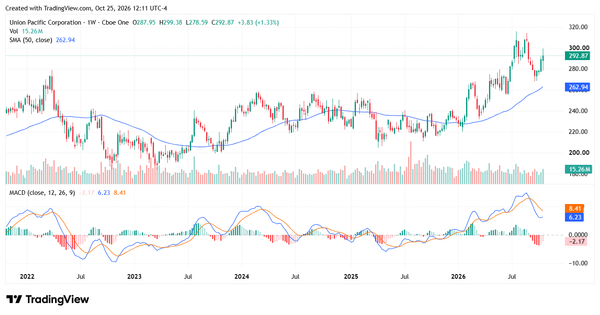
The five-year weekly chart frames the bigger picture. From mid-2022 through 2025, UNP traded largely between $200 and $260. Every rally stalled as freight demand stayed choppy.
That changed in early 2026. The stock broke out of its multi-year range as volumes accelerated. It peaked near $316 in July. The 50-week simple moving average (SMA) has turned sharply higher and now sits near $263.
The weekly moving average convergence divergence (MACD) has rolled over from its summer peak. However, it remains well above zero. That reads as consolidation within an uptrend, not a reversal.
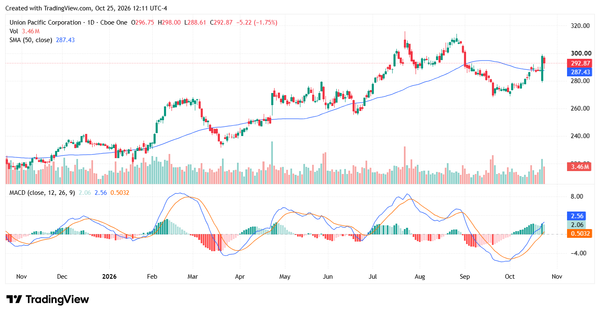
The one-year daily chart shows that consolidation up close. UNP slid from about $313 in late August to near $270 by early October. It then rebounded into the report.
On earnings day, shares dipped toward $279 before closing near $298 on a volume spike. Buyers clearly stepped in. Even after Friday’s pullback, the stock sits above its 50-day SMA of about $287. The daily MACD has also crossed back above zero.
Taken together, the charts match the volume data. The trend that began with the 2026 freight recovery remains intact.
The Merger and CFO Transition Are Noise
On Oct. 16, Union Pacific announced that Hamann will retire in early 2027 after 35 years. A successor hasn’t been named. Still, the timeline allows for an orderly handoff. Hamann also reaffirmed her strong support for the merger.
The $85 billion Norfolk Southern deal is a longer-dated question. The Surface Transportation Board is now reviewing its merits. Opposition comments are due Nov. 18, and final briefs are due May 28, 2027.
Merger costs were not a margin problem this quarter. They were actually a smaller drag than a year ago, improving the operating ratio comparison by 0.4 points.
Meanwhile, the balance sheet keeps getting stronger. Year-to-date cash from operations rose 18% to $8.3 billion. Union Pacific repaid $1.5 billion of debt, and adjusted debt-to-EBITDA fell to 2.4x from 2.7x at year-end.
Valuation Is the Key Concern
The CFO transition and margin pressure from the proposed merger with Norfolk Southern (NYSE: NSC) add elements of short-term uncertainty to UNP. However, assuming that both of those situations are resolved in a satisfactory fashion, the key concern for Union Pacific is valuation.
At around 22.3x earnings, UNP is trading at a slight discount to the S&P 500, which is around 26x as of Oct. 22. However, it’s expensive relative to its own history and slightly more expensive than the Rail Transportation sector, as noted by Yardeni Research.
If income is your key reason to own UNP, and you don’t already own the stock, it may be better to wait for more merger certainty. However, if you’re looking for a long-term compounder with growth that appears to be accelerating, Union Pacific is a sound choice that will look even better when diesel prices revert to the mean.