Lockheed Martin (NYSE: LMT) delivered the earnings report bulls had been waiting for. Lockheed Martin earnings report for the third quarter showed growth in all four segments. Management also raised full-year guidance for the second straight quarter. The stock closed up 6.98% at $590.01 on Oct. 22.
That move matters because of what came before it. LMT entered the report about 20% below its 52-week high of $692. Several Wall Street analysts spent the prior two weeks cutting their price targets. Short sellers had added to their positions in September. In other words, expectations were low going in.
However, the report didn’t just clear a low bar. It produced a record backlog that reframes the growth story for years to come. The question now is whether the market finishes bidding LMT higher.
Record $292 Billion Backlog Signals Years of Demand
Sales rose 11% year-over-year to $20.7 billion. That topped the consensus estimate of about $20.46 billion. Diluted earnings per share (EPS) rose 15% to $7.97, up from $6.95. Net earnings climbed 14% to $1.8 billion.
Missiles and Fire Control (MFC) did the heavy lifting. Segment sales jumped 24% to $4.5 billion on higher PAC-3, THAAD, GMLRS, and PrSM production. Operating profit rose by the same 24% to $631 million. Aeronautics sales grew 13% to $8.2 billion on higher F-35 production and sustainment volume.
The Backlog Is the Real Headline
Lockheed Martin ended the quarter with a record backlog of $292 billion. That’s up 27% from the second quarter. It includes $52.5 billion tied to a multi-year award for PAC-3 MSE interceptors. The book-to-bill ratio was roughly 4x.
The MFC segment alone now carries a $142.5 billion backlog. At the end of 2025, that figure was $46.7 billion. For context, MFC’s full-year sales guidance is $17.25 billion to $17.45 billion. The segment has years of visible work ahead.
This is the data that backs up the munitions supercycle argument. It’s also why the “defense spending has peaked” narrative looked shaky heading into the print.
Guidance Moves Higher Again
Management raised its 2026 outlook across the board. Sales guidance is now $80 billion to $82 billion. EPS guidance rose to $30.35 to $30.75, from $29.95 to $30.65. Free cash flow guidance jumped $800 million at the midpoint, to $7.8 billion to $8.0 billion.
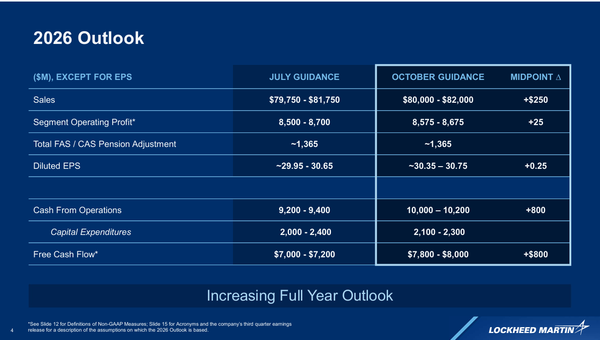
That’s the second consecutive quarterly raise. CEO Jim Taiclet also noted the company raised its dividend for the 24th straight year.
There is one caveat. Lockheed remains in negotiations on F-35 production lots 20 and higher. Costs on the Lot 20 advance contract began exceeding funded authorization in the third quarter. The company warned that results and cash flow will suffer without additional funding. Investors should watch that closely.
LMT Stock Surges Past Wall Street’s Recently Lowered Price Targets
The setup is where this gets interesting. In the days before the report, analysts were trimming targets, not raising them:
- TD Cowen: $600 to $570 (Hold), Oct. 9
- Goldman Sachs: $503 to $486, Oct. 12
- Bernstein: $629 to $564 (Market Perform), Oct. 14
- RBC Capital: $600 to $550 (Sector Perform), Oct. 15
Barclays also initiated coverage with an Equal Weight rating and a $554 target. After today’s move, LMT trades above all five targets.
UBS took the other side. Analyst Gavin Parsons reiterated a Buy rating and a $653 target on Oct. 16. He projects 20% annual growth for the MFC segment over the next five years. PAC-3, THAAD, and JASSM/LRASM are the main drivers. His core argument is that the market underestimates how large and durable the munitions ramp will be. Today’s backlog figure supports that view.
When a stock moves above a cluster of targets, those analysts face a choice. They can raise their numbers or defend a below-market view. Upward revisions can help feed a re-rating.
That said, target revisions often chase price rather than lead it. The more durable signal is the multiple. At $590, LMT trades at about 19.3x the midpoint of 2026 EPS guidance. UBS’s $653 target implies about 21.4x. That’s a modest re-rating for a company with a $292 billion backlog.
What Short Interest Says (and What It Doesn’t)
Short interest in LMT climbed into the end of September. About 2.74 million shares were sold short as of Sept. 30. That compares with 2.69 million on Aug. 31. One source shows short interest up roughly 14% versus the prior period.
Still, it’s important not to overstate this. Short interest is only about 1.2% of the float. Days to cover is around two. This isn’t the setup for a classic short squeeze, and that’s not my argument.
The better read is behavioral. Bears were pressing their bets just as the stock was bottoming near $505. Those positions are now underwater by more than 15%. Some covering likely helped fuel the October rally. The next FINRA update, for the Oct. 15 settlement date, will show how much was flushed out. Any shorts that remain got one more reason to cover today.
Can Shares Break Above $615?
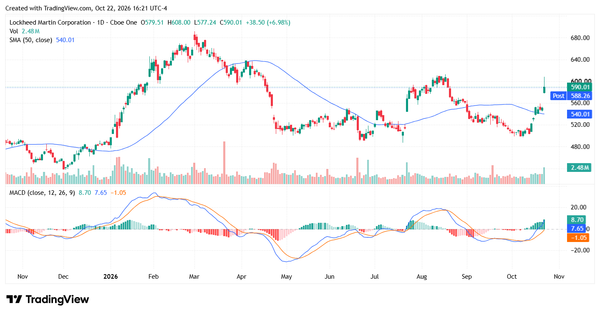
Today’s chart reinforces the fundamental story. LMT gapped above resistance near $560 on volume of 2.48 million shares. That’s roughly double its average daily volume. The stock is well above its 50-day simple moving average of about $540, which has started to turn higher. The MACD crossed above its signal line in mid-October and is now firmly positive.
One note of caution: shares hit an intraday high of $608 before closing at $590. That upper wick tagged the $600 to $615 zone that capped the stock in August. A decisive close above that range would be the confirmation bulls want. A partial gap fill toward $560 wouldn’t break the trend.
LMT Stock Outlook: Backlog Growth Meets a Key Test
Lockheed Martin entered this report with low expectations, falling price targets, and rising short interest. It exited with a record backlog; a second straight guidance raise and a breakout chart. The F-35 contract talks remain a real risk. But the gap between how the market perceived Lockheed Martin and what the business is delivering just got harder to ignore.