Meta Platforms (NASDAQ: META) grew revenue 26% in the third quarter 2026 report, and advertisers paid 14% more for their ads. Then the company spent $34.9 billion on capital expenditures in three months and ended up with negative $2.12 billion in free cash flow.
I can see why investors are excited about Meta’s AI push. Its advertising business is getting stronger, its recommendation systems are improving, and the company says those AI investments are already bringing in more advertising revenue.
But if you own the stock, there is another number worth considering. One year ago, Meta generated $10.6 billion in free cash flow in the third quarter. This time, it burned through cash.
So, how much more does Mark have to spend before the payoff catches up with the bill?
Start with the advertising numbers, because they tell us what Meta is getting right. Revenue reached $64.60 billion, up 26% year over year, while advertising revenue climbed to $63.06 billion. Ad impressions increased 10%, average prices rose 14%, and the company’s family of apps reached 3.64 billion daily active people, up 3%.
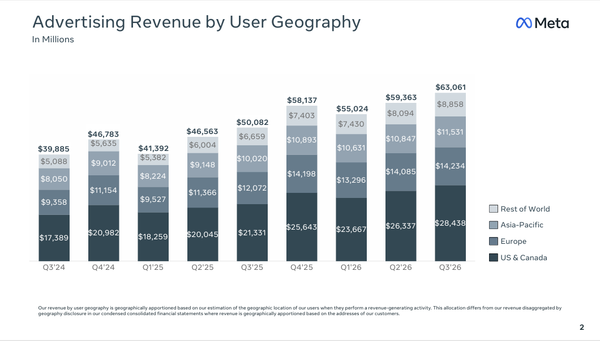
Put yourself in an advertiser’s shoes for a moment. You can reach billions of people across Facebook, Instagram, Messenger, and WhatsApp, and Meta is getting better at matching ads with the people most likely to respond. If that translates into better results for your business, paying more for the placement becomes easier to justify. The company gets to charge more while showing more ads, and revenue grows without needing its user base to expand at the same pace.
Management credits AI-powered recommendations, engagement, and ad monetization for part of that improvement. We cannot pin the entire 26% revenue increase on AI, but Meta says the technology is already generating incremental advertising revenue. That is a far stronger case than asking shareholders to buy into a vision with no commercial evidence behind it.
In July, I explored how long Meta could run on vision and ideas. Since then, the company has given us more evidence that its AI ambitions can strengthen the business it already owns. The debate has moved on to what the company must spend to keep that advantage growing.
Meta reported operating income of $12.99 billion, down 37% year over year, and diluted earnings per share of $3.83. Those figures look out of place beside 26% revenue growth, until you account for the $9.89 billion charge tied to its agreement with 52 state attorneys general over litigation involving teen mental health and social media.
Remove that charge, and operating income rises to $22.88 billion while diluted EPS reaches $7.40. The underlying business performed much better than the headline earnings suggest, so I wouldn’t use the reported decline as evidence that Meta’s advertising engine has stalled.
Still, the legal bill deserves more than a footnote. Meta continues to face youth-related scrutiny, with additional US trials scheduled in the coming months. Adjusting for a one-time charge helps us assess operating performance, but it doesn’t erase the legal exposure or guarantee that future proceedings will come cheaply.
AI Spending Pushes Free Cash Flow Into Negative Territory
Now this deserves a proper debate. Meta generated $32.79 billion in operating cash flow, but capital expenditure and principal payments on finance leases pushed free cash flow to negative $2.12 billion. In Q3 last year, free cash flow was positive $10.63 billion. That is a $12.75 billion swing in twelve months.
And management has raised its 2026 capital expenditure outlook to $135 billion–$145 billion, lifting the bottom end of its previous range. The company plans to keep investing aggressively in AI infrastructure, model training and new products. It has also acknowledged that these newer investments will take longer to generate returns than investments in its core business.
I understand the argument for spending now. AI is improving Meta’s advertising tools, and falling behind in infrastructure or model development could leave competitors with an advantage that becomes expensive to recover. When a business serves billions of people, even small improvements in recommendations and ad performance can translate into enormous sums.
But shareholders still have to fund the buildout, and they cannot pay their bills with engagement gains or promises about future models. Meta held $82.45 billion in cash, cash equivalents, and marketable securities at quarter-end, so a negative free-cash-flow quarter does not put the company in immediate financial trouble. The concern is how long spending at this scale continues, and whether the returns eventually justify it.
Can AI Growth Justify Up to $145 Billion in Spending?
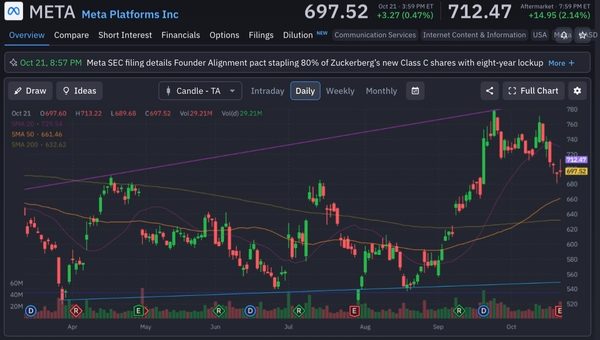
META closed regular trading at $697.52 before climbing to $712.47 after hours, up 2.14%. The stock remains below its 20-day moving average near $729.54, although it trades above the 50-day average around $661.46 and the 200-day average near $632.62. Reclaiming $730 would help repair the near-term chart; a pullback toward $660 would test the strength of the recovery.
So, how much more does Meta have to spend on AI? With capex projected at $135 billion to $145 billion this year, shareholders need to see those investments translate into stronger cash flow. The company’s advertising engine is already benefiting from AI, and that gives the spending a credible purpose. If those gains continue and free cash flow recovers, the bill could prove worthwhile. Until then, Meta has earned room to invest, not a blank cheque.