ajax loader

Loading...


Ride-the-Wave Strategy – Best for Stock Traders

Ride-the-Wave targets multi-day price momentum following a company’s earnings announcement (EA). With this strategy:

  1. Buy a stock one day post-EA if a stock reacts positively post-earnings:
    1. Near the close of trading the EA-day for a pre-market-EA
    2. Near the close of the following day for a post-market-EA
  2. Sell-to-close after 7-10 days, or possibly earlier if a desired price target is reached

Similarly,

  1. short a stock one day post-EA if a stock reacts negatively post-earnings:
    1. near the close of trading the EA-day for a premarket-EA
    2. near the close of the following day for a post-market-EA
  2. then buy-to-close after 7-10 days, or possibly earlier if a desired price target is reached

Important: Ride-the-Wave is predicated on significant price momentum triggered by an EA. The 7-10 day scenario is the maximum trade hold-time. If you see post EA-momentum is halted or reversed by a significant opposite move, re-evaluate your presence in the trade.

This popular StockEarnings screen below will give you a list of stocks that historically exhibit significant price momentum following an EA for the next seven days:

  1. Stocks exhibiting positive post-EA price moves are buy-candidates
  2. Stocks exhibiting negative post-EA price moves are sell/short-candidates

The screen includes those stocks whose Earnings just came out in last two days.

Screen criteria:

  1. Earnings Date Start Date : Current Date + -1 Day
  2. Earnings Date End Date : Current Date + -2 Days
  3. Predicted Move (Next Day) Max : 7%
  4. Predicted Move (On 7th Day) Min : 7%

Strategy Guideline:

  1. Buy the stock if stock has reacted positively. Short the stock if stock has reacted negatively (see above).
  2. Close the position in 7-10 days, or possibly earlier based on price move.

Volatility Crush Strategy - Best for Options Traders

The Volatility Crush strategy is used with stocks that typically experience relatively low-to-moderate price moves (≤4%) following their Earnings Announcements (EA). The basic trade idea is to sell put or call options right before the EA, collecting a credit when options premium is very high due to elevated implied volatility (IV). You then close the position right after the EA by buying the option back much cheaper due to the significant drop in IV that occurs after the mystery of the EA disappears. In assessing this trade, you need to do your homework to ensure you collect sufficient premium to make the trade worthwhile.

This trade is practical due to the low-to-moderate price-move after the EA, which generally won’t significantly affect the options price, unlike an “action” stock, which experience great price moves post-EA. With these symbols, if you’re on the right side of the price move, that’s a great thing. But if you’re on the wrong side of the move, not so great. Consequently, by minimizing the effect of the post-EA price move, you have a much better chance to profit from the reduction in IV without it being ruined by a violent price move.

For this trade, open the position either (1) the night before the EA when the company announces earnings or (2) during the EA day when it announces post-market, generally capturing IV at or close to its peak.

For this trade, open the position either (1) the night before the EA when the company announces earnings or (2) during the EA day when it announces post-market, generally capturing IV at or close to its peak.

This popular stockearnings screen will give you a list of stocks which do not react more than 4% fpost-EA. It includes only those stocks whose earnings are releasing next day.

Screen criteria:

  1. Earnings Date Start Date : Current Date + 1
  2. Earnings Date End Date : Current Date + 1
  3. Predicted Move (Next Day) Max : 4%
  4. Options Type: Weekly

Strategy Guideline:

  1. Options Strategy: Sell Call and Put
  2. Options Strike Price: Current Stock Price – (% Predicated Move x 2)
  3. Expiration Date: It should generally be the closest expiry immediately after the EA.
  4. Buy Insurance: Buying back Call and Put at Strike price which 10% lower than Sell Strike Price is optional but recommended.

Watch Video for More Detail

Volatility Rush Strategy - Best for Options Traders

The Volatility Rush takes advantage of increasing options premiums into earnings announcements (EA) caused by an anticipated rise in Implied Volatility (IV). With this strategy, Buy a Call and Put at-the-money (a long straddle) 2-3 weeks before the EA when IV is lower. Sell the position either (1) the night before the EA when the company announces earnings pre-market, or (2) during the EA day when it announces post-market, generally capturing IV at or close to its peak.

This popular screen will give you a list of stocks whose Options premiums tend to rise into Earnings. It includes only those stocks whose Earnings are at least two weeks away from today.

Screen criteria:

  1. Earnings Date Start Date : Current Date + 15 Days
  2. Earnings Date End Date : Current Date + 30 Days
  3. Predicted Move (Next Day) Min : 5%
  4. Options Type: Weekly or Monthly if that lines up with the two to three-week lead-time for entering the trade

Strategy Guideline:

  1. Buy a Straddle at or close to the money two to three weeks pre-EA.
  2. Sell the position either the night before the EA when the company announces earnings pre-market, or during the EA day when it announces post-market.
  3. Expiration date should generally be the closest expiry immediately after the EA.
  4. Straddle price should not be more 60% of predicted move.

Predicted Move (Volatility)

Similar to Implied Volatility in Options. Expected volatility % based on our Proprietary Volatility Predication Model. We are expecting that stock price will likely to reach % in either direction by the end of next trading session after Earnings are released and not necessarily the closing volatility %.

Why is it important?

    This indicator helps

  1. Knowing expected volatility in stocks after Earnings helps to decide trading stocks before Earnings Announcement.
  2. Taking Advantage of volatility collapse following Earnings Results by using Advance Options strategies such as Spread and Straddles.

Since Last Earnings

Change in share price since last Earnings release.

Why is it Important?

When share has gained more than 10% since it's last Earning release, it tends to over react to minor bad news and give up some gains if not all. So, it contains more downside volatility than upside When share has dropped more than 10% since it's last Earning release, it tends to over react to minor good news and recover some drops if not all. So, it contains more upside volatility than downside.

EPS Surprise (%)

Occurs when a company's reported quarterly or annual profits are above or below analysts' expectations. Here is the formula to derive % EPS Surprice:

Actual EPS - Estimated EPS
------------------------------------- x 100
Estimated EPS

Why is it Important?

Earnings surprises can have a huge impact on a company's stock price. Several studies suggest that positive earnings surprises not only lead to an immediate hike in a stock's price, but also to a gradual increase over time. Hence, it's not surprising that some companies are known for routinely beating earning projections. A negative earnings surprise will usually result in a decline in share price.

Next Day Price Change (%)

Next Regular trading session Closing price following Earnings result.

For After Market Close Earnings, It is a next trading day closing price. For Before Market Open Earnings, It is the same trading day closing price.

Why is it Important?

Next Day price change is a reaction of Earnings result.

3M Stock Beats and Raises as Amazon Deal Boosts AI Story

Posted on Oct 21, 2026 by Chris Markoch

3M Stock Beats and Raises as Amazon Deal Boosts AI Story

3M Co. (NYSE: MMM) delivered another beat-and-raise quarter on Oct. 20. The 3M earnings report showed adjusted EPS of $2.50, up 12% year-over-year (YOY). That topped the consensus estimate of $2.39. Revenue of $6.6 billion landed roughly in line with forecasts.

Management also raised its full-year outlook. 3M now expects 2026 adjusted EPS of $9.10 to $9.15. The prior range was $8.95 to $9.10 on a comparable basis. Shares responded, rising about 4% for the week through Tuesday’s close of $171.37.

The headline numbers were solid. But the bigger story came from a partnership announcement. 3M expanded its relationship with Amazon (NASDAQ: AMZN) around optical connectivity for data centers. The deal includes a warrant tied to $6 billion in potential sales over seven years.

That matters for how investors see this company. For years, 3M traded as a litigation story with a conglomerate attached. Today, it wants to be valued as a self-help turnaround with an AI kicker. This quarter moved that perception forward. It did not finish the job.

Here is what investors need to know about the quarter, the Amazon deal, and what still deserves caution.

Margin Expansion Did the Heavy Lifting


Adjusted organic sales grew 3.3%. That is a solid but not spectacular pace. The real strength showed up in profitability. Adjusted operating margin reached 26.2%, up 110 basis points from a year ago. Gross margin expanded by 230 basis points.

CFO Anurag Maheshwari said the margin gains included no one-time benefit. He credited cost control and productivity across the supply chain and G&A. 3M has closed 16 manufacturing sites and distribution centers so far this year. Another 10 are slated for action over the next 12 months.

Pricing also helped. CEO Bill Brown said 3M is being a bit more aggressive on price. He expects full-year pricing slightly above 1.5%, with the back half above 2%.

One accounting note deserves mention. Starting this quarter, 3M excludes intangible amortization from adjusted results. That lifts adjusted EPS by about four cents per quarter. Prior periods were restated, so YOY comparisons remain apples to apples.

Safety and Industrial Carried the Quarter

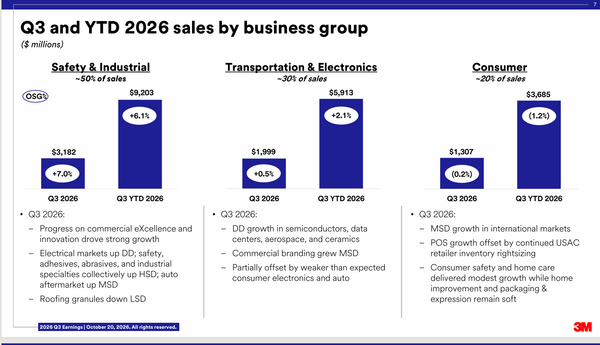
The Safety and Industrial segment was the standout. Organic sales rose 7%. Reported segment sales jumped 9.1%, helped by the Madison Fire & Rescue acquisition. Segment operating income climbed to $960 million from $792 million. Electrical Markets grew double digits on data center demand.

Transportation and Electronics grew just 0.5% organically. Consumer electronics sales fell by a mid-teens percentage. That offset gains in semiconductors and aerospace. Management pointed to a segment backlog up double digits as a reason for fourth-quarter confidence.

The Consumer segment was roughly flat, with organic sales down 0.2%. U.S. point-of-sale trends improved, but some large retailers trimmed inventory. Geographically, the U.S. and Canada grew about 7% on an adjusted organic basis. China remained the weak spot.
3M - StockEarnings

The Amazon Deal Changes the Conversation

The Amazon warrant covers up to 3.2 million shares, or about 0.6% of 3M’s stock. Vesting depends on $6 billion in cumulative sales of 3M optical connectivity and data center products over seven years. Brown was clear that there are no volume commitments. 3M has to earn the business.

Still, the signal matters. Hyperscalers rarely structure equity-linked deals with suppliers they doubt. 3M also announced a contract manufacturing deal with Genius Electronic Optical. It is taking a roughly 4.7% stake in that company. The goal is to scale production of its Expanded Beam Optics technology.

Here is where perception may be running ahead of fundamentals. Data center revenue should reach about $700 million this year, up from roughly $550 million. That is under 3% of total sales. Expanded Beam Optics revenue is expected near $40 million this year. The AI story is real, but it is still early.

Litigation: Off the Slides, Not Off the Books

Neither the slide deck nor the prepared remarks addressed litigation. That fits the narrative 3M wants to tell. Yet the earnings release shows the issue has not disappeared.

Net costs for significant litigation and PFAS exit were 19 cents per share, matching last year. The bigger impact was on cash. 3M made about $1 billion in pre-tax litigation and PFAS payments in the quarter. As a result, GAAP operating cash flow was just $486 million. That compares with $1.76 billion a year earlier.

Adjusted free cash flow of $1.2 billion excludes those payments. That’s a useful view of the operating business. But dividends are paid with actual cash, not adjusted cash. 3M paid about $400 million in dividends in the quarter. It also repurchased $200 million in stock.

Meanwhile, more than 15,000 PFAS personal injury cases remain pending in federal court. No new bellwether trial date has been set. No global settlement exists. Total debt also rose about $2.4 billion year-to-date, partly to fund the Madison acquisition.

This is not a red flag. It is a caution flag, mainly for income investors. The dividend yields about 1.8%. Coverage looks comfortable on adjusted numbers. It looks tighter in quarters with heavy settlement payments.

What the Chart Says

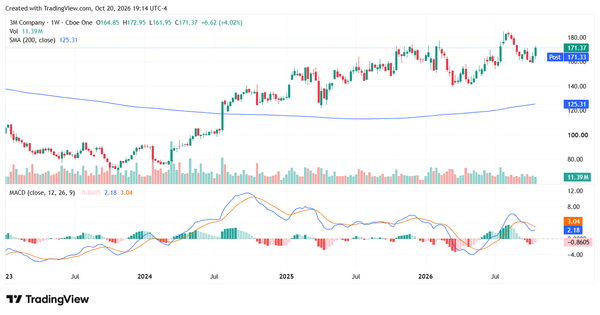
On the weekly chart, MMM remains in a long-term uptrend. Shares sit well above the rising 200-week moving average, now near $125. The stock peaked near $185 in August, then pulled back to the low $160s.

This week’s bounce is encouraging. Still, the MACD remains below its signal line. The histogram is negative but narrowing, suggesting selling momentum is fading. A weekly close above the $175 area would strengthen the bullish case. Reclaiming the August high near $185 would confirm it.
3M - StockEarnings

Valuation and the Bottom Line

At $171, MMM trades near 18.8 times the midpoint of 2026 EPS guidance. That is reasonable for 11% to 12% earnings growth. Management also expects 2027 organic growth near 4%. It sees margins topping its 25.4% Investor Day target.

The bull case rests on three pillars. They are steady margin gains, accelerating innovation, and a credible AI infrastructure angle. 3M launched 87 new products this quarter. It expects more than 350 for the full year.

Growth investors have new reasons to pay attention. Income investors should stay engaged but watch cash flow, not just adjusted earnings. For both groups, this quarter showed a company changing its story. The market is beginning to believe it.


A former marketing copywriter turned freelance financial writer and market analyst. I have a passion for delivering insights to investors. I write regularly about stocks for StockEarnings and MarketBeat. Posts are not advice.

Join over 1.2M+ investors/traders who receive daily and weekly notable earnings alerts with predicted move