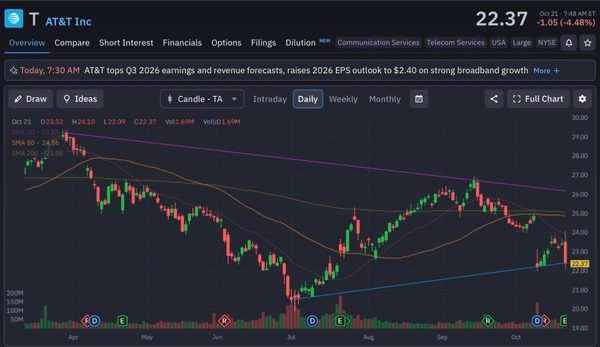
AT&T (NYSE: T) raised its 2026 earnings outlook, grew adjusted earnings by 20.4%, and added 442,000 fiber customers in the third quarter. Yet shares fell 4.48% on October 21 to $22.37, putting a key support zone under pressure despite a solid earnings beat.
After breaking down the numbers, I think the disconnect comes down to what AT&T is building versus what shareholders are getting back. Fiber is driving stronger operating performance, but the cash flow needed to fund that expansion, reduce debt, and reward shareholders still needs to improve. That was the tension in my pre-earnings article, and Q3 gives us a clearer picture of both sides.
Fiber Is Finally Showing Up in the Margins
AT&T generated $32.32 billion in revenue, up 5.3% year over year, while adjusted diluted EPS climbed to $0.65 from $0.54, beating analyst expectations on both measures.
The strongest numbers came from Advanced Connectivity, which combines AT&T’s wireless and internet businesses. Revenue grew 7.2% to $29.48 billion, while operating income jumped 18.9% to $7.63 billion. The segment’s operating margin expanded to 25.9% from 23.3%, showing that the business is converting its growth into earnings more efficiently.
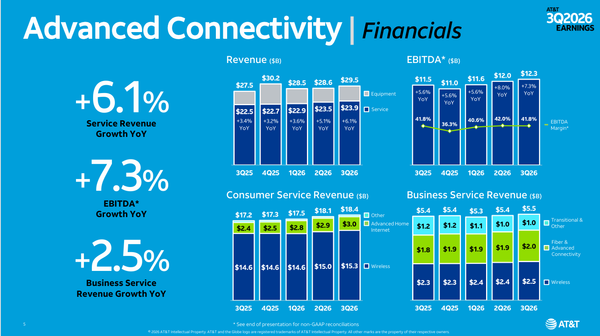
Fiber is doing much of the work. AT&T added 442,000 fiber internet customers, up from 309,000 a year earlier, while total internet net additions increased to 769,000 from 613,000. Advanced home internet revenue surged 23.4% to $2.98 billion.
These are the numbers I wanted to see after the previous breakdown. AT&T is building out its fiber network, attracting more customers and growing operating income faster than revenue. Its ability to bundle internet with wireless service adds another revenue opportunity.
Wireless growth was more restrained, with postpaid phone net additions falling to 379,000 from 405,000 a year ago and churn holding at 0.92%. Fiber remains the stronger growth engine, and the improving margins suggest its contribution is extending beyond subscriber counts.
The Earnings Outlook Is Moving Higher
Management raised its 2026 adjusted EPS outlook to approximately $2.40, above its previous $2.25–$2.35 range. That upgrade strengthens the case that better operating performance is feeding into the bottom line, rather than remaining a promise tied to future network investment.
AT&T expects at least $18 billion in free cash flow this year, rising to $19 billion in 2027 and $21 billion in 2028. Capital spending is projected at $23 billion to $24 billion in 2026 before easing to $22 billion to $23 billion annually in 2027 and 2028.
The spending trajectory is worth watching because the company needs its expanding network to produce more cash as the heavy investment phase matures. If fiber revenue and operating income continue climbing while capital expenditure declines, more money could become available to pay down debt and support shareholder returns.
Q3 free cash flow reached $4.95 billion, up slightly from $4.87 billion a year earlier, while cash remaining after dividends improved to $3.00 billion from $2.83 billion. However, nine-month free cash flow was $12.13 billion, down from $12.41 billion in the same period last year. The latest quarter moved in the right direction, but the year-to-date trend still needs to turn.
Debt Is the Part Investors Cannot Ignore
AT&T reported GAAP EPS of $0.12, down from $1.29 a year earlier, after recording $3.37 billion in asset impairments, abandonments and restructuring charges. Adjusted operating income actually increased to $7.61 billion from $6.55 billion, making the adjusted figures a better read on underlying operations.
The debt figures are harder to look past. The company ended September with $159.63 billion in total debt and $149.82 billion in net debt. Net debt to adjusted EBITDA rose to 3.13x from 2.59x at the end of 2025, while spectrum acquisitions added another substantial cash commitment during the quarter.
And now, it plans to return more than $45 billion to shareholders over 2026–2028, including roughly $10 billion in share repurchases during 2026, while maintaining its $1.11 annualized dividend. It also aims to bring leverage toward 2.5x by 2029.
That is an ambitious list of obligations for a company still spending heavily on its network. Fiber growth is strengthening earnings, but shareholders need to see that growth translate into sustained free cash flow and lower leverage before the balance sheet becomes less of a drag on the stock.
The Stock Has to Prove It Can Hold Support
AT&T shares closed the session at $22.37, below the 20-day moving average at $23.89, the 50-day at $24.86 and the 200-day at $25.08. The selloff has pushed the stock toward support around $22.00–$22.30, with a break potentially exposing the July lows around $20.50–$21.00. Reclaiming $23.89 would be the first sign of a recovery, followed by resistance near $24.86–$25.08.
I lean bullish on AT&T because fiber is producing measurable growth, segment margins are expanding, and management has raised its earnings outlook. The shares have been punished despite those improvements, leaving an opportunity if the company can turn stronger operations into sustained cash generation.
The risk is straightforward: net leverage is rising while year-to-date free cash flow is lower. AT&T’s fiber bet is paying off in the operating numbers; the next proof needs to show up in the cash left over after investment and dividends. Until then, $22 support is the level to watch.