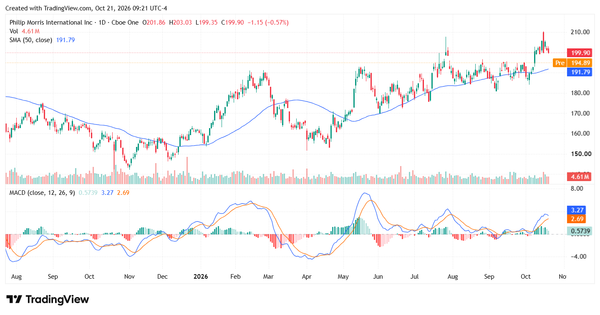
Philip Morris International (NYSE: PM) delivered higher sales, stronger adjusted earnings, and improving demand for its ZYN nicotine pouches. But the stock is down. The primary reasons for the bearish sentiment were rising costs and disruptions tied to conflicts in the Middle East and Ukraine.
For Philip Morris, the challenge is maintaining growth while managing expenses that are harder to predict. Its latest results show progress, but they also explain why investors are looking beyond the earnings beat.
Philip Morris Q3 Earnings Beat Wall Street Expectations
Philip Morris reported third-quarter revenue of $11.4 billion, up 5.5% from the prior year. Adjusted earnings reached $2.36 per share, compared with expectations of $2.30. Revenue also exceeded estimates of $11.32 billion. Growth came from both traditional cigarettes and the company’s expanding smoke-free business. Total shipments increased 0.6%, while higher prices helped the company generate more revenue.
The business also became more profitable. Gross profit rose 6.7%, and operating income increased 14.1%, according to the supplied company release. However, reported EPS fell 4.9% to $2.12, largely because of a noncash adjustment to the value of equity investments.
ZYN Nicotine Pouch Growth Recovers as Philip Morris Increases Investment
One encouraging development was the improvement in ZYN shipments. U.S. shipments increased 4.2% to 3.2 billion pouches in the third quarter. That followed growth of 1.8% in the second quarter and a 23% decline in the first, according to the supplied material.
The direction is encouraging. Still, Philip Morris is spending more to strengthen the brand and compete for customers.
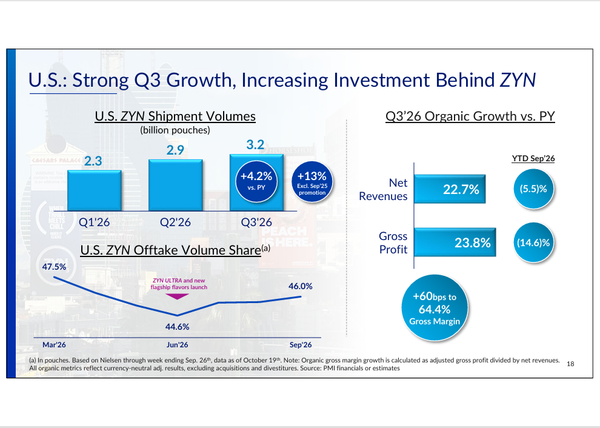
The company has introduced additional flavors, nicotine strengths, and product formats. It also plans to move most of its flagship ZYN lineup from 15-pouch cans to 20-pouch cans, alongside increased marketing and support for that transition.
For investors, the question is whether those investments generate enough additional demand to justify their cost. More products and larger cans could help ZYN appeal to a wider range of adult nicotine consumers. But launching products, supporting distribution, and advertising all require money before their full benefits become clear.
Smoke-Free Products Drive More Than 40% of Philip Morris Revenue
Philip Morris’s shift toward smoke-free products continues to reshape its revenue mix. These products generated more than 40% of third-quarter revenue and around 42% of revenue through the first nine months. The company said its smoke-free products were available in 110 markets.
This business includes IQOS heated-tobacco products, ZYN nicotine pouches and VEEV vaping products. Smoke-free revenue increased 4.1%, while shipments grew 2.7%. Those figures suggest the business continues expanding, although results varied across products and markets.
Traditional cigarettes also remained an important contributor. Higher pricing helped support sales and profitability despite broadly flat shipments in the international cigarette business.
There is a qualification, however. That business benefited from changes to distribution arrangements in certain markets. Philip Morris said those benefits would not repeat at the same level in future quarters.
Rising Costs and Geopolitical Risks Cloud Philip Morris Earnings Outlook
The biggest uncertainty may be what happens to expenses.
Philip Morris said the Middle East conflict is pushing up energy-related costs, with a greater impact expected in the fourth quarter as more input-price increases take effect.
In Ukraine, attacks affecting supply chains and logistics are also expected to weigh on operating income. The company increased its full-year adjusted earnings forecast to $8.29 to $8.44 per share from $8.26 to $8.41. That makes the increase less significant than a stronger underlying profit forecast. Meanwhile, the quarterly dividend rose 8.8% to $1.60 per share, equivalent to $6.40 annually.
Can ZYN Growth Offset Rising Costs for Philip Morris Stock?
Philip Morris gave shareholders several positives: growing revenue, improving ZYN shipments and a larger smoke-free business. The next test is whether those strengths can absorb higher costs and heavier investment. Investors will want evidence that ZYN’s recovery can continue without putting too much pressure on profits. Until that becomes clearer, even a solid earnings beat may struggle to lift the shares.