International Business Machines Corp. (NYSE: IBM) just delivered 6% revenue growth at constant currency, grew adjusted earnings per share by 11%, and generated $3 billion in quarterly free cash flow. Management also raised its full-year free-cash-flow growth outlook, giving investors more evidence that IBM’s shift toward software, hybrid cloud and enterprise AI is feeding into the financials.
As you’ll discover, this is a business gaining momentum where it counts, just as we flagged the potential for a recovery in our earlier IBM earnings preview, where software growth, delayed deals and the full-year outlook were central to the thesis. Q3 has now given us a stronger software print and an upgraded cash-flow outlook, although the after-hours selloff shows the stock still has ground to make up.
Software Growth Accelerates as Red Hat and Data Lead
IBM generated $17.1 billion in Q3 revenue, up 5% year over year and 6% at constant currency. Adjusted diluted EPS reached $2.95, up 11%, while operating pre-tax margin expanded 70 basis points to 19.3%. The earnings beat came with better profitability and stronger cash generation, giving the quarter more substance than a headline revenue surprise.
Software is doing much of the heavy lifting. Revenue climbed 8.2% to $7.8 billion, with Data growing 19%, Transaction Processing up 9%, and Red Hat’s hybrid-cloud business expanding 11%. OpenShift, IBM’s enterprise Kubernetes platform, reached $2.4 billion in annual recurring revenue, with growth accelerating beyond 30%.
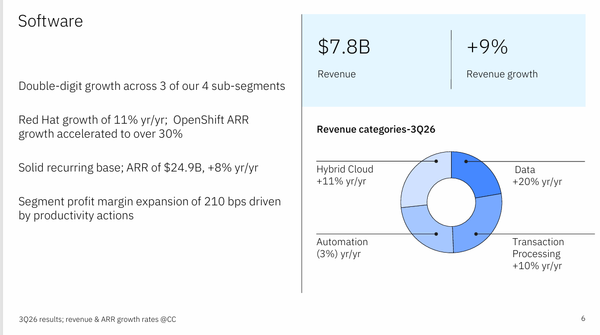
I like the breadth behind those numbers because the company isn’t relying on a single AI product to carry the quarter. Enterprises need data infrastructure, secure hybrid-cloud environments, and software that can integrate AI into existing workflows, and IBM is selling across those layers. Its recurring-revenue base also gives the company a foundation for compounding growth as customers expand deployments.
Management raised its full-year software growth outlook to approximately 7%–8%, using 7% as its revised base case. That upgrade gives the investment thesis a clearer direction: software growth is accelerating, and IBM expects that momentum to carry into the final quarter.
IBM’s AI Growth Extends to Infrastructure and Consulting
Infrastructure revenue increased 4.2% to $3.7 billion, or 4.9% at constant currency, led by 31% growth in distributed infrastructure. IBM Z revenue fell 20%, reflecting the uneven timing of mainframe demand, but distributed infrastructure and storage are benefiting as clients modernize systems and support heavier AI workloads.
Management also pointed to a sizable distributed-infrastructure backlog exiting the quarter, which supports the expectation of continued momentum in Q4. That gives IBM another growth contributor alongside software, even as individual product cycles move in different directions.
Consulting was the weaker part of the report. Revenue was essentially flat at $5.34 billion, while segment profit margin slipped to 12.2% from 12.9%. Automation revenue also declined 3%, showing that Big Blue’s growth isn’t evenly spread across the portfolio.
Still, consulting’s role in enterprise AI deployments could help connect the company’s software and infrastructure offerings to larger client projects. The company reported that AI represented about 30% of consulting revenue and 35% of its backlog. Converting those engagements into sustained revenue growth will be important as IBM pushes toward a more software-led business model.
Free Cash Flow Rises as Acquisitions and Debt Remain in Focus
IBM generated $3.03 billion in free cash flow during Q3, up from $2.37 billion a year earlier. For the first nine months, free cash flow reached $7.79 billion, compared with $7.18 billion in 2025. Operating cash flow excluding IBM Financing receivables also increased to $3.48 billion for the quarter from $2.78 billion.
Those gains underpin management’s decision to raise its full-year free-cash-flow growth expectation to more than $1 billion year over year, while maintaining its forecast for 4%–5% revenue growth at constant currency. The company expects 100 basis points of operating pre-tax margin expansion for the full year, supported by productivity initiatives and tighter operating discipline.
IBM is using AI and automation internally to improve software development, sales efficiency and services delivery, with those productivity gains helping fund investment and shareholder returns. The strategy is beginning to show up in margins and cash flow, although higher capital expenditure, cash taxes and net interest expense continue to absorb some of the gains.
Acquisitions add another layer to the equation. The company invested $11.4 billion in acquisitions during the first nine months, and total debt stood at $63.8 billion at quarter-end, including $12.7 billion tied to its financing business. Cash, restricted cash and marketable securities totaled $11.1 billion, down $3.4 billion from year-end 2025.
The balance sheet remains investment grade, and IBM returned $4.8 billion to shareholders through dividends in the first nine months. But acquisitions and continued investment need to deliver durable growth if IBM is to keep expanding cash flow without allowing the debt burden to become a larger concern.
IBM Stock Drops After Earnings Despite Strong Fundamentals
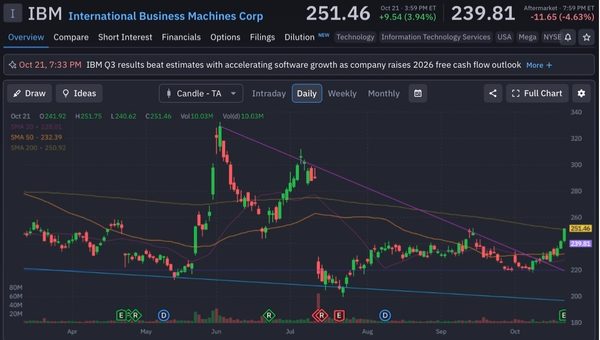
IBM’s chart showed a potential breakout above a descending trendline, with the regular-session close at $251.46 moving above the 200-day moving average at $250.92. The after-hours slide to $239.81 has put that move in doubt, bringing the $232–$240 area into focus as the first zone bulls need to defend. A break lower could send the stock toward $220, while reclaiming $250–$251 would help restore the breakout case.
IBM Stock Outlook: Why the Bullish Case Still Holds
I’d stake my bet on IBM because software growth is accelerating, infrastructure is gaining traction and free cash flow is moving higher alongside margins. The stock’s reversal creates a tougher technical picture, but it doesn’t undo the operating progress in the report.
The next leg depends on the company sustaining software momentum and converting more of its AI opportunity into cash. Q3 gives investors evidence that the strategy is working; the coming quarters need to show that the gains can keep compounding.