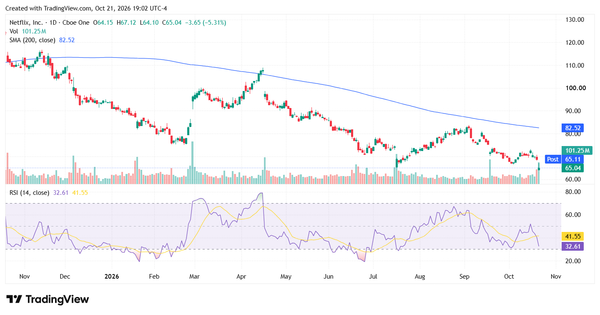
Netflix (NASDAQ: NFLX) delivered a solid, but not spectacular, Q3 2026 earnings report. But it’s safe to say the market wanted much, much more. Shares of NFLX were down 5.3% the day after the report.
The price action is leading investors to ask what’s wrong with the stock. From my perspective, investors are coming to the realization that Netflix is a grown-up company where the easy money has been made, and now it’s moving into the next phase of its growth.
What Netflix Delivered in Q3
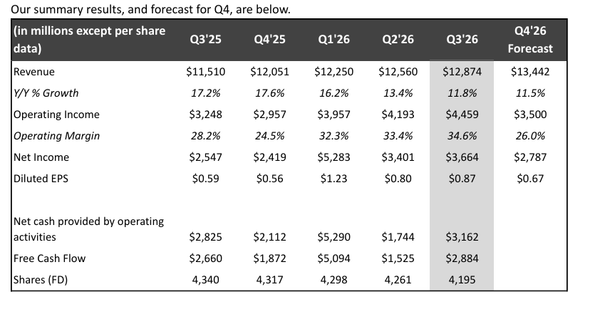
Let’s start with the headline numbers. Revenue came in at $12.9 billion, up 12% year over year, or 11% on a currency-neutral basis. That was right in line with the company’s forecast. Subscription revenue did the heavy lifting, thanks to membership growth and higher prices.
Netflix also said churn improved year over year, both globally and in the U.S. In other words, the price hikes didn’t send members running for the exits. That matters when canceling takes one tap.
The bottom line looked even better. Operating income jumped 37% to $4.5 billion, and operating margin rose to 34.6% from 28.2% a year ago. Diluted earnings per share climbed 49% to $0.87. Don’t read too much into that headline growth.
Netflix said the margin beat was mostly about the timing of expenses. Last year’s 28.2% margin also set a low bar. Buybacks helped too. Netflix repurchased $4.8 billion of stock, its largest quarter ever, and its diluted share count fell about 3%.
 Source: Netflix
So Why Did NFLX Stock Fall?
Look at the guidance. Netflix now expects about $2.7 billion in 2026 ad revenue, down from roughly $3 billion. The company blamed a slower-than-expected rollout of some ad product capabilities. Full-year revenue guidance of $51.1 billion came in slightly below the midpoint of its prior range. Fourth-quarter margins will also absorb costs from recently announced layoffs. And free cash flow guidance slipped to $12 billion from $12.5 billion, mostly because of a real estate deal.
None of that is a disaster. Netflix still expects a 31.5% operating margin for 2026, up from 29.5% last year. But the ad shortfall stings because ads are the growth story investors are paying for. Management pointed to the ad tier launching in 15 new countries in 2027. That’s encouraging. Still, for a company that’s growing up, “next year” is becoming a familiar answer.
But what does that next phase look like? That’s worth a closer look. You could look at subscriber numbers, engagement numbers, ad revenue, and the like. But that’s not where the story is. For that, you have to look at the person in the mirror.
Streaming Habits Have Changed
I don’t own Netflix, but I am a subscriber to the streaming service. In fact, although I’m not an original Netflix subscriber, I’m old school enough to still pay for the premium, ad-free service.
Congratulations on all my success, I know. The fact is, one of the reasons I subscribed to the streaming service was for the ad-free viewing. I don’t subscribe to many other services. So, with subscription creep not hitting my budget, I’ve made the decision that I’d rather stay ad-free. That’s even though Netflix would prefer that I did (more on that in a moment).
But my larger point is that 10 years ago, we didn’t have streaming habits. We had Netflix, or we didn’t. That gave Netflix the appearance of a moat that was more like a pit. It was only a matter of time before other companies came along and filled that pit.
And fill it, they did. In fact, other companies entered so fast that concepts like subscription creep and streaming fatigue entered our lexicon. To compensate, Netflix was forced to change its business model. As it turned out, making original content is expensive, and subscribers were going to accept only so much of a price hike.
So, Netflix took a page out of other streaming companies’ books. It launched a budget-friendly ad-supported tier. It also cracked down on password sharing.
I’ll admit to being a skeptic at the time. But I was wrong on both counts. The ad-supported tier was wildly successful, and it made password sharing less necessary.
Where Will the Next Wave of Growth Come From?
The history lesson is important because Netflix is now facing a situation where it can’t just grow its way forward. This is the fundamental question coming out of earnings. Simply put, what will Netflix do for its next act?
Netflix is a mature company that has an entrenched base. The quarterly subscriber and engagement numbers are nice to have, but are really just noise, at least to me.
The ballgame is the ad revenue and what will make advertisers pay more. Sure, the company has blockbusters like The Diplomat, and it still appeals to nostalgia with shows like Seinfeld or The West Wing. But it’s harder to be disruptive when consumers can cancel with a tap.
Live sports is one area to watch, but I don’t think Netflix is going to try to copy the model of Apple Inc. (NASDAQ: AAPL) and get a large contract. I believe it’s comfortable playing in the “special event” lane and doesn’t want to get in a price war it might not win.
One place to look may be short-form content. Alphabet (NASDAQ: GOOGL) has become one of the company’s fiercest competitors due to its YouTube channel. I’m not sure how much that would cost Netflix to move companies onto its platform, but it’s a logical step.
Is NFLX a Buy or a Hold?
As of this writing, NFLX is trading at a 52-week low. The stock is down over 30% in 2026 and over 47% in the last 12 months. It has the feel of a falling knife, not a turnaround story.
But Netflix isn’t going out of business. That’s why I didn’t put Sell as an option. With no immediate concerns about engagement and retention, the company is likely to continue to deliver growth, but growth that is slower and more mature. As I noted in the introduction, the easy gains have been made.
Still, at around 18x forward earnings, NFLX doesn’t seem overvalued. Analysts remain bullish. Price targets are coming down, but a consensus price target of around $89 suggests the stock could have 38% upside.
So what does the chart tell me? A conflicting story. NFLX has had several sharp pullbacks (i.e., bear markets) in its history. That in itself isn’t alarming. But the downtrend in the 200-day moving average is a concern in the short term. That suggests that there’s likely to be more churn ahead.
But the slope does appear to be flattening, and NFLX is getting close to being oversold based on its relative strength indicator. None of this is investing advice. There’s risk with NFLX right now. If you own it, it’s probably a Hold, with the idea that it’s starting to look so bad it’s good. However, you may want to have it on a watch list and wait for more confirmation of a turnaround before committing new money.