On Tuesday, I published my Tesla (NASDAQ: TSLA) Q3 earnings preview with one question hanging over Elon Musk’s AI ambitions: Can Tesla’s automotive business generate enough profit to finance the robotaxi, robotics, and AI compute expansion? Two days later, Musk delivered his answer in Tesla’s Q3 2026 earnings report. Revenue came in at $28.05 billion, adjusted EPS hit $0.48, and free cash flow returned to positive territory at $1.53 billion.
That last number caught my attention. But the rest of the report left me with a bigger question about how much profit Tesla can actually squeeze out of its growing business.
Tesla’s Cash Recovered But Operating Profit Stalled
In Tuesday’s preview, I argued that Tesla needed to show its vehicle business could help fund the next phase of its growth. The company had just come off a rough Q2, when operating margin collapsed to 1.4% and capital expenditures hit $5.79 billion. Free cash flow turned negative by $1.09 billion, forcing investors to weigh Musk’s enormous ambitions against the cash required to make them happen.
Now we have the Q3 numbers, and the cash picture looks better. Operating cash flow climbed to $6.26 billion from $4.70 billion in Q2, while capital expenditures fell to $4.73 billion. Tesla ended September with $45.45 billion in cash, cash equivalents, and short-term investments, up from $43.52 billion at the end of June.
Musk has room to keep building. Yet I wanted to see what that spending capacity was buying the company financially, and the operating results still give me pause. Revenue was virtually flat year over year, while operating expenses climbed 39% to $4.78 billion. Research and development alone jumped to $2.76 billion from $1.63 billion, as Tesla poured more money into its development programs.
Operating income fell 56% to $718 million, leaving an operating margin of 2.6%, against 5.8% a year earlier.
There is progress on the automotive side. Gross margin excluding regulatory credits improved to 18.1% from 16.3% in Q2. Tesla delivered 486,532 vehicles, and management reported its largest passenger-vehicle backlog in four years. Those are encouraging signs, but deliveries declined 2% year over year, and stronger gross margins have yet to translate into stronger operating income.
That is where my original question still stands. Tesla has the balance sheet to finance its ambitions, but the earnings engine paying for them has more work to do.
AI Spending Is Eating Into Free Cash Flow
The consensus figures cited in the previous article projected $7.77 billion in Q3 capex and negative $4.51 billion in free cash flow. The actual report came in much better: capex was $4.73 billion, and free cash flow was positive $1.53 billion.
Tesla did not burn through cash at the rate analysts had anticipated. But the longer-term numbers aren’t clean either. Trailing-12-month capital expenditures reached $15.41 billion, while free cash flow fell to $3.30 billion from $6.83 billion a year earlier. Tesla is generating operating cash, yet the investment required to expand the business is taking a much larger bite out of it.
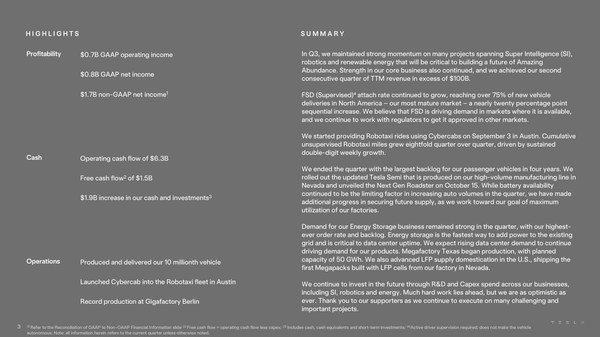
And Musk has plenty more on his plate. Tesla plans to reach 400 megawatts of AI training compute capacity by year-end. Cybercab has entered the Austin Robotaxi fleet, Optimus production has begun in Fremont, Tesla Semi production has started in Nevada, and Megafactory Texas has begun producing energy storage products.
I can see the logic. Tesla wants to build the infrastructure and products that could eventually generate new revenue streams. The problem is timing: the spending is happening now, while the financial contribution from several of these projects remains uncertain.
The $45.45 billion cash reserve buys Musk time. It does not tell us how much these projects will eventually earn.
Robotaxis Is Moving
There is one part of Tesla’s expansion that deserves more credit: software and services are already contributing to the business.
Active FSD subscriptions reached 1.74 million, up 67% year over year. More than 75% of new deliveries in North America included FSD subscriptions. Services and other gross profit climbed to a record $734 million, with a 15.9% gross margin, helped by charging, insurance and parts sales.
Robotaxi is moving, too. Tesla began providing Cybercab rides in Austin on September 3 and recorded nearly two million cumulative unsupervised Robotaxi miles by quarter-end, an eightfold sequential increase.
These are real developments, not just promises on a presentation slide. Still, mileage growth does not establish fleet profitability, and FSD continues to require active driver supervision. Tesla has to show that adoption can translate into meaningful earnings as its operations expand.
Energy storage offers another opportunity, especially with growing demand for data-center power infrastructure. Yet energy generation and storage revenue fell 16% year over year to $2.88 billion, partly due to tariff-related customer refunds. Even this growing business has quarterly bumps that investors need to account for.
Musk is laying the groundwork for a company that could eventually make money from far more than vehicle sales. I want to see how quickly those new businesses can start carrying their own weight.
TSLA Has Another Test Ahead
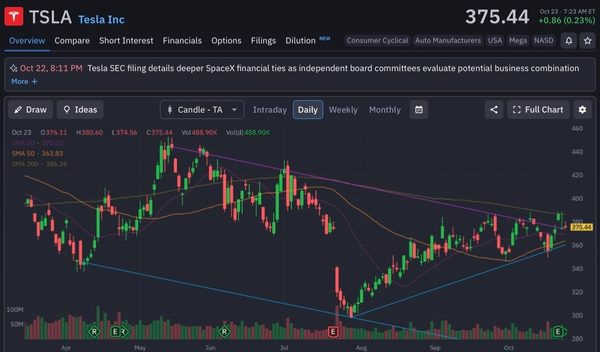
Tesla shares were trading around $375.44. The stock is above its 20-day moving average near $370 and its 50-day average near $364, but the 200-day average around $386 remains overhead.
The 378-380 area is the first bottleneck, followed by 386-390. Rejection could send TSLA back toward the 350-355 support zone.
Musk gave me a better cash-flow answer than I expected on Tuesday. What he has not yet delivered is the kind of year-over-year operating profit growth that would settle my bigger concern.
For TSLA, the next chapter comes down to execution: can Musk turn this enormous investment program into businesses that contribute enough profit to justify the money going in? That is the question I’ll be watching as Tesla’s AI ambitions move from factory floors and test fleets into the income statement.