PayPal (NASDAQ: PYPL) processed $487.1 billion in payments in the third quarter, up 6% year over year, but revenue grew just 2%. That gap captures the challenge facing the payments giant as it tries to turn around its business: customers are using its network more frequently, yet the additional activity is producing comparatively little growth in revenue. Management raised its 2026 earnings outlook, but investors still need evidence that PayPal can extract more value from the payments it already processes.
The company’s 7% increase in payment transactions and 8% growth in non-GAAP earnings per share offer reasons for optimism. However, GAAP operating income fell 8%, operating cash flow declined 19%, and active accounts barely grew. PayPal’s turnaround hinges on closing the gap between transaction growth and financial growth. If it cannot improve monetization while controlling costs, higher payment volume alone will struggle to deliver the stronger earnings trajectory shareholders need.
More Payments Without Capturing Enough Growth
PayPal ended the quarter with 440 million active accounts, up just 0.6% year over year, while payment transactions per active account over the trailing 12 months increased 6% to 60.8. Existing customers are using the network more frequently, driving payment transactions to 6.8 billion, but customer acquisition is contributing little additional momentum.
That engagement should give PayPal more opportunities to generate revenue from its existing user base. Instead, revenue reached $8.58 billion, growing substantially slower than payment volume. Transaction revenue increased 3%, while revenue from other value-added services declined 2%. PayPal is handling more payments, but the financial return from that activity is not keeping pace.
The distinction matters because transaction volume is only valuable to shareholders when it produces profitable revenue. PayPal needs to strengthen monetization across its branded checkout and broader payment services while managing the costs associated with processing transactions. Otherwise, growing payment volume could coexist with sluggish revenue and limited operating leverage.
Transaction margin dollars are particularly important here because they measure the dollars PayPal retains from payment activity after transaction-related expenses. Management raised its full-year transaction margin dollar outlook alongside its earnings guidance, suggesting it expects profitability from its payment operations to improve. The next results need to show that improvement reaching the bottom line.
Higher EPS Guidance Faces a Cash Flow Problem
PayPal raised its full-year 2026 non-GAAP earnings-per-share guidance from approximately $5.38 to $5.60. That upgrade supports the turnaround thesis, but the third-quarter results reveal a widening gap between adjusted earnings and reported profitability.
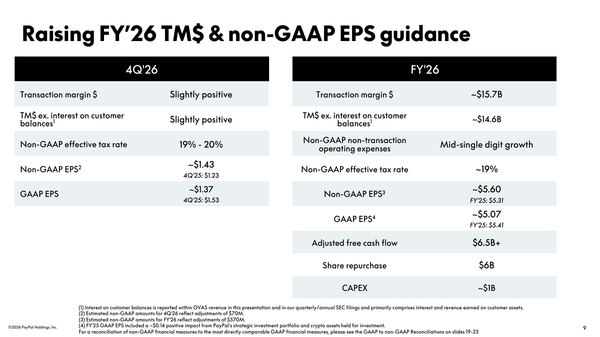
Non-GAAP EPS increased 8% to $1.45, while GAAP EPS fell 4% to $1.25. Non-GAAP operating income grew 3% to $1.61 billion, but GAAP operating income declined 8% to $1.40 billion. GAAP operating margin contracted 173 basis points to 16.3%.
Restructuring costs contributed to the pressure, reaching $178 million compared with just $1 million a year earlier. Those expenses reflect the ongoing transformation, but the financial payoff ultimately needs to extend beyond adjusted earnings. Investors need to see stronger operating performance as PayPal works through its restructuring.
Cash generation makes that test more urgent. Operating cash flow fell 19% to $1.59 billion, free cash flow declined 17% to $1.43 billion, and adjusted free cash flow dropped 10% to $2.05 billion. PayPal repurchased $1.5 billion of stock during the quarter, returning capital to shareholders while cash generation weakened.
Buybacks can support earnings per share by reducing the share count, but they cannot solve the underlying monetization problem. The more important measure of progress is whether PayPal can turn its growing transaction base into stronger operating income and cash flow. Until those figures improve, the higher EPS forecast carries more weight than the underlying business has yet demonstrated.
PYPL Needs $58 to Confirm Its Recovery
PayPal shares traded at $55.70 on October 28, hovering around the 20-day moving average near $55.74 and the 50-day average near $55.54. The stock has recovered from June’s lows around $41 and climbed toward $62 in August, but the subsequent pullback has left it struggling to extend that advance.
The immediate test is whether PYPL can hold the $55 area and reclaim $58, near the recent trading range’s upper boundary. A sustained move through $58 would put the shares back on firmer footing after the pullback and create room to challenge the $60 area. A break below $55, meanwhile, would signal that the recent recovery is losing support and could expose the stock to another decline toward the low-$50s.
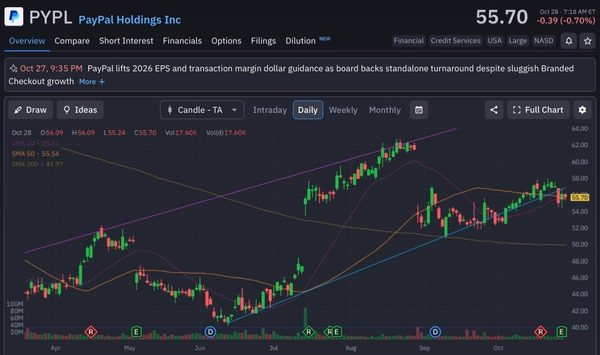
That makes the next move more than a chart question. PayPal has raised its earnings outlook, but the stock needs evidence that the upgrade reflects improving business economics rather than adjusted earnings alone. A move toward $60 would strengthen the bullish case for PYPL; sustained weakness below $55 would reinforce investor concerns about the gap between transaction growth and financial performance.
For PayPal, the next catalyst is proof that 6% payment-volume growth can produce more than 2% revenue growth. Until stronger monetization translates into better operating income and cash generation, the turnaround remains unfinished.