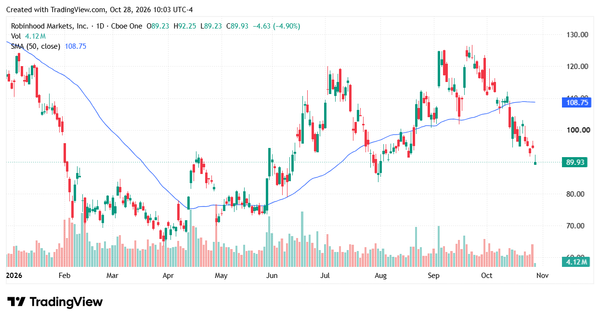
Robinhood Markets (NASDAQ: HOOD) is attracting more customer money and generating strong growth in options and prediction markets. Unfortunately, earnings aren’t so hot, even though parts of the report were strong.
For the quarter ended September 30, Robinhood earned 51 cents per share, down from 61 cents a year earlier. That fell below the 56-cent consensus. Revenue increased 12% to $1.42 billion, matching estimates. Net income attributable to Robinhood declined to $468 million from $556 million, a drop of roughly 16%. In short, Robinhood brought in more revenue, but less of it reached shareholders as profit.
There was also a shortfall in the business investors watch most closely. Transaction-based revenue rose 19% to $867 million, yet missed the $879 million estimate. The gap was relatively modest. Even so, it raised a bigger question: How much growth can the company deliver when one major trading category weakens?
Options and Prediction Markets Carry More Weight
There were clear signs that Robinhood’s customer base remains engaged. Options revenue climbed 31% to $399 million, while equities revenue increased 41% to $121 million. Those gains helped cushion the damage from weaker cryptocurrency trading.
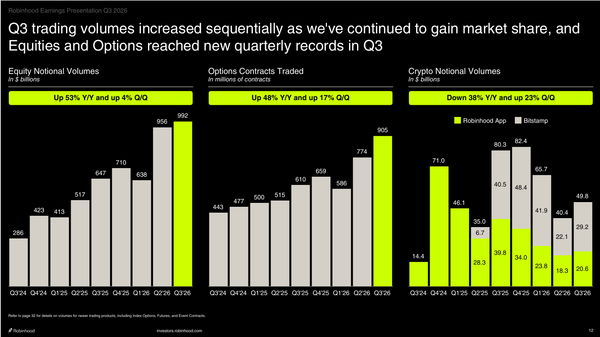
Prediction markets delivered especially strong growth, with event-contract revenue increasing more than 500% from a year earlier. These contracts let customers trade around specified outcomes. Their growth gives the company another way to generate transaction revenue and another reason for customers to remain active on its platform.
According to CNBC, CFO Shiv Verma said contracts tied to cryptocurrency price movements performed well during the quarter. That suggests customers can retain an interest in trading crypto-related outcomes even when direct cryptocurrency trading loses momentum.
For investors, this is an encouraging development. Robinhood has more ways to capture customer activity than it once did.
Crypto Remains a Meaningful Weak Spot
Cryptocurrency revenue fell 55% to $120 million, creating a substantial drag on the quarter.
That decline illustrates the challenge of building expectations around a business tied to investor enthusiasm. When customers become less willing to trade, revenue can retreat quickly.
The strength elsewhere matters because it prevented that weakness from overwhelming total revenue growth. But the earnings miss shows that offsetting a decline is different from delivering the results investors expected.
Other pressures also deserve attention. Robinhood reported operating expenses of $739 million, up 16% from a year earlier. Reported earnings included $67 million in unrealized losses, primarily associated with Robinhood Ventures Fund I.
Those details make the quarter more complicated than a simple story about slowing crypto activity. Investors should distinguish between changes in underlying operations and investment valuation swings when assessing future earnings.
Customer Deposits Offer a Longer-Term Signal
The most encouraging figure was the amount of fresh money entering the platform. Net deposits totaled $15.7 billion during the quarter. That represented a 17% annualized growth rate relative to platform assets at the end of the second quarter.
Over the preceding year, net deposits reached $71 billion, equivalent to 21% of platform assets at the end of the third quarter of 2025. Those figures matter because customer relationships can extend well beyond individual trades. A larger pool of assets creates opportunities for subscriptions, wealth management, and other services. Still, deposits are not revenue, and asset growth alone cannot guarantee higher profits. Robinhood must persuade customers to use additional products while managing the costs of serving them.
The next earnings report will help investors judge whether those relationships are becoming more valuable. Continued deposits would support the growth story. Stronger profitability would give that story more substance.
Robinhood Stock Faces Its Next Profitability Test
Robinhood has plenty to build on. Customers are bringing more money to the platform, and growth in options and prediction markets is helping absorb the crypto slowdown. The challenge now is making that broader business consistently more profitable.
For investors, the next test is whether Robinhood can grow earnings without relying on a rebound in cryptocurrency trading. If subscriptions, wealth management, and other services begin contributing more meaningfully to profits, the company could emerge from this slowdown on stronger footing. Until then, rising deposits are encouraging, but what Robinhood earns from those assets will matter more.