ajax loader

Loading...


Ride-the-Wave Strategy – Best for Stock Traders

Ride-the-Wave targets multi-day price momentum following a company’s earnings announcement (EA). With this strategy:

  1. Buy a stock one day post-EA if a stock reacts positively post-earnings:
    1. Near the close of trading the EA-day for a pre-market-EA
    2. Near the close of the following day for a post-market-EA
  2. Sell-to-close after 7-10 days, or possibly earlier if a desired price target is reached

Similarly,

  1. short a stock one day post-EA if a stock reacts negatively post-earnings:
    1. near the close of trading the EA-day for a premarket-EA
    2. near the close of the following day for a post-market-EA
  2. then buy-to-close after 7-10 days, or possibly earlier if a desired price target is reached

Important: Ride-the-Wave is predicated on significant price momentum triggered by an EA. The 7-10 day scenario is the maximum trade hold-time. If you see post EA-momentum is halted or reversed by a significant opposite move, re-evaluate your presence in the trade.

This popular StockEarnings screen below will give you a list of stocks that historically exhibit significant price momentum following an EA for the next seven days:

  1. Stocks exhibiting positive post-EA price moves are buy-candidates
  2. Stocks exhibiting negative post-EA price moves are sell/short-candidates

The screen includes those stocks whose Earnings just came out in last two days.

Screen criteria:

  1. Earnings Date Start Date : Current Date + -1 Day
  2. Earnings Date End Date : Current Date + -2 Days
  3. Predicted Move (Next Day) Max : 7%
  4. Predicted Move (On 7th Day) Min : 7%

Strategy Guideline:

  1. Buy the stock if stock has reacted positively. Short the stock if stock has reacted negatively (see above).
  2. Close the position in 7-10 days, or possibly earlier based on price move.

Volatility Crush Strategy - Best for Options Traders

The Volatility Crush strategy is used with stocks that typically experience relatively low-to-moderate price moves (≤4%) following their Earnings Announcements (EA). The basic trade idea is to sell put or call options right before the EA, collecting a credit when options premium is very high due to elevated implied volatility (IV). You then close the position right after the EA by buying the option back much cheaper due to the significant drop in IV that occurs after the mystery of the EA disappears. In assessing this trade, you need to do your homework to ensure you collect sufficient premium to make the trade worthwhile.

This trade is practical due to the low-to-moderate price-move after the EA, which generally won’t significantly affect the options price, unlike an “action” stock, which experience great price moves post-EA. With these symbols, if you’re on the right side of the price move, that’s a great thing. But if you’re on the wrong side of the move, not so great. Consequently, by minimizing the effect of the post-EA price move, you have a much better chance to profit from the reduction in IV without it being ruined by a violent price move.

For this trade, open the position either (1) the night before the EA when the company announces earnings or (2) during the EA day when it announces post-market, generally capturing IV at or close to its peak.

For this trade, open the position either (1) the night before the EA when the company announces earnings or (2) during the EA day when it announces post-market, generally capturing IV at or close to its peak.

This popular stockearnings screen will give you a list of stocks which do not react more than 4% fpost-EA. It includes only those stocks whose earnings are releasing next day.

Screen criteria:

  1. Earnings Date Start Date : Current Date + 1
  2. Earnings Date End Date : Current Date + 1
  3. Predicted Move (Next Day) Max : 4%
  4. Options Type: Weekly

Strategy Guideline:

  1. Options Strategy: Sell Call and Put
  2. Options Strike Price: Current Stock Price – (% Predicated Move x 2)
  3. Expiration Date: It should generally be the closest expiry immediately after the EA.
  4. Buy Insurance: Buying back Call and Put at Strike price which 10% lower than Sell Strike Price is optional but recommended.

Watch Video for More Detail

Volatility Rush Strategy - Best for Options Traders

The Volatility Rush takes advantage of increasing options premiums into earnings announcements (EA) caused by an anticipated rise in Implied Volatility (IV). With this strategy, Buy a Call and Put at-the-money (a long straddle) 2-3 weeks before the EA when IV is lower. Sell the position either (1) the night before the EA when the company announces earnings pre-market, or (2) during the EA day when it announces post-market, generally capturing IV at or close to its peak.

This popular screen will give you a list of stocks whose Options premiums tend to rise into Earnings. It includes only those stocks whose Earnings are at least two weeks away from today.

Screen criteria:

  1. Earnings Date Start Date : Current Date + 15 Days
  2. Earnings Date End Date : Current Date + 30 Days
  3. Predicted Move (Next Day) Min : 5%
  4. Options Type: Weekly or Monthly if that lines up with the two to three-week lead-time for entering the trade

Strategy Guideline:

  1. Buy a Straddle at or close to the money two to three weeks pre-EA.
  2. Sell the position either the night before the EA when the company announces earnings pre-market, or during the EA day when it announces post-market.
  3. Expiration date should generally be the closest expiry immediately after the EA.
  4. Straddle price should not be more 60% of predicted move.

Predicted Move (Volatility)

Similar to Implied Volatility in Options. Expected volatility % based on our Proprietary Volatility Predication Model. We are expecting that stock price will likely to reach % in either direction by the end of next trading session after Earnings are released and not necessarily the closing volatility %.

Why is it important?

    This indicator helps

  1. Knowing expected volatility in stocks after Earnings helps to decide trading stocks before Earnings Announcement.
  2. Taking Advantage of volatility collapse following Earnings Results by using Advance Options strategies such as Spread and Straddles.

Since Last Earnings

Change in share price since last Earnings release.

Why is it Important?

When share has gained more than 10% since it's last Earning release, it tends to over react to minor bad news and give up some gains if not all. So, it contains more downside volatility than upside When share has dropped more than 10% since it's last Earning release, it tends to over react to minor good news and recover some drops if not all. So, it contains more upside volatility than downside.

EPS Surprise (%)

Occurs when a company's reported quarterly or annual profits are above or below analysts' expectations. Here is the formula to derive % EPS Surprice:

Actual EPS - Estimated EPS
------------------------------------- x 100
Estimated EPS

Why is it Important?

Earnings surprises can have a huge impact on a company's stock price. Several studies suggest that positive earnings surprises not only lead to an immediate hike in a stock's price, but also to a gradual increase over time. Hence, it's not surprising that some companies are known for routinely beating earning projections. A negative earnings surprise will usually result in a decline in share price.

Next Day Price Change (%)

Next Regular trading session Closing price following Earnings result.

For After Market Close Earnings, It is a next trading day closing price. For Before Market Open Earnings, It is the same trading day closing price.

Why is it Important?

Next Day price change is a reaction of Earnings result.

PayPal Q2 Earnings: Two Markets, Two Valuations

Posted on Jul 29, 2026 by Grayson Cavern

PayPal Q2 Earnings: Two Markets, Two Valuations

PayPal Holdings Inc (NASDAQ: PYPL) second-quarter earnings arrived with adjusted EPS of $1.38 and total revenue of $8.68 billion, management raised its full-year outlook, and the company continued talking up its transformation strategy.

Three months ago, I argued Q1 “respectable” results weren’t enough to change my mind because the business was stabilizing faster than it was accelerating, and the market seemed to agree. 

This quarter, something changed.

Not because of the earnings. But because PayPal reportedly received an offer worth more than $53 billion and a $60.50-per-share takeover approach from a consortium led by Advent International and Stripe before rejecting it in favor of remaining independent. Suddenly, this isn’t just a debate between management and public shareholders over what PayPal is worth. There are sophisticated buyers willing to put real money behind a different answer.

The earnings will tell us whether management’s transformation is finally becoming visible in the numbers. The reported bid tells us someone already believes it is.

Cashflow Makes A Stronger Case


If Stripe and Advent did spend months evaluating PayPal, they weren’t buying a turnaround story. They were buying a cash-generating business they believed could become more valuable than the public market was willing to recognize.

This quarter gives them a case to make.

Total Payment Volume rose 10% year over year to $443.5 billion, transaction margin dollars increased 7% to $3.8 billion, and PayPal generated $1.8 billion in free cash flow during the quarter. The company also repurchased roughly $1.5 billion of its own shares while raising full-year guidance for both non-GAAP earnings per share and transaction margin dollar growth. It’s difficult to argue the business is fading when it’s still throwing off billions in cash and funding its own transformation in this fashion.

But there’s another side to the ledger.

Operating margin narrowed, transaction margin slipped to 44.9% from 46.4% a year ago, and profitability still isn’t expanding at the same pace as payment volume. That’s the same tension I pointed out after Q1. More payments alone don’t automatically create a more valuable business. The market wants proof that PayPal’s transformation can lift the economics of every transaction, not simply process more of them

Growth Needs Better Execution

One reason I wasn’t willing to own PayPal Holdings after last quarter was that the company’s transformation story remained largely theoretical. Management kept talking about branded checkout, Venmo, Braintree, and new commerce initiatives. However, the financial statements still looked like those of a mature payments company fighting for incremental growth rather than creating a new earnings engine. 

This quarter doesn’t completely erase that concern, but it does give the strategy more credibility.

Branded Checkout returned to healthier growth, Venmo continued expanding beyond peer-to-peer payments, and management is putting more emphasis on merchant services, advertising, in-store payments and AI-powered commerce. None of those businesses will transform PayPal overnight. Together, however, they point toward something larger: generating more revenue from each merchant and customer already inside its network instead of relying primarily on processing more payment volume.

That’s why you need to pay attention to the reported takeover.

See, Stripe isn’t trying to buy PayPal because it processes payments. Stripe already does that exceptionally well. If the reports are accurate, the attraction is more likely the combination of PayPal’s global consumer network, merchant relationships, Venmo ecosystem and cash-generation potential. Those are strategic assets that can become more valuable under the right execution… and exactly the kind of assets public markets often undervalue while focusing on quarterly growth rates.

Trend Finds New Direction

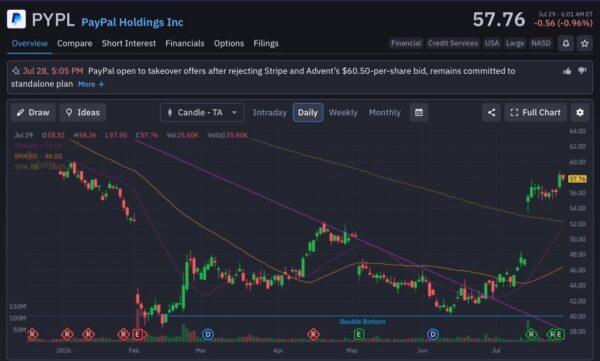
In the last quarter, I said PayPal’s chart looked “supported, not sponsored.” Buyers were willing to step in after earnings, but not with enough conviction to change the longer-term trend. 

Well, that is harder to defend now. PayPal has broken the downtrend that defined much of the past year, reclaimed its 20-day and 50-day moving averages, and is now trading comfortably above both while approaching its 200-day moving average. More importantly, the stock is making higher highs and higher lows instead of simply bouncing after earnings. That’s the kind of price structure that suggests institutions are accumulating positions rather than merely covering shorts.

There’s another detail that’s difficult to ignore. The stock is trading around the same level as the reported $60.50-per-share takeover approach. Whether a deal eventually materializes is almost beside the point. The reported bid has introduced a second reference point for valuation, one that’s no longer coming exclusively from public markets.

From the way I see it, investors are becoming more willing to give management the benefit of the doubt.
paypal-StockEarnings

Watch, Don’t Change

Three months ago, I argued that PayPal wasn’t a broken business, but one that hadn’t done enough to earn investors’ conviction. I don’t think this quarter completely overturns that view. That said, one thing has changed. PayPal is no longer just being judged by public shareholders. Reports that Stripe and Advent explored a roughly $60.50-per-share bid introduced a second opinion, and one from buyers with every incentive to value the business correctly. Private equity doesn’t pay premiums for nostalgia, and strategic buyers don’t spend months evaluating companies they believe are in terminal decline.

I’m still not ready to own PayPal today. But unlike last quarter, I’m also no longer comfortable dismissing it. If management can prove that its transformation translates into sustained margin expansion and stronger profitability, I’d be willing to revisit my thesis. For the first time in a while, PayPal has moved off my “avoid” list and onto my watchlist


Join over 1.2M+ investors/traders who receive daily and weekly notable earnings alerts with predicted move