Oracle’s fiscal 2026 earnings report answered one question and raised a much larger one. The numbers were recorded across almost every line that matters; revenue reached $67.4 billion, cloud infrastructure surged 77%, operating cash flow jumped 54% to $32 billion, and net income climbed 37% to $17.1 billion. Fourth-quarter earnings also showed revenue grew 21% to $19.2 billion, cloud revenue surged 47% to $9.9 billion, and EPS rose 21% to $1.45. By almost any conventional measure, this was the quarter that confirmed Oracle’s transformation from legacy software giant into a ginormous AI infrastructure contender.
Then management revealed the bill – $55.7 billion in capital expenditures during the fiscal year, negative free cash flow of $23.7 billion, $43 billion raised in new debt, and another $5 billion in equity – and the conversation shifted entirely away from the results and toward the cost of producing them.
Oracle Stopped Acting Like A Software Company
For decades, Oracle Corp (NYSE: ORCL) was one of the most legible businesses in enterprise technology; sell software, collect recurring revenue, generate predictable cash flows, return capital to shareholders. That model produced enormous wealth and an investor base conditioned to expect consistency over ambition. What I’m looking at now is categorically different, and the capital structure makes that plain without requiring any interpretation.
A software company operating inside its traditional boundaries does not spend $55.7 billion on infrastructure in a single fiscal year, does not push free cash flow deeply negative, and does not simultaneously raise about $50 billion in external capital unless the opportunity being pursued is large enough to justify restructuring the entire financial profile of the business to chase it. Oracle Corp (NYSE: ORCL) is racing to build capacity before demand overwhelms what it can currently deliver – and the spending reflects management’s read on the urgency of that race, not a loss of financial discipline.
The Number That Changes Everything Else In The Report
Every figure in the 2026 fiscal year and fourth quarter earnings release mattered, but none of them carried the weight of $638 billion – Oracle’s Remaining Performance Obligations, representing contracted future business the company has already secured but not yet recognized as revenue. The company generated $67.4 billion in revenue during fiscal 2026, and its backlog now stands at nearly ten times that amount, with $85 billion of new RPO added in a single quarter alone. To put that in the sharpest possible terms: Oracle added more contracted future business in three months than it generated in revenue across the entire fiscal year.
That figure reframes the capital expenditure conversation completely. The $55.7 billion being spent is not speculative infrastructure built in anticipation of demand that may or may not materialize – it is capacity being constructed against a backlog that already dwarfs the current business. Management added one more detail that I think matters more than most analysts gave it credit for: large AI customers are increasingly prepaying for capacity or providing their own GPUs, with those commitments now totaling $75 billion. Customers are not waiting for Oracle to build. They are actively funding the buildout. That tells you more about the conviction behind future demand than any forward guidance ever could.
The Selloff Was Always About Capital Allocation
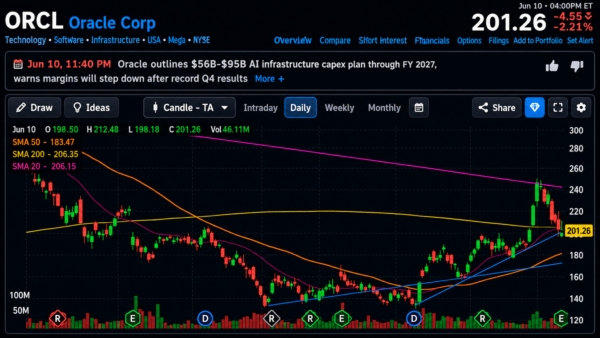
The stock’s reaction tells us exactly where investors became uncomfortable. Oracle entered earnings after a powerful run that carried shares from roughly $135 in April to nearly $250 in early June, a gain of more than 80% in just two months. Throughout that advance, the stock stayed firmly above its rising 20-day moving average and repeatedly found support near the 50-day moving average, signaling aggressive institutional accumulation rather than speculative buying.
Following the release, shares sold off from the $240-$250 area and briefly undercut the 20-day moving average, which now sits near $206. More importantly, buyers immediately showed up near the same zone where the rising trendline intersects with price. Even after the pullback, Oracle remains comfortably above its 50-day moving average at $183.47 and well above the longer-term uptrend that has been in place since April.
More than 46 million shares changed hands during the selloff, making it one of the heaviest trading sessions of the year. That’s significant because the market had every opportunity to punish the stock after management revealed plans to spend as much as $95 billion on AI infrastructure through fiscal 2027. Instead of collapsing through support, Oracle stabilized near the 200-day moving average around $206.
To me, that looks less like investors abandoning the AI story and more like investors recalibrating what they’re willing to pay for it. The market isn’t questioning whether Oracle can grow. Fourth-quarter cloud revenue already proved that. The market is questioning how much spending, borrowing, and near-term margin pressure should be tolerated before those investments begin showing up in future earnings.
As long as Oracle continues holding above the rising 50-day moving average and the broader trend structure remains in place, the selloff looks more like a reaction to the size of the investment plan than a verdict on the business itself.
The Rational Spending
Most earnings reactions focus on what a company accomplished in the period being reported. Oracle’s report redirected my attention entirely toward what management believes is coming, and the behavior of a company that expects demand to moderate does not look anything like this.
The stock sold off because the spending figures were genuinely enormous. But so is a backlog approaching two-thirds of a trillion dollars, and that figure is the one I keep returning to, because it explains why management is willing to spend at a pace that makes the rest of the market deeply uncomfortable.
When the backlog is ten times your annual revenue, uncomfortable spending starts to look like the only rational response.