ajax loader

Loading...


Ride-the-Wave Strategy – Best for Stock Traders

Ride-the-Wave targets multi-day price momentum following a company’s earnings announcement (EA). With this strategy:

  1. Buy a stock one day post-EA if a stock reacts positively post-earnings:
    1. Near the close of trading the EA-day for a pre-market-EA
    2. Near the close of the following day for a post-market-EA
  2. Sell-to-close after 7-10 days, or possibly earlier if a desired price target is reached

Similarly,

  1. short a stock one day post-EA if a stock reacts negatively post-earnings:
    1. near the close of trading the EA-day for a premarket-EA
    2. near the close of the following day for a post-market-EA
  2. then buy-to-close after 7-10 days, or possibly earlier if a desired price target is reached

Important: Ride-the-Wave is predicated on significant price momentum triggered by an EA. The 7-10 day scenario is the maximum trade hold-time. If you see post EA-momentum is halted or reversed by a significant opposite move, re-evaluate your presence in the trade.

This popular StockEarnings screen below will give you a list of stocks that historically exhibit significant price momentum following an EA for the next seven days:

  1. Stocks exhibiting positive post-EA price moves are buy-candidates
  2. Stocks exhibiting negative post-EA price moves are sell/short-candidates

The screen includes those stocks whose Earnings just came out in last two days.

Screen criteria:

  1. Earnings Date Start Date : Current Date + -1 Day
  2. Earnings Date End Date : Current Date + -2 Days
  3. Predicted Move (Next Day) Max : 7%
  4. Predicted Move (On 7th Day) Min : 7%

Strategy Guideline:

  1. Buy the stock if stock has reacted positively. Short the stock if stock has reacted negatively (see above).
  2. Close the position in 7-10 days, or possibly earlier based on price move.

Volatility Crush Strategy - Best for Options Traders

The Volatility Crush strategy is used with stocks that typically experience relatively low-to-moderate price moves (≤4%) following their Earnings Announcements (EA). The basic trade idea is to sell put or call options right before the EA, collecting a credit when options premium is very high due to elevated implied volatility (IV). You then close the position right after the EA by buying the option back much cheaper due to the significant drop in IV that occurs after the mystery of the EA disappears. In assessing this trade, you need to do your homework to ensure you collect sufficient premium to make the trade worthwhile.

This trade is practical due to the low-to-moderate price-move after the EA, which generally won’t significantly affect the options price, unlike an “action” stock, which experience great price moves post-EA. With these symbols, if you’re on the right side of the price move, that’s a great thing. But if you’re on the wrong side of the move, not so great. Consequently, by minimizing the effect of the post-EA price move, you have a much better chance to profit from the reduction in IV without it being ruined by a violent price move.

For this trade, open the position either (1) the night before the EA when the company announces earnings or (2) during the EA day when it announces post-market, generally capturing IV at or close to its peak.

For this trade, open the position either (1) the night before the EA when the company announces earnings or (2) during the EA day when it announces post-market, generally capturing IV at or close to its peak.

This popular stockearnings screen will give you a list of stocks which do not react more than 4% fpost-EA. It includes only those stocks whose earnings are releasing next day.

Screen criteria:

  1. Earnings Date Start Date : Current Date + 1
  2. Earnings Date End Date : Current Date + 1
  3. Predicted Move (Next Day) Max : 4%
  4. Options Type: Weekly

Strategy Guideline:

  1. Options Strategy: Sell Call and Put
  2. Options Strike Price: Current Stock Price – (% Predicated Move x 2)
  3. Expiration Date: It should generally be the closest expiry immediately after the EA.
  4. Buy Insurance: Buying back Call and Put at Strike price which 10% lower than Sell Strike Price is optional but recommended.

Watch Video for More Detail

Volatility Rush Strategy - Best for Options Traders

The Volatility Rush takes advantage of increasing options premiums into earnings announcements (EA) caused by an anticipated rise in Implied Volatility (IV). With this strategy, Buy a Call and Put at-the-money (a long straddle) 2-3 weeks before the EA when IV is lower. Sell the position either (1) the night before the EA when the company announces earnings pre-market, or (2) during the EA day when it announces post-market, generally capturing IV at or close to its peak.

This popular screen will give you a list of stocks whose Options premiums tend to rise into Earnings. It includes only those stocks whose Earnings are at least two weeks away from today.

Screen criteria:

  1. Earnings Date Start Date : Current Date + 15 Days
  2. Earnings Date End Date : Current Date + 30 Days
  3. Predicted Move (Next Day) Min : 5%
  4. Options Type: Weekly or Monthly if that lines up with the two to three-week lead-time for entering the trade

Strategy Guideline:

  1. Buy a Straddle at or close to the money two to three weeks pre-EA.
  2. Sell the position either the night before the EA when the company announces earnings pre-market, or during the EA day when it announces post-market.
  3. Expiration date should generally be the closest expiry immediately after the EA.
  4. Straddle price should not be more 60% of predicted move.

Predicted Move (Volatility)

Similar to Implied Volatility in Options. Expected volatility % based on our Proprietary Volatility Predication Model. We are expecting that stock price will likely to reach % in either direction by the end of next trading session after Earnings are released and not necessarily the closing volatility %.

Why is it important?

    This indicator helps

  1. Knowing expected volatility in stocks after Earnings helps to decide trading stocks before Earnings Announcement.
  2. Taking Advantage of volatility collapse following Earnings Results by using Advance Options strategies such as Spread and Straddles.

Since Last Earnings

Change in share price since last Earnings release.

Why is it Important?

When share has gained more than 10% since it's last Earning release, it tends to over react to minor bad news and give up some gains if not all. So, it contains more downside volatility than upside When share has dropped more than 10% since it's last Earning release, it tends to over react to minor good news and recover some drops if not all. So, it contains more upside volatility than downside.

EPS Surprise (%)

Occurs when a company's reported quarterly or annual profits are above or below analysts' expectations. Here is the formula to derive % EPS Surprice:

Actual EPS - Estimated EPS
------------------------------------- x 100
Estimated EPS

Why is it Important?

Earnings surprises can have a huge impact on a company's stock price. Several studies suggest that positive earnings surprises not only lead to an immediate hike in a stock's price, but also to a gradual increase over time. Hence, it's not surprising that some companies are known for routinely beating earning projections. A negative earnings surprise will usually result in a decline in share price.

Next Day Price Change (%)

Next Regular trading session Closing price following Earnings result.

For After Market Close Earnings, It is a next trading day closing price. For Before Market Open Earnings, It is the same trading day closing price.

Why is it Important?

Next Day price change is a reaction of Earnings result.

The Defense-Space Convergence: 3 Stocks In The New Military Space Race

Posted on Jun 09, 2026 by Grayson Cavern

The Defense-Space Convergence: 3 Stocks In The New Military Space Race

For centuries, military power followed a familiar path. Nations fought to control territory, then sea lanes, then the skies above them. Each shift created new winners, new technologies, and new industries. Today, another transition is taking shape, except this time the battlefield sits in space.

That may sound dramatic until you consider how modern conflicts are fought. Satellites help guide missiles, coordinate troops, support drone operations, and provide the intelligence commanders rely on before making decisions. 

That’s why I think investors are still looking at this sector through the wrong lens. The next space race isn’t primarily about tourism, moon landings, or colonizing Mars. It’s about building the systems that allow nations to launch faster, see farther, and act sooner than their rivals. That said, these 3 stocks top my list:

Rocket Lab:The Company Building The Roads Into Orbit


Every satellite, missile-warning system, communications platform, and intelligence network begins with the same question: how does it get into orbit in the first place?

That’s where Rocket Lab (NASDAQ: RKLB) enters the story.

The first thing that comes to most investors’ minds when they hear Rocket Lab is “launch provider”. That term is limiting. Rocket Lab is now morphing into a vertically integrated space and defense contractor, one that launches satellites, manufactures critical components, develops spacecraft, and continues winning larger government programs.

Its recent $816 million missile-warning satellite contract is a perfect example. Governments aren’t awarding contracts of that size because they need rockets, or bragging rights of space landing. They’re awarding them because they need infrastructure. In fact, the company also reported record 2026 quarter 1 revenue of $200 million and a record backlog of $2.2 billion, providing a glimpse into how rapidly demand is expanding across both commercial and defense markets.

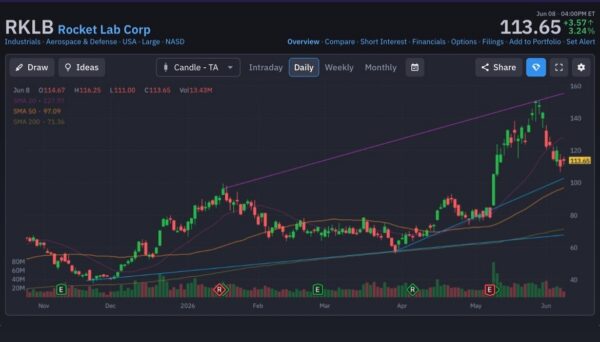
Rocket Lab shares spiked from $60 in April to nearly $150 before pulling back, a move that naturally invited profit-taking after one of the strongest rallies anywhere in aerospace. Yet even after the correction, the stock remains comfortably above its 50-day moving average near $97 and its 200-day moving average near $71. The recent decline looks dramatic when viewed in isolation. Viewed in context, it looks more like investors digesting gains while the underlying business continues accumulating contracts.

Infrastructure might not always be the most exciting part of a military system, but it’s often the most important.
space-StockEarnings

Planet Labs: The Company Building The Eyes

Getting assets into orbit solves one problem. But knowing what’s happening on Earth creates the next advantage.

Military history is filled with examples of armies losing battles because they lacked information. Today the challenge isn’t collecting information. It’s collecting it fast enough to matter. That’s why you’d find Planet Labs PBC (NYSE:PL) an interesting choice.

The company operates one of the largest Earth-observation satellite networks in existence, generating imagery and data that governments use for border surveillance, infrastructure monitoring, military analysis, disaster response, and intelligence gathering. Roughly 60% of revenue comes from defense-related customers, which makes Planet less of a traditional space company and more of an intelligence platform operating from orbit.

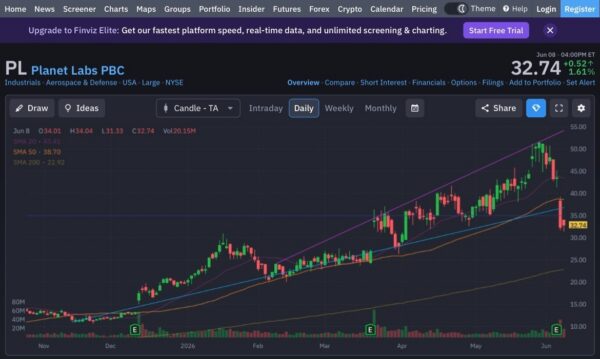
Its Q1 fiscal 2027 earnings’ numbers support that view. Revenue climbed 42% to $94.2 million, management raised guidance, and backlog surpassed $900 million. Yet despite those results, the stock suffered a sharp pullback. That took me aback until I looked into what happened before the selloff.

Shares had climbed from under $20 to more than $50 in only a few months, transforming Planet into one of the market’s hottest space names. Investors weren’t paying for a strong business anymore. They were paying for flawless execution. When expectations reach those levels, even good news can trigger selling.

What I find encouraging is where the stock stabilized. Despite the decline, shares remain well above their 200-day moving average, while the broader uptrend remains intact. The market appears to be resetting expectations rather than questioning the long-term opportunity.

If Rocket Lab is building the roads into orbit, Planet is building the eyes.
space-StockEarnings

BlackSky: Turning Information Into Advantage

Information alone doesn’t create military superiority, what you do with it, the interpretation, does. Take a satellite image, for example. Having such an image, and most importantly, knowing what it means before anyone else does can be the difference between getting attacked or being proactive enough to stop it dead in its tracks, which is a real warfare advantage. That’s the role BlackSky Technology Inc (NYSE: BKSY) occupies.

The company combines satellite imagery, AI-powered analytics, and real-time intelligence tools designed to help governments make decisions faster. In many ways, BlackSky sits at the final layer of the military-space stack. Rocket Lab launches the infrastructure. Planet collects the information. BlackSky transforms information into actionable intelligence.

That distinction matters because governments ultimately aren’t just buying pictures but answers.

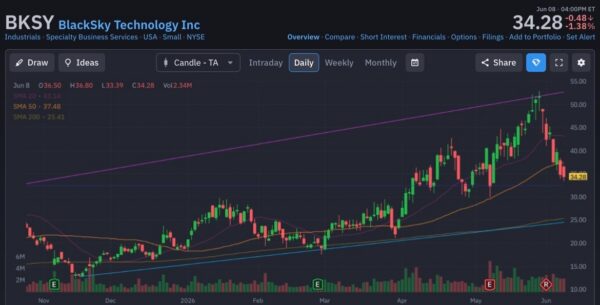
The company generated $20.8 million in quarterly revenue, raised guidance, secured contracts worth up to $160 million, and continues deploying its next-generation Gen-3 satellite constellation. Meanwhile, the stock surged toward $50 before retreating into the mid-$30s as profit-taking spread across the sector.

Yet the longer-term chart remains constructive. Shares continue trading above their 200-day moving average near $25, suggesting investors are reassessing expectations rather than abandoning the thesis altogether. The market may be debating growth rates. But governments are focused on intelligence advantages.
space-StockEarnings

The New Arms Race Is Already Underway

Rocket Lab is helping build the infrastructure. Planet Labs is gathering the information. BlackSky is turning information into intelligence. Three companies. Three layers of the same military-space system. Indicating that the next military race may not be decided by who has the biggest army, the largest navy, or the most advanced aircraft. But by who launches first, sees first, and understands first.

These companies are positioning themselves at every step of that chain, as I am.

Join over 1.2M+ investors/traders who receive daily and weekly notable earnings alerts with predicted move