ajax loader

Loading...


Ride-the-Wave Strategy – Best for Stock Traders

Ride-the-Wave targets multi-day price momentum following a company’s earnings announcement (EA). With this strategy:

  1. Buy a stock one day post-EA if a stock reacts positively post-earnings:
    1. Near the close of trading the EA-day for a pre-market-EA
    2. Near the close of the following day for a post-market-EA
  2. Sell-to-close after 7-10 days, or possibly earlier if a desired price target is reached

Similarly,

  1. short a stock one day post-EA if a stock reacts negatively post-earnings:
    1. near the close of trading the EA-day for a premarket-EA
    2. near the close of the following day for a post-market-EA
  2. then buy-to-close after 7-10 days, or possibly earlier if a desired price target is reached

Important: Ride-the-Wave is predicated on significant price momentum triggered by an EA. The 7-10 day scenario is the maximum trade hold-time. If you see post EA-momentum is halted or reversed by a significant opposite move, re-evaluate your presence in the trade.

This popular StockEarnings screen below will give you a list of stocks that historically exhibit significant price momentum following an EA for the next seven days:

  1. Stocks exhibiting positive post-EA price moves are buy-candidates
  2. Stocks exhibiting negative post-EA price moves are sell/short-candidates

The screen includes those stocks whose Earnings just came out in last two days.

Screen criteria:

  1. Earnings Date Start Date : Current Date + -1 Day
  2. Earnings Date End Date : Current Date + -2 Days
  3. Predicted Move (Next Day) Max : 7%
  4. Predicted Move (On 7th Day) Min : 7%

Strategy Guideline:

  1. Buy the stock if stock has reacted positively. Short the stock if stock has reacted negatively (see above).
  2. Close the position in 7-10 days, or possibly earlier based on price move.

Volatility Crush Strategy - Best for Options Traders

The Volatility Crush strategy is used with stocks that typically experience relatively low-to-moderate price moves (≤4%) following their Earnings Announcements (EA). The basic trade idea is to sell put or call options right before the EA, collecting a credit when options premium is very high due to elevated implied volatility (IV). You then close the position right after the EA by buying the option back much cheaper due to the significant drop in IV that occurs after the mystery of the EA disappears. In assessing this trade, you need to do your homework to ensure you collect sufficient premium to make the trade worthwhile.

This trade is practical due to the low-to-moderate price-move after the EA, which generally won’t significantly affect the options price, unlike an “action” stock, which experience great price moves post-EA. With these symbols, if you’re on the right side of the price move, that’s a great thing. But if you’re on the wrong side of the move, not so great. Consequently, by minimizing the effect of the post-EA price move, you have a much better chance to profit from the reduction in IV without it being ruined by a violent price move.

For this trade, open the position either (1) the night before the EA when the company announces earnings or (2) during the EA day when it announces post-market, generally capturing IV at or close to its peak.

For this trade, open the position either (1) the night before the EA when the company announces earnings or (2) during the EA day when it announces post-market, generally capturing IV at or close to its peak.

This popular stockearnings screen will give you a list of stocks which do not react more than 4% fpost-EA. It includes only those stocks whose earnings are releasing next day.

Screen criteria:

  1. Earnings Date Start Date : Current Date + 1
  2. Earnings Date End Date : Current Date + 1
  3. Predicted Move (Next Day) Max : 4%
  4. Options Type: Weekly

Strategy Guideline:

  1. Options Strategy: Sell Call and Put
  2. Options Strike Price: Current Stock Price – (% Predicated Move x 2)
  3. Expiration Date: It should generally be the closest expiry immediately after the EA.
  4. Buy Insurance: Buying back Call and Put at Strike price which 10% lower than Sell Strike Price is optional but recommended.

Watch Video for More Detail

Volatility Rush Strategy - Best for Options Traders

The Volatility Rush takes advantage of increasing options premiums into earnings announcements (EA) caused by an anticipated rise in Implied Volatility (IV). With this strategy, Buy a Call and Put at-the-money (a long straddle) 2-3 weeks before the EA when IV is lower. Sell the position either (1) the night before the EA when the company announces earnings pre-market, or (2) during the EA day when it announces post-market, generally capturing IV at or close to its peak.

This popular screen will give you a list of stocks whose Options premiums tend to rise into Earnings. It includes only those stocks whose Earnings are at least two weeks away from today.

Screen criteria:

  1. Earnings Date Start Date : Current Date + 15 Days
  2. Earnings Date End Date : Current Date + 30 Days
  3. Predicted Move (Next Day) Min : 5%
  4. Options Type: Weekly or Monthly if that lines up with the two to three-week lead-time for entering the trade

Strategy Guideline:

  1. Buy a Straddle at or close to the money two to three weeks pre-EA.
  2. Sell the position either the night before the EA when the company announces earnings pre-market, or during the EA day when it announces post-market.
  3. Expiration date should generally be the closest expiry immediately after the EA.
  4. Straddle price should not be more 60% of predicted move.

Predicted Move (Volatility)

Similar to Implied Volatility in Options. Expected volatility % based on our Proprietary Volatility Predication Model. We are expecting that stock price will likely to reach % in either direction by the end of next trading session after Earnings are released and not necessarily the closing volatility %.

Why is it important?

    This indicator helps

  1. Knowing expected volatility in stocks after Earnings helps to decide trading stocks before Earnings Announcement.
  2. Taking Advantage of volatility collapse following Earnings Results by using Advance Options strategies such as Spread and Straddles.

Since Last Earnings

Change in share price since last Earnings release.

Why is it Important?

When share has gained more than 10% since it's last Earning release, it tends to over react to minor bad news and give up some gains if not all. So, it contains more downside volatility than upside When share has dropped more than 10% since it's last Earning release, it tends to over react to minor good news and recover some drops if not all. So, it contains more upside volatility than downside.

EPS Surprise (%)

Occurs when a company's reported quarterly or annual profits are above or below analysts' expectations. Here is the formula to derive % EPS Surprice:

Actual EPS - Estimated EPS
------------------------------------- x 100
Estimated EPS

Why is it Important?

Earnings surprises can have a huge impact on a company's stock price. Several studies suggest that positive earnings surprises not only lead to an immediate hike in a stock's price, but also to a gradual increase over time. Hence, it's not surprising that some companies are known for routinely beating earning projections. A negative earnings surprise will usually result in a decline in share price.

Next Day Price Change (%)

Next Regular trading session Closing price following Earnings result.

For After Market Close Earnings, It is a next trading day closing price. For Before Market Open Earnings, It is the same trading day closing price.

Why is it Important?

Next Day price change is a reaction of Earnings result.

Apple (AAPL) Just Pulled Off a Coup Without Firing a (CapEx) Shot

Posted on Jun 10, 2026 by Chris Markoch

Apple (AAPL) Just Pulled Off a Coup Without Firing a (CapEx) Shot

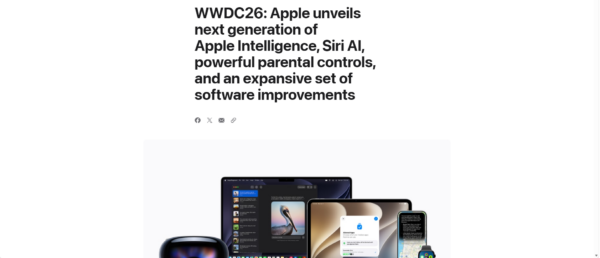
Apple Inc. (NASDAQ: AAPL) hosted its latest Worldwide Developer Conference (WWDC) on June 8. The event was seen as the moment when the company would finally deliver an artificial intelligence (AI) strategy that would bring its storied past into the future. 

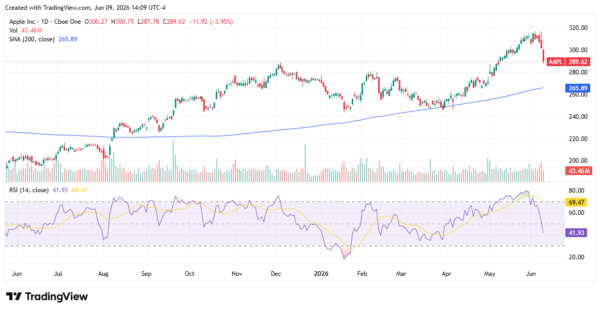
At first glance, investors aren’t buying it. AAPL stock is down about 7.5% the day after the event.  

I get it. For many years, the story of Apple hinged on one new product after another. First, the iPhone, then the iPad, the Apple Watch, and on and on. Each one brought with a rapid base of loyalists (yours truly among them).  

And yes, it’s not fair to write an article about Apple that dismisses the fact that the company hasn’t had much by way of whiz-bang technology lately. But that misses the point. Apple has evolved, but it’s following a similar, if modified, playbook. 

In the past, the playbook for Apple was to wait for companies to do something. Then take the core learnings and make something better. But that was always done with the backing of a massive total addressable market that lived within the company’s walled garden.  

It’s that last part that investors may be missing. AAPL’s intrinsic value isn’t in its hardware or services. It’s in its customer base. That’s the overlay for everything that happened at the WWDC. 

A Reimagined Siri 


One of the most anticipated moments from the conference was what Apple was going to do about Siri. Apple’s assistant has been the butt of a decade’s worth of jokes. However, Apple has rebuilt Siri from scratch.  

The new Siri is a dedicated app with conversational memory, multi-step task handling, and deep hooks into every core application on your iPhone. However, it comes with a caveat. That is, it runs on Google Gemini. 

Apple, the company that built its brand on privacy, just handed its AI infrastructure to one of its oldest rivals. The irony is hard to overstate and also hard to price. It also comes with regulatory blowback. EU users won’t see the new Siri this fall, blocked by the Digital Markets Act before launch day. 
aapl - StockEarnings

Where Apple is Pulling Off a Coup 

Investors should be focused on services. Every AI feature announced ties back to subscriptions and iCloud+, Apple’s highest-margin business. And with iOS 27 supporting devices as far back as the iPhone 11 but reserving the full AI experience for newer hardware, Apple has handed over a billion existing users the most compelling upgrade argument in years. 

However, the story has more layers to come. Specifically, the reimagined Siri, if it lives up to its billing, will be provided for free on every new Apple device…for a price. That’s not-so-stealth monetization of AI that many companies can’t match and comes without the capex spend that is essential for many of its big tech brethren.   

Putting Child Safety First 

Apple is known for taking a “measure twice, cut once” approach to product development. When it comes to the twin issues of AI and child safety, there’s no amount of checks and balances that should be overlooked.  

The safety features that Apple has put in place put the parent first and foremost. At a time when many social media companies are in the crosshairs of regulators, this is a feature that shouldn’t be overlooked.  

Many families are Apple families. That means children will be part of any upgrade cycle. This can help parents introduce their children to AI with greater confidence that they will avoid the darker side of the technology.  

The AAPL Chart Shows the Opportunity 

AAPL had priced in a strong developer conference since the company reported earnings on April 30. It’s not surprising that investors would be in a sell-first move after the report, which didn’t come with an obvious revenue driver.  

It didn’t help that Apple’s WWDC happened at a time when investors are becoming jittery about stock growth in a higher-for-longer interest rate environment. Momentum could stay on the side of the bears. 

But the analyst’s reaction since the report has been bullish. Many price targets have come in at levels significantly above the consensus price target of around $314. It’s significant to note that on June 5, the Friday before the WWDC, Dan Ives of Wedbush reiterated his Outperform rating and $400 price target for AAPL.  
aapl - StockEarnings

Where the Bull Case Could Stall 

The upgrade supercycle thesis only works if the new Siri actually works. Apple has made this promise before — and underdelivered. If the Gemini integration produces an assistant that’s still slower, clunkier, or less capable than what users can get directly from Google or OpenAI, the narrative falls apart fast. There’s no loyalty tax that survives a bad product. 

The privacy angle is also a live wire. Apple’s premium brand has always carried an implicit promise: we’re not Google. That promise is now more of a pinkie promise. If data-handling details around the Gemini partnership surface in ways that make users uncomfortable, the backlash will reach Apple’s core base.  

Speaking of that base, upgrading to an iPhone 16 or 17 to unlock the full AI experience is a discretionary purchase in an environment where consumers are already stretched. It’s too early to tell how a higher-for-longer rate environment will pair with a supercycle that depends on discretionary spending. 

Apple Is At an Inflection Point

Apple didn’t walk onto the WWDC stage with a ChatGPT moment. It walked on with something arguably more durable: a distribution strategy. A billion-plus users, the highest-margin services business in big tech, and a monetization model that doesn’t require building a data center. 

The Google Gemini partnership raises real questions about privacy, about brand differentiation, and about what Apple actually controls in its own AI stack. But investors who are selling AAPL off a 7.5% post-conference dip may be pricing in a company that’s fallen behind when the evidence suggests it’s simply playing a different game. The bull case isn’t gone. It’s just contingent on execution, on consumer appetite, and on whether the new Siri is finally worth the wait. 

A former marketing copywriter turned freelance financial writer and market analyst. I have a passion for delivering insights to investors. I write regularly about stocks for StockEarnings and MarketBeat. Posts are not advice.

Join over 1.2M+ investors/traders who receive daily and weekly notable earnings alerts with predicted move