How does a company operating mostly in towns with fewer than 20,000 people process 800 million transactions a year?
Casey’s General Stores (NASDAQ: CASY) gave investors another reason to ask that question after reporting a strong fiscal fourth quarter and fiscal year 2026. Fourth-quarter revenue climbed to $4.57 billion while diluted EPS surged 66% to $4.37. For the full fiscal year, revenue reached a record $17.56 billion and diluted EPS climbed to $19.16. On the surface, it looked like another strong earnings report. Yet the figures that kept pulling my attention weren’t revenue or earnings. They were buried elsewhere: 2,944 stores, nearly 10.5 million rewards members, and roughly 800 million annual transactions generated largely from communities many national retailers have spent decades ignoring.
The Company That Built Where Others Didn’t
Most retailers spent the last few decades chasing population growth. Bigger cities meant more customers, more traffic, and more opportunities to scale. Casey’s took a different path, building store after store across smaller communities where competition was often thinner and customer relationships tended to run deeper.
Today, approximately two-thirds of Casey’s stores are located in towns with populations of 20,000 people or less. That’s an astonishing statistic when you stop and think about it. A company concentrated in rural America has built a footprint large enough to support 10.5 million rewards members and generate 800 million annual transactions. Those aren’t the characteristics of a niche regional retailer. They’re the characteristics of a business operating at a scale most investors don’t immediately associate with Casey’s.
The footprint itself is only part of the story. Supporting nearly 2,944 stores across 19 states requires infrastructure, and Casey’s spent years building it. Three distribution centers now supply roughly 70% of in-store products and approximately 60% of fuel. Long before management started talking about loyalty programs, prepared foods, and digital ordering, the company was laying the foundation that would allow those initiatives to scale efficiently across thousands of locations.
It’s no surprise why the Fourth-quarter net income jumped to $162.7 million from $98.3 million a year ago, while EBITDA climbed to $350.3 million. For the full fiscal year, net income reached $714.4 million and EBITDA climbed to a record $1.48 billion. Casey’s also ended the year with $523 million in cash, repurchased $200.5 million worth of shares during fiscal 2026, and increased its buyback authorization to $1 billion. All of which indicates how productive this network has become.
Why Pizza Keeps Showing Up In The Numbers
The easiest explanation for Casey’s success is pizza.Yes, their breakfast pizza is undefeatable. But the problem is that pizza alone doesn’t explain 800 million transactions.
What pizza does explain is customer behavior.
Prepared-food and fountain same-store sales increased 6.6% during the fourth quarter. More importantly, prepared-food margins expanded to 59.5% from 57.8% a year earlier. A business many investors still categorize as a convenience-store operator is generating restaurant-like margins from one of its fastest-growing categories.
Fuel remains important. Total fuel gallons sold increased 3.6%, same-store fuel gallons rose 1.5%, and fuel gross profit surged 29.1% to $397.4 million. Fuel margins averaged 46.9 cents per gallon. Strong numbers, certainly.
That’s why the pizza moat argument, while simplistic, contains a grain of truth.
People don’t drive across town because they’re emotionally attached to a gallon of gasoline. They absolutely drive across town for food they enjoy. Casey’s pizza has become something of a destination product throughout many of the communities the company serves, creating a reason for customers to choose Casey’s even when competing convenience stores are nearby.
The rest of the inside-store business tells a similar story. Fourth-quarter inside same-store sales increased 5.5%, while inside gross profit climbed 10.5% to $643.4 million. Even more encouraging, inside margin expanded to 42.4% from 41.2% a year ago.
Every one of those figures points in the same direction. Customers aren’t simply stopping at Casey’s, they’re also spending more once they arrive.
Investors Are Now Catching On
The good news is, the market is beginning to appreciate what management has built.
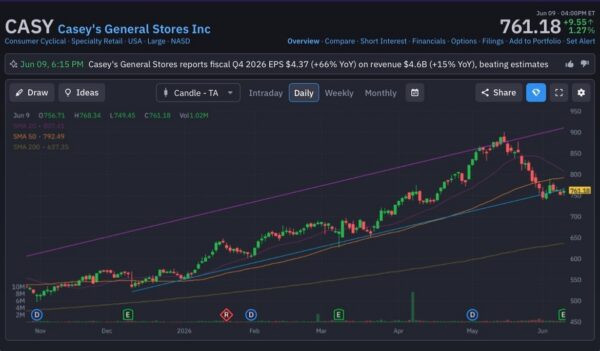
Over the past year, shares climbed from roughly $500 to nearly $900 before entering a consolidation phase that pulled the stock back toward the mid-$700s. Strong stocks often pause after major advances, especially when investors lock in gains following a powerful run. What matters is what happens next.
Casey’s never came close to breaking its longer-term uptrend. Shares remained comfortably above the 200-day moving average near $637 while repeatedly attracting buyers during periods of weakness. The 50-day moving average continues to trend above the 200-day moving average, reinforcing the broader bullish structure, and volume following earnings reflected investors responding positively to another quarter of strong execution rather than searching for an exit.
That reaction makes sense. Revenue is growing. Net income is growing faster. Margins are expanding. Higher-value categories continue gaining traction. Meanwhile, the network supporting all of it remains extraordinarily difficult to replicate.
The Asset Most Investors Are Still Undervaluing
While Pizza attracts attention because it’s easy to understand, the network requires more work.
Yet one appears far more valuable than the other.
Casey’s spent decades building a footprint few competitors could realistically recreate today. This quarter and fiscal year offered another reminder that the company is becoming increasingly effective at monetizing that advantage. The bulls are happy with this.