When Oracle Corp (NYSE: ORCL) reported its Q4 and fiscal year 2026 results in June, the company gave investors a set of numbers that looked almost too large to process, with full-year revenue reaching $67.4 billion, cloud infrastructure revenue surging 77%, and remaining performance obligations climbing to $638 billion.
However, the market fixated on the other side of the equation, where Oracle spent $55.7 billion on capital expenditures, produced -$23.7 billion in free cash flow and raised $43 billion in new debt as it raced to build the infrastructure required to service its AI customers.
My problem is, Oracle had more future business on its books than it could recognize as revenue, yet fulfilling that required a level of spending that pushed the company’s cash flow into negative territory.
Now Q1 puts the spotlight on what happens between those two numbers.
The $638 Billion Question
Oracle’s $638 billion RPO gives investors a reason to look beyond the next quarter, but it also creates a much higher bar for the business because management now has to convert those commitments into revenue while carrying the infrastructure bill required to fulfill them.
That scale of backlog could make even a veteran investor anxious about the coming report. Oracle added $85 billion of new RPO in one quarter, which means the company keeps signing future business at a rate that can overwhelm the numbers appearing in its current income statement.
But how much of that backlog can Oracle recognize over the next few quarters? That is where investors could get caught looking at the wrong number.
A huge RPO number can make the future look almost guaranteed. The business still has to build the capacity, deploy the infrastructure and turn those contracts into actual revenue and cash. Q1 gives us another piece of that conversion story.
Oracle’s Debt Is The Part I Wouldn’t Brush Aside
The $43 billion in new debt from fiscal 2026 becomes critical when you put it beside the company’s $55.7 billion in capital expenditures and -$23.7 billion in free cash flow.
Oracle has chosen to finance an AI infrastructure race before the full economic payoff arrives, and that creates a very different risk profile from the Oracle many of us knew a few years ago.
According to the management, that risk is inevitable. Large AI customers have already prepaid for capacity or supplied their own GPUs, with those commitments reaching $75 billion. That makes the debt argument more complicated than just saying Oracle borrowed too much. Customers are helping fund the buildout because they want the capacity.
Still, debt has to get serviced. Capital has to earn a return. And free cash flow has to recover.
If Q1 shows revenue growth accelerating without a corresponding improvement in the cash economics, I would have a much harder time treating the financing burden as a temporary cost of expansion.
The Trap Could Be Expecting Another AI Explosion
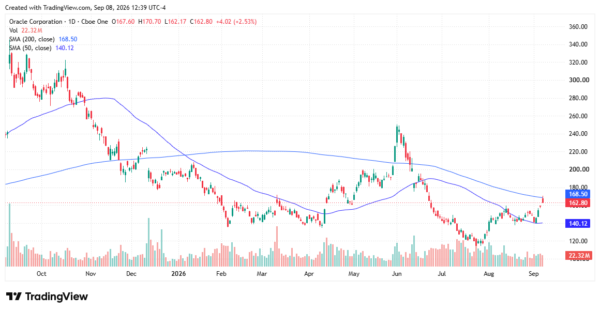
We already know Oracle has an AI story. The stock ran from about $135 in April to nearly $250 in June, and that move showed just how much enthusiasm the market could attach to the company’s AI opportunity before the June earnings report.
The mistake now would be assuming that another strong AI headline automatically means ORCL should move higher.
What happens if Oracle delivers strong cloud growth but investors decide the spending required to produce that growth has become too expensive? Or if the RPO keeps climbing but the market wants to see more of it recognized as revenue?
My biggest red flag would be a combination of weaker-than-expected cloud momentum and continued pressure on cash flow. That would give me a reason to question whether Oracle can fund this expansion without leaning harder on external capital.
On the other hand, another strong step in cloud growth, continued RPO expansion and evidence that customer commitments are reducing Oracle’s funding burden would strengthen my conviction.
ORCL Is In A Much Different Position
Oracle closed September 4 at $158.78, with the chart showing the stock above its 20-day moving average at $148.31 and 50-day moving average at $139.84, while the 200-day moving average sits at $168.78.
That puts ORCL below its long-term average but above the two shorter-term averages, after the stock fell from the June area near $250 toward the July low around $115.
The technical setup leaves us with a clear battle zone. A strong earnings reaction that pushes ORCL through the 200-day average would put the stock back above a major trend reference after months of repair. A failure around that level would keep the longer-term downtrend in play. The fundamental and technical stories clash here.
Oracle has spent the past quarter building the financial machinery behind a huge AI bet. Now the market gets to see whether the numbers coming out of that machinery are starting to justify the cost of building it.
Conversion…All I Ask For
As I wrote back in June, the $638 billion in RPO was the number that changed everything for me, because it showed that customers were committing to the infrastructure before Oracle finished building it. But the next leg of that thesis needs evidence.
If Oracle starts turning that backlog into stronger revenue and cash generation, the market has a much better reason to look past the debt and capex. If it cannot, the same numbers that made the AI opportunity exciting could become the numbers investors use against the stock.