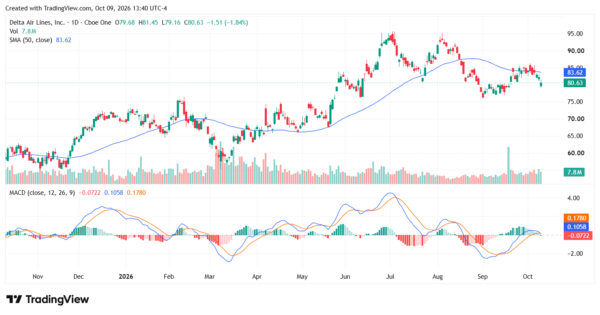
Delta Air Lines (NYSE: DAL) has a problem that higher ticket prices haven’t been able to solve: a soaring fuel bill. Travelers are still booking flights. Premium seats remain popular. And revenue continues to climb. But the airline is spending so much more on fuel that even those strengths aren’t enough to protect its earnings outlook.
Just this morning, Delta lowered its full-year adjusted profit forecast to between $5.10 and $5.60 per share, down from the $6.50 to $7.50 it projected in July. It also reduced its free cash flow forecast to $2.5 billion, compared with expectations for as much as $4 billion.
Travelers Aren’t Backing Away
The encouraging part of Delta’s latest update is that customers haven’t stopped spending.
According to CEO Ed Bastian, demand remains healthy across business and leisure travel, different destinations, and all cabin categories. That matters because airlines facing sharply higher expenses have limited options. They can raise fares, adjust capacity, find savings, or accept lower profits.
Delta has been increasing ticket prices, and customers have continued to book. That suggests travel remains a priority for many consumers, even as getting from one place to another becomes more expensive. Businesses also appear willing to keep employees traveling.
Fuel Is Taking a Bigger Bite
Delta is dealing with an approximately $6 billion increase in fuel costs this year, according to Bastian. That is a substantial hurdle, even for a large airline. The figures help to explain the pressure. U.S. Gulf Coast jet fuel prices reached $4.34 per gallon on Thursday, compared with $2.19 a year earlier. In other words, prices have nearly doubled.
The surge associated with the Iran war has created a difficult situation across the airline industry. Carriers can charge more for seats, but fuel expenses can rise faster than those fare increases flow through their results.
Revenue Rose, but Earnings Fell
For the third quarter, Delta reported adjusted revenue of $17.59 billion, slightly below the $17.67 billion Wall Street expected. Adjusted earnings came in at $1.72 per share, compared with expectations for $1.75. Those were relatively small misses. The year-over-year decline in reported profit was more substantial. Net income fell 47% to $756 million, or $1.15 per share, from $1.42 billion, or $2.17 per share, a year earlier.
Meanwhile, adjusted revenue increased 16%, and total operating revenue climbed 21% to $20.19 billion. The takeaway is straightforward: Delta is bringing in more money, but keeping less of it as profit.
One encouraging development is the continued strength of Delta’s premium business. Third-quarter premium revenue increased 18% to $6.82 billion, edging past main cabin revenue of $6.8 billion, which grew 12%.
It also supports Delta’s emphasis on attracting customers who value additional comfort and service. However, premium demand doesn’t eliminate exposure to fuel prices. Those passengers may generate more revenue, but the aircraft still needs fuel regardless of where everyone is sitting.
Delta also has an unusual advantage through its refinery in Trainer, Pennsylvania. The facility helps offset some fuel pressure, although the reduced earnings outlook makes clear that it cannot fully insulate the business.
What Matters from Here
Delta expects fourth-quarter revenue to rise approximately 20% from a year earlier, suggesting that strong sales momentum could continue. The bigger test is whether those additional dollars translate into stronger profits.
Investors should watch fuel prices, booking trends, premium demand, and Delta’s ability to recover costs through fares. The lower cash flow forecast deserves attention, too, because it leaves less financial flexibility.
Delta’s customer demand remains encouraging, but the earnings reset shows the limits of pricing power. For the stock, a more convincing improvement would come when healthy bookings and revenue growth are accompanied by steadier costs and better profitability. Until then, full planes tell only part of the story.