Neurogene (NASDAQ: NGNE) has had a difficult few months, but JPMorgan (NYSE: JPM) believes the biotechnology company could have substantial upside as it advances an experimental gene therapy for Rett syndrome.
The firm just initiated coverage with an Overweight rating and a $60 price target, suggesting roughly 132% upside from Wednesday’s closing price. Analyst Priyanka Grover’s optimism centers on NGN-401, a potential one-time treatment that could become an important option for patients with the rare genetic disorder.
With shares down nearly 32% over the past three months, the call gives investors a reason to take another look. However, the investment case depends on something much more meaningful than a stock market rebound: whether Neurogene can turn encouraging clinical progress into an approved treatment.
NGN-401 Targets the Root Cause of Rett Syndrome
Rett syndrome primarily affects girls and can change a child’s development dramatically. After an initial period of apparently typical development, children may lose communication abilities, purposeful hand movements, and other motor skills. Walking difficulties, seizures, and breathing problems can also occur.
Nearly all cases involve mutations in the MECP2 gene, which provides instructions for making a protein important to brain development and function. When that protein is missing or does not work properly, the consequences can be severe.
For families, the impact extends into almost every part of daily life. That helps explain why researchers are pursuing treatments aimed at the underlying biology of the disorder.
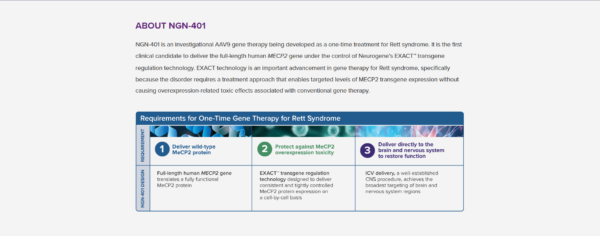
Neurogene’s NGN-401 is designed to deliver a functional copy of the MECP2 gene. The goal is to help cells produce the working protein patients need.
Neurogene’s Gene Therapy Takes a Controlled Approach
Gene therapy sounds straightforward in theory: deliver working genetic instructions to address a problem. In practice, getting the amount of protein right can be difficult. That challenge is particularly important here because producing too much MeCP2 can also be harmful.
Neurogene’s EXACT technology is designed to regulate expression of the delivered gene, limiting excessive protein production. NGN-401 is administered through an intracerebroventricular procedure, which delivers the therapy into fluid-filled spaces in the brain. It is being developed as a one-time treatment.
2027 Could Be a Make-or-Break Year for NGNE Stock
The next major chapter is expected in the second half of 2027, when Neurogene anticipates releasing topline results from its Embolden registrational trial. The company has completed dosing 25 participants in that study. A registrational trial is intended to generate evidence supporting a potential application for regulatory approval.
Earlier findings provide a reason for optimism. In its June update, Neurogene reported that all 10 participants in its Phase 1/2 analysis gained at least one developmental milestone and improved on a clinician-rated assessment. Participants gained 47 milestones collectively, with follow-up extending through 30 months.
Those results are encouraging, but a small early study cannot settle every question. Investors will want to see whether the next dataset reinforces the apparent benefits and supports a favorable balance between effectiveness and risk. That makes 2027 a potential turning point. Strong results could strengthen confidence in the program. Disappointing findings could undermine the investment case.
Neurogene Has Cash to Reach Its Next Major Catalyst
Clinical progress gets the headlines, but funding determines whether a biotechnology company can keep moving toward its goals.
Neurogene reported second-quarter research and development expenses of $25.5 million, up from $19.4 million a year earlier. The increase reflected spending on NGN-401 development, including clinical and manufacturing activities.
Following its July financing, the company reported approximately $360.2 million in pro forma cash, cash equivalents, and short-term investments. Management expected those resources to fund planned operations into the first quarter of 2029. That projected runway extends beyond the anticipated 2027 results. It gives investors a clearer view of how the company expects to finance its next major milestone, although spending needs and timelines can change.
Can NGNE Reclaim Its 200-Day Average?
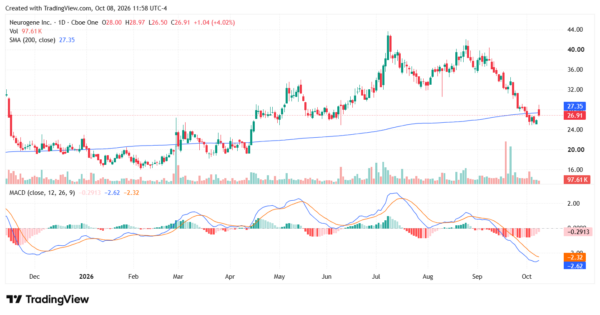
Neurogene stock remains in a technical downtrend after falling from around $40 in September to a recent low near $25. However, NGNE rebounded to $26.91 on Oct. 8, putting the stock just below its 200-day simple moving average at $27.35.
That level is now an important test: a sustained move above the 200-day average could signal that selling pressure is easing and put the $30-$32 area back in focus. A failure to reclaim the moving average would leave support around $25, followed by the low-$20s area.
The MACD remains bearish, with both the MACD and signal lines below zero, although the recent histogram suggests downside momentum may be moderating. Overall, the chart is still cautious, but a breakout above the 200-day moving average would materially improve the technical setup.