ajax loader

Loading...


Ride-the-Wave Strategy – Best for Stock Traders

Ride-the-Wave targets multi-day price momentum following a company’s earnings announcement (EA). With this strategy:

  1. Buy a stock one day post-EA if a stock reacts positively post-earnings:
    1. Near the close of trading the EA-day for a pre-market-EA
    2. Near the close of the following day for a post-market-EA
  2. Sell-to-close after 7-10 days, or possibly earlier if a desired price target is reached

Similarly,

  1. short a stock one day post-EA if a stock reacts negatively post-earnings:
    1. near the close of trading the EA-day for a premarket-EA
    2. near the close of the following day for a post-market-EA
  2. then buy-to-close after 7-10 days, or possibly earlier if a desired price target is reached

Important: Ride-the-Wave is predicated on significant price momentum triggered by an EA. The 7-10 day scenario is the maximum trade hold-time. If you see post EA-momentum is halted or reversed by a significant opposite move, re-evaluate your presence in the trade.

This popular StockEarnings screen below will give you a list of stocks that historically exhibit significant price momentum following an EA for the next seven days:

  1. Stocks exhibiting positive post-EA price moves are buy-candidates
  2. Stocks exhibiting negative post-EA price moves are sell/short-candidates

The screen includes those stocks whose Earnings just came out in last two days.

Screen criteria:

  1. Earnings Date Start Date : Current Date + -1 Day
  2. Earnings Date End Date : Current Date + -2 Days
  3. Predicted Move (Next Day) Max : 7%
  4. Predicted Move (On 7th Day) Min : 7%

Strategy Guideline:

  1. Buy the stock if stock has reacted positively. Short the stock if stock has reacted negatively (see above).
  2. Close the position in 7-10 days, or possibly earlier based on price move.

Volatility Crush Strategy - Best for Options Traders

The Volatility Crush strategy is used with stocks that typically experience relatively low-to-moderate price moves (≤4%) following their Earnings Announcements (EA). The basic trade idea is to sell put or call options right before the EA, collecting a credit when options premium is very high due to elevated implied volatility (IV). You then close the position right after the EA by buying the option back much cheaper due to the significant drop in IV that occurs after the mystery of the EA disappears. In assessing this trade, you need to do your homework to ensure you collect sufficient premium to make the trade worthwhile.

This trade is practical due to the low-to-moderate price-move after the EA, which generally won’t significantly affect the options price, unlike an “action” stock, which experience great price moves post-EA. With these symbols, if you’re on the right side of the price move, that’s a great thing. But if you’re on the wrong side of the move, not so great. Consequently, by minimizing the effect of the post-EA price move, you have a much better chance to profit from the reduction in IV without it being ruined by a violent price move.

For this trade, open the position either (1) the night before the EA when the company announces earnings or (2) during the EA day when it announces post-market, generally capturing IV at or close to its peak.

For this trade, open the position either (1) the night before the EA when the company announces earnings or (2) during the EA day when it announces post-market, generally capturing IV at or close to its peak.

This popular stockearnings screen will give you a list of stocks which do not react more than 4% fpost-EA. It includes only those stocks whose earnings are releasing next day.

Screen criteria:

  1. Earnings Date Start Date : Current Date + 1
  2. Earnings Date End Date : Current Date + 1
  3. Predicted Move (Next Day) Max : 4%
  4. Options Type: Weekly

Strategy Guideline:

  1. Options Strategy: Sell Call and Put
  2. Options Strike Price: Current Stock Price – (% Predicated Move x 2)
  3. Expiration Date: It should generally be the closest expiry immediately after the EA.
  4. Buy Insurance: Buying back Call and Put at Strike price which 10% lower than Sell Strike Price is optional but recommended.

Watch Video for More Detail

Volatility Rush Strategy - Best for Options Traders

The Volatility Rush takes advantage of increasing options premiums into earnings announcements (EA) caused by an anticipated rise in Implied Volatility (IV). With this strategy, Buy a Call and Put at-the-money (a long straddle) 2-3 weeks before the EA when IV is lower. Sell the position either (1) the night before the EA when the company announces earnings pre-market, or (2) during the EA day when it announces post-market, generally capturing IV at or close to its peak.

This popular screen will give you a list of stocks whose Options premiums tend to rise into Earnings. It includes only those stocks whose Earnings are at least two weeks away from today.

Screen criteria:

  1. Earnings Date Start Date : Current Date + 15 Days
  2. Earnings Date End Date : Current Date + 30 Days
  3. Predicted Move (Next Day) Min : 5%
  4. Options Type: Weekly or Monthly if that lines up with the two to three-week lead-time for entering the trade

Strategy Guideline:

  1. Buy a Straddle at or close to the money two to three weeks pre-EA.
  2. Sell the position either the night before the EA when the company announces earnings pre-market, or during the EA day when it announces post-market.
  3. Expiration date should generally be the closest expiry immediately after the EA.
  4. Straddle price should not be more 60% of predicted move.

Predicted Move (Volatility)

Similar to Implied Volatility in Options. Expected volatility % based on our Proprietary Volatility Predication Model. We are expecting that stock price will likely to reach % in either direction by the end of next trading session after Earnings are released and not necessarily the closing volatility %.

Why is it important?

    This indicator helps

  1. Knowing expected volatility in stocks after Earnings helps to decide trading stocks before Earnings Announcement.
  2. Taking Advantage of volatility collapse following Earnings Results by using Advance Options strategies such as Spread and Straddles.

Since Last Earnings

Change in share price since last Earnings release.

Why is it Important?

When share has gained more than 10% since it's last Earning release, it tends to over react to minor bad news and give up some gains if not all. So, it contains more downside volatility than upside When share has dropped more than 10% since it's last Earning release, it tends to over react to minor good news and recover some drops if not all. So, it contains more upside volatility than downside.

EPS Surprise (%)

Occurs when a company's reported quarterly or annual profits are above or below analysts' expectations. Here is the formula to derive % EPS Surprice:

Actual EPS - Estimated EPS
------------------------------------- x 100
Estimated EPS

Why is it Important?

Earnings surprises can have a huge impact on a company's stock price. Several studies suggest that positive earnings surprises not only lead to an immediate hike in a stock's price, but also to a gradual increase over time. Hence, it's not surprising that some companies are known for routinely beating earning projections. A negative earnings surprise will usually result in a decline in share price.

Next Day Price Change (%)

Next Regular trading session Closing price following Earnings result.

For After Market Close Earnings, It is a next trading day closing price. For Before Market Open Earnings, It is the same trading day closing price.

Why is it Important?

Next Day price change is a reaction of Earnings result.

Cloudflare (NET) Offers a Relative Safe Haven Amid Broader Market Weakness

Posted on Mar 12, 2026 by Joshua Enomoto

Cloudflare (NET) Offers a Relative Safe Haven Amid Broader Market Weakness

Cloudflare (NYSE: NET) is emerging as a potential relative safe haven at a time when broader market signals are turning more fragile. Earlier this month (March 4 to be exact), I stated that the benchmark SPDR S&P 500 ETF Trust (NYSEARCA: SPY) flashed an ominous quantitative signal. Essentially, in the trailing 10 weeks, the SPY ETF had printed seven up weeks, which you would ordinarily deem as an optimistic framework. However, the overall slope from beginning to end was negative, thereby creating what I call a 7-3-D sequence: seven up, three down, downward slope.

It’s not so much that there’s something inherently problematic about this signal in the abstract. Statistically, though, this pattern is extremely rare, having only materialized a handful of times over the last several years. What’s more, when this signal flashes, the end result tends to be negative for the SPY.

And so far, that’s exactly what we’re seeing. Since the close of March 4, the benchmark ETF has lost roughly 2.5%. The significance here is not so much about the raw performance loss but the overall trend. Due to the rising inferno stemming from the Iran war and its implications for global economic stability, the SPY could be the canary in the coal mine.

Still, not all sectors may be due for a steep correction. If I had to be bullish on a sector right now, I’d take a long look at cybersecurity, especially names like Cloudflare. Headquartered in San Francisco, California, Cloudflare provides a range of internet services, including content delivery network services and cloud cybersecurity.

Fundamentally, these specialties should see rising relevance given Iran’s cybersecurity capabilities. Also, the Iranian strategy isn’t focused on mano-a-mano warfare but rather asymmetric attacks. The bottom line is that no country is going to attack the U.S. head-on. Instead, the point here is to make the war economically unsustainable for the Americans.

That puts U.S. business interests at great risk of cyberattacks, driving relevance for NET stock. Not only that, it appears the smart money has the same idea.

Volatility Skew Goes Bimodal for NET Stock


Easily one of the most important options-related screeners to consider is volatility skew. By definition, the skew identifies implied volatility (IV) — or a stock’s potential range of motion — across the strike price spectrum of a given options chain. In effect, the screener showcases the surface-area distortion of volatility space, allowing retail traders to understand the smart money’s risk positioning.

If you think about it this way, if sentiment were perfectly neutral for NET stock, the skew would be completely flat. However, the market for popular securities is never like that. Most market participants — especially institutional investors — are worried about downside movements. As such, they may buy put options, which act as an insurance product against corrections.

On the flipside, other participants are worried about missing upside opportunities. In that case, you will likely see traders pay a heftier premium for call options. In turn, the skew on the right-hand side (toward higher strike prices) may rise, suggesting that the smart money is positioning for upside convexity.

What makes NET stock rather unique is that its skew is bimodal. From the starting gun, put IV rises higher and higher toward the left-hand side (toward lower strikes). This setup indicates a prioritization of mitigating downside volatility. However, on the other end, call IV also rises toward the right-hand side. Here, the structure suggests that traders simultaneously don’t want to miss out on any rallies.

It’s worth reminding ourselves that the smart money isn’t smart because it’s prescient. This skew reflects the point. It’s obvious that even the most sophisticated players are unsure of where NET stock may head next. But despite the volatility concerns, these folks also don’t want to miss out on a potential sustained rally.

Using the Inductive Approach to Trade Cloudflare Stock

While the smart money may not know where NET stock may go next (hence the bimodal skew), a nagging question remains: is there a way to deduce this information? From a purely mathematical sense, the answer is no. Nothing about the current state of affairs necessarily compels a future outcome. However, what we can do is to reasonably infer an outcome.

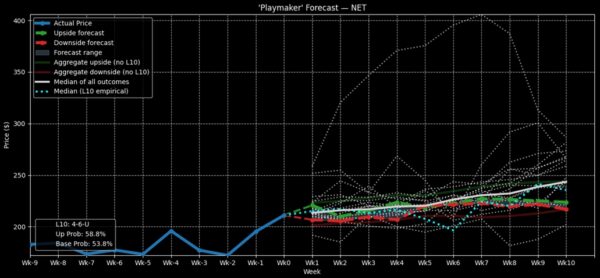
Essentially, we’re going to rely on pattern recognition. Here’s the deal. In the past 10 weeks, Cloudflare stock printed only four up weeks, but the overall slope was positive. This market structure creates a rare 4-6-U sequence. As alluded to earlier, there’s nothing special in the abstract about this sequence. However, it’s a distinct signal — and statistically, this setup should yield a distinct distribution.
Cloudflare - StockEarnings

It’s just like baseball. For many players, the batting average fluctuates depending on whether there are runners in scoring position. Some players simply rise to the occasion and their situational batting average reflects this reality. It’s the same principle (I believe) in the equities market.

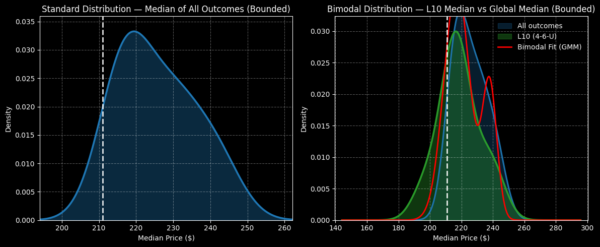
Under 4-6-U conditions, NET stock would have a tendency to land between $175 and $262. To be fair, probability density is expected to peak at around $218 on a median basis. However, this data encompasses an approximation from all examples of the 4-6-U sequence. Fundamentally, I speculate that the current circumstance of the Iran war offers an unusual catalyst.

We’re facing a potential paradigm-shifting event that could impose long-standing economic consequences. Further, U.S. business interests will be prime targets for Iranian asymmetric attacks. Given this framework, I don’t think adding some Kentucky windage is a bad idea.

Identifying a Specific Trading Idea

For aggressive speculators, the one idea that I find appealing is the 240/250 bull call spread expiring May 15. This wager requires NET stock to rise through the $250 strike at expiration to be fully profitable. If it does, the maximum payout (at time of writing) comes out to nearly 120%. Breakeven lands at $244.55, helping to somewhat improve probabilistic credibility.
Cloudflare - StockEarnings

There’s no doubt that this trade features a thin wing, meaning that the window of profitability is narrow. In order for this trade to work, we would be aiming for the security’s high point (which flashed on Halloween). While an aggressive target, the combo of fundamental and quantitative evidence arguably makes NET stock intriguing.


Joshua Enomoto is a seasoned financial writer with a strong track record of in-depth stock analysis, offering clear, insightful commentary for retail investors across all levels of expertise. Renowned for his ability to blend analytical rigor with engaging wit, Joshua's work has been featured on leading investment platforms, including TipRanks, InvestorPlace, Barchart, Benzinga, and Fintel. He was also handpicked to spearhead high-impact initiatives such as InvestorPlace's "Trade of the Day" and Benzinga’s ETF coverage. As a frequent guest expert for CGTN America, Joshua discusses a wide range of economic, societal, and consumer market trends. A graduate of U.C. San Diego, Joshua brings a thoughtful and fresh perspective to complex financial narratives, helping enterprise clients connect with their audiences. He also composes music in his spare time.

Join over 1.2M+ investors/traders who receive daily and weekly notable earnings alerts with predicted move