ajax loader

Loading...


Ride-the-Wave Strategy – Best for Stock Traders

Ride-the-Wave targets multi-day price momentum following a company’s earnings announcement (EA). With this strategy:

  1. Buy a stock one day post-EA if a stock reacts positively post-earnings:
    1. Near the close of trading the EA-day for a pre-market-EA
    2. Near the close of the following day for a post-market-EA
  2. Sell-to-close after 7-10 days, or possibly earlier if a desired price target is reached

Similarly,

  1. short a stock one day post-EA if a stock reacts negatively post-earnings:
    1. near the close of trading the EA-day for a premarket-EA
    2. near the close of the following day for a post-market-EA
  2. then buy-to-close after 7-10 days, or possibly earlier if a desired price target is reached

Important: Ride-the-Wave is predicated on significant price momentum triggered by an EA. The 7-10 day scenario is the maximum trade hold-time. If you see post EA-momentum is halted or reversed by a significant opposite move, re-evaluate your presence in the trade.

This popular StockEarnings screen below will give you a list of stocks that historically exhibit significant price momentum following an EA for the next seven days:

  1. Stocks exhibiting positive post-EA price moves are buy-candidates
  2. Stocks exhibiting negative post-EA price moves are sell/short-candidates

The screen includes those stocks whose Earnings just came out in last two days.

Screen criteria:

  1. Earnings Date Start Date : Current Date + -1 Day
  2. Earnings Date End Date : Current Date + -2 Days
  3. Predicted Move (Next Day) Max : 7%
  4. Predicted Move (On 7th Day) Min : 7%

Strategy Guideline:

  1. Buy the stock if stock has reacted positively. Short the stock if stock has reacted negatively (see above).
  2. Close the position in 7-10 days, or possibly earlier based on price move.

Volatility Crush Strategy - Best for Options Traders

The Volatility Crush strategy is used with stocks that typically experience relatively low-to-moderate price moves (≤4%) following their Earnings Announcements (EA). The basic trade idea is to sell put or call options right before the EA, collecting a credit when options premium is very high due to elevated implied volatility (IV). You then close the position right after the EA by buying the option back much cheaper due to the significant drop in IV that occurs after the mystery of the EA disappears. In assessing this trade, you need to do your homework to ensure you collect sufficient premium to make the trade worthwhile.

This trade is practical due to the low-to-moderate price-move after the EA, which generally won’t significantly affect the options price, unlike an “action” stock, which experience great price moves post-EA. With these symbols, if you’re on the right side of the price move, that’s a great thing. But if you’re on the wrong side of the move, not so great. Consequently, by minimizing the effect of the post-EA price move, you have a much better chance to profit from the reduction in IV without it being ruined by a violent price move.

For this trade, open the position either (1) the night before the EA when the company announces earnings or (2) during the EA day when it announces post-market, generally capturing IV at or close to its peak.

For this trade, open the position either (1) the night before the EA when the company announces earnings or (2) during the EA day when it announces post-market, generally capturing IV at or close to its peak.

This popular stockearnings screen will give you a list of stocks which do not react more than 4% fpost-EA. It includes only those stocks whose earnings are releasing next day.

Screen criteria:

  1. Earnings Date Start Date : Current Date + 1
  2. Earnings Date End Date : Current Date + 1
  3. Predicted Move (Next Day) Max : 4%
  4. Options Type: Weekly

Strategy Guideline:

  1. Options Strategy: Sell Call and Put
  2. Options Strike Price: Current Stock Price – (% Predicated Move x 2)
  3. Expiration Date: It should generally be the closest expiry immediately after the EA.
  4. Buy Insurance: Buying back Call and Put at Strike price which 10% lower than Sell Strike Price is optional but recommended.

Watch Video for More Detail

Volatility Rush Strategy - Best for Options Traders

The Volatility Rush takes advantage of increasing options premiums into earnings announcements (EA) caused by an anticipated rise in Implied Volatility (IV). With this strategy, Buy a Call and Put at-the-money (a long straddle) 2-3 weeks before the EA when IV is lower. Sell the position either (1) the night before the EA when the company announces earnings pre-market, or (2) during the EA day when it announces post-market, generally capturing IV at or close to its peak.

This popular screen will give you a list of stocks whose Options premiums tend to rise into Earnings. It includes only those stocks whose Earnings are at least two weeks away from today.

Screen criteria:

  1. Earnings Date Start Date : Current Date + 15 Days
  2. Earnings Date End Date : Current Date + 30 Days
  3. Predicted Move (Next Day) Min : 5%
  4. Options Type: Weekly or Monthly if that lines up with the two to three-week lead-time for entering the trade

Strategy Guideline:

  1. Buy a Straddle at or close to the money two to three weeks pre-EA.
  2. Sell the position either the night before the EA when the company announces earnings pre-market, or during the EA day when it announces post-market.
  3. Expiration date should generally be the closest expiry immediately after the EA.
  4. Straddle price should not be more 60% of predicted move.

Predicted Move (Volatility)

Similar to Implied Volatility in Options. Expected volatility % based on our Proprietary Volatility Predication Model. We are expecting that stock price will likely to reach % in either direction by the end of next trading session after Earnings are released and not necessarily the closing volatility %.

Why is it important?

    This indicator helps

  1. Knowing expected volatility in stocks after Earnings helps to decide trading stocks before Earnings Announcement.
  2. Taking Advantage of volatility collapse following Earnings Results by using Advance Options strategies such as Spread and Straddles.

Since Last Earnings

Change in share price since last Earnings release.

Why is it Important?

When share has gained more than 10% since it's last Earning release, it tends to over react to minor bad news and give up some gains if not all. So, it contains more downside volatility than upside When share has dropped more than 10% since it's last Earning release, it tends to over react to minor good news and recover some drops if not all. So, it contains more upside volatility than downside.

EPS Surprise (%)

Occurs when a company's reported quarterly or annual profits are above or below analysts' expectations. Here is the formula to derive % EPS Surprice:

Actual EPS - Estimated EPS
------------------------------------- x 100
Estimated EPS

Why is it Important?

Earnings surprises can have a huge impact on a company's stock price. Several studies suggest that positive earnings surprises not only lead to an immediate hike in a stock's price, but also to a gradual increase over time. Hence, it's not surprising that some companies are known for routinely beating earning projections. A negative earnings surprise will usually result in a decline in share price.

Next Day Price Change (%)

Next Regular trading session Closing price following Earnings result.

For After Market Close Earnings, It is a next trading day closing price. For Before Market Open Earnings, It is the same trading day closing price.

Why is it Important?

Next Day price change is a reaction of Earnings result.

Forget NVIDIA: 3 Stocks Riding AI’s Exploding Energy Demand

Posted on Jun 17, 2026 by Grayson Cavern

Forget NVIDIA: 3 Stocks Riding AI’s Exploding Energy Demand

Maybe you don’t understand the scope of what we are dealing with yet. In 2025 alone, data centers consumed electricity at nearly six times the pace of global power demand. Still, the International Energy Agency expects consumption to reach 945 terawatt-hours by 2030 – a figure larger than Japan’s entire annual electricity consumption today. Just as one AI campus could consume as much electricity as 5 million households.

But you see, every new AI model requires servers, those servers require electricity, and that electricity must be generated, transmitted, distributed, and cooled before a single query ever reaches a user. Thus, creating bottlenecks across the power grid, the transformer market, the electrical equipment industry, and the cooling infrastructure sector. Forget the chip story everyone else is chasing and you’d see that the opportunity sitting here is golden, especially when you consider these 3 stocks.

Quanta Services Is Building The Highways Electricity Travels On


Electricity generated hundreds of miles away carries no value if it never reaches the data center consuming it. This is why utilities across the country are racing to expand transmission networks, modernize aging infrastructure, and physically connect growing AI power demand to the grid. Quanta (NYSE: PWR) sits at the epicenter of that buildout.

Quanta’s 2026 first quarter earnings show exactly how much work is already flowing into the pipeline. Revenue climbed to $7.87 billion from $6.23 billion a year earlier, net income increased to $220.6 million from $144.3 million, and adjusted EPS jumped to $2.68 from $1.78. Most importantly, backlog reached a record $48.5 billion. That figure is impossible to ignore because a company doesn’t accumulate $48.5 billion of future work on the hope that AI demand might eventually materialize. Utilities and large-load customers are committing real capital to infrastructure projects years before the facilities they’re building toward ever go operational.

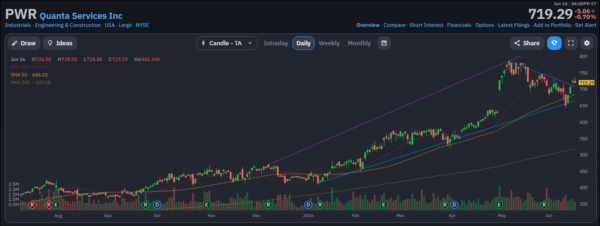
The chart confirms the same conviction. Shares recently traded at $719.29, above the 20-day moving average of $708.84, the 50-day at $686.02, and the 200-day at $520.18. The stock corrected from nearly $780, found support at the 50-day average, and has begun rebuilding momentum on healthy volume as buyers continue defending higher lows. The grid itself may become one of the largest beneficiaries of the entire AI cycle, and Quanta remains one of the cleanest ways to own that exposure directly.
AI-StockEarnings

Powell Industries Controls The Power Once It’s Inside The Building

Getting electricity to a facility solves only half the problem, because once it arrives, that power has to be routed, managed, protected, and distributed throughout the building without interruption. The problem is, data centers cannot tolerate voltage instability or equipment failure at any point in that chain. Every rack, server cluster, and cooling system depends on sophisticated electrical infrastructure operating quietly behind the scenes, and that infrastructure is Powell (NYSE: POWL) entire business.

Powell’s 2nd quarter fiscal 2026 shows revenue increased 6% to $296.6 million, gross profit climbed to $87.9 million, new orders reached $490 million, and backlog expanded to approximately $1.8 billion. On top of that, Powell announced a single data-center order exceeding $400 million, surpassing the company’s entire quarterly revenue in one award. Projects of that magnitude indicate that customers are committing billions toward facilities that require enormous, dedicated electrical capacity from day one.

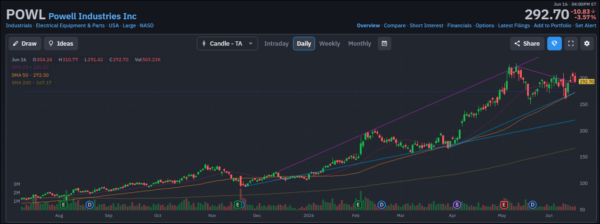
Powell now trades at $292.70, above the 20-day moving average of $286.83, the 50-day at $272.50, and the 200-day at $167.17. The stock pulled back from May highs near $330, stabilized directly at the 50-day average, and continues respecting a long-term uptrend now running more than a year. Investors gravitate toward chips because chips are visible and easy to picture. 

Data centers spend billions on electrical systems that almost nobody watches, and Powell sits directly inside that overlooked spending cycle.
AI-StockEarnings

Vertiv Solves The Heat Problem AI Keeps Creating

Electricity produces heat the moment it enters a data center. Every watt consumed by AI hardware eventually becomes thermal energy that has to go somewhere, and as computing density continues rising, cooling requirements rise directly alongside it… creating one of the most durable infrastructure tailwinds anywhere in the AI ecosystem. This is where Vertiv (NYSE: VRT) comes in.

Last quarter, revenue surged 30% to $2.65 billion from $2.04 billion, net income jumped to $390.1 million from $164.5 million, diluted EPS increased to $0.99 from $0.42, and adjusted operating profit climbed 64% to $550.9 million. 

Vertiv generated a whopping 44.3% organic growth rate in its America segment, driven by the data-center demand. This means that customers physically deploy capital and building facilities that require advanced cooling and power-management systems before a single server ever goes live.

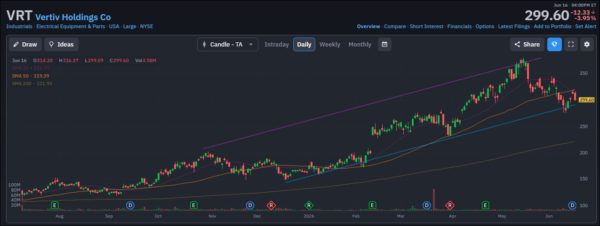
The stock now trades at $299.60, sitting below the 20-day moving average of $312.99 and the 50-day at $319.39 after correcting from highs above $370. The 200-day average remains much lower at $221.95, and buyers stepped in aggressively near major support around $280, suggesting the stock is building a new base after a meaningful reset rather than breaking down. Vertiv may carry the most direct, unavoidable link between AI adoption and infrastructure spending of these three names.
AI-StockEarnings

Infrastructure Vs Intelligence

While the market’s biggest winners attract the most attention, its biggest constraints create the biggest opportunities, and right now, those are not the same trade. Data-center electricity demand is growing at a pace few industries have ever experienced, utilities are racing to expand transmission, facilities require enormous electrical buildouts, and cooling systems must handle workloads denser than anything the grid was originally designed for.

Quanta’s record $48.5 billion backlog, Powell’s $400 million single data-center award, and Vertiv’s 44.3% Americas growth are all proving, everyday, to be inevitable inside the entire buildout. 

Join over 1.2M+ investors/traders who receive daily and weekly notable earnings alerts with predicted move