Nasdaq just did something extraordinary. In its effort to land SpaceX (NASDAQ: SPCX), the exchange slashed a key seasoning requirement from roughly 90 trading days to just 15. An 83% reduction, compressing what had long been a three-month waiting period into little more than three weeks. The announcement was framed as a technical rule adjustment. I’d argue it is something more consequential than that, because buried inside that procedural change is a much larger question about how retirement money gets invested, who controls the filters governing that process, and whether one of passive investing’s most important safeguards just became dramatically weaker.
The old framework was straightforward by design. A company went public, the market spent time pressure-testing the business, analysts built models, institutions challenged management’s assumptions, and investors gradually determined whether the valuation presented during the roadshow had any durable connection to reality. Only after that process played out would a company become eligible for index inclusion, and with it, the automatic buying power of every passive fund, retirement account, and target-date vehicle tracking that index.
The waiting period wasn’t punitive. It existed to separate excitement from evidence.
Nasdaq Tore The Old Playbook
SpaceX is not a company that requires charity from anyone. It reshaped the economics of orbital launches, built Starlink into one of the fastest-growing communications networks on the planet, and established itself as an indispensable partner to governments, militaries, and commercial operators across multiple industries. Few private companies have ever approached public markets with a résumé this impressive.
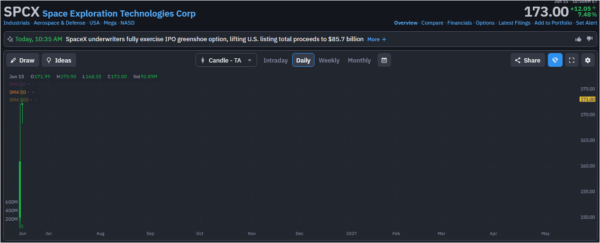
Investors reflected that confidence immediately. The stock opened at $135 per share and surged as high as $173 within days, a gain of roughly 28%. Trading volume was enormous during those first sessions as institutions, funds, and retail investors scrambled to establish positions, creating exactly the kind of price discovery process the old seasoning period was designed to observe before index inclusion.
That activity helped push SpaceX’s valuation to about $2 trillion, implying well over 100 times its estimated annual revenue of roughly $18.7 billion. Whether that multiple is justified is a genuinely open question, and I won’t pretend otherwise. Elon Musk has spent the better part of two decades making skeptics look foolish, and I have no interest in joining that particular tradition.
But the honest answer is that nobody knows yet whether $2 trillion is the right price. The stock has already swung sharply from its IPO price, surged, pulled back, and continues to search for equilibrium. That’s normal. That’s what public markets are supposed to do.
Under the framework that existed before Nasdaq rewrote it, investors would have had roughly ninety days to watch that process unfold before passive capital began flowing in automatically. They would have seen where volume settled, where institutions were willing to support the stock, and whether the initial enthusiasm could withstand scrutiny.
Now they get fifteen days.
That is the real consequence of the rule change. Not whether SpaceX succeeds or fails, but whether the market gets enough time to determine what the company is actually worth before index mandates start forcing retirement money into the trade.
The Investors Buying SpaceX May Not Realize They Already Own It
Most retirement savers don’t build portfolios stock by stock anymore. They buy funds. That’s the entire appeal of passive investing. You trust the index provider to create the rules. You trust the methodology. The screening process. When a company earns its place, the fund buys it for you. Simple. At least it used to be.
Since SpaceX has debuted on Nasdaq-100 under the accelerated framework, every investor in the Invesco QQQ (NASDAQ: QQQ), the Invesco NASDAQ 100 ETF (NASDAQ: QQQM), other Nasdaq-linked workplace plans, and the enormous universe of target-date funds benchmarked to that index is now a buyer whether they agree with the valuation or not. No opportunity to say, “I love the company but I think 100-times-sales is crazy.” The index says buy. So the fund buys. And that’s where this story stops being about SpaceX and starts becoming about trust.
SpaceX Isn’t The Actual Risk Here
SpaceX may justify every dollar of its current valuation and then some, and I genuinely would not bet against Elon Musk. What concerns me is what happens next, because rules rarely become controversial because of the first company that benefits from them. They become controversial because of the fifth. Or the tenth.
The pipeline of mega-cap private companies approaching public markets is not getting smaller; OpenAI, Stripe, Anthropic, Databricks, and a growing list of businesses valued in the hundreds of billions are all watching how this unfolds, and they should be.
A shortened seasoning period doesn’t just accelerate index inclusion – it helps them reach your retirement money faster. Because once passive funds become buyers, demand is no longer a function of whether individual investors find the valuation compelling. The benchmark says buy, and trillions of dollars tied to that benchmark follow along.
The seasoning period existed precisely because the integrity of an index is never tested when everything goes right. It is tested when something goes wrong when a company enters at a valuation the market eventually determines was disconnected from reality, and the passive capital that flowed in automatically has no mechanism to have said otherwise.
Nasdaq just shortened that filter by 83%. Space Exploration Technology Corp was the first beneficiary, and it may prove to be an exceptional one. My gripe is not whether SpaceX deserves the exception. It is whether investors will feel equally comfortable with the rule when the next company that benefits from it turns out to be something considerably less exceptional.