ajax loader

Loading...


Ride-the-Wave Strategy – Best for Stock Traders

Ride-the-Wave targets multi-day price momentum following a company’s earnings announcement (EA). With this strategy:

  1. Buy a stock one day post-EA if a stock reacts positively post-earnings:
    1. Near the close of trading the EA-day for a pre-market-EA
    2. Near the close of the following day for a post-market-EA
  2. Sell-to-close after 7-10 days, or possibly earlier if a desired price target is reached

Similarly,

  1. short a stock one day post-EA if a stock reacts negatively post-earnings:
    1. near the close of trading the EA-day for a premarket-EA
    2. near the close of the following day for a post-market-EA
  2. then buy-to-close after 7-10 days, or possibly earlier if a desired price target is reached

Important: Ride-the-Wave is predicated on significant price momentum triggered by an EA. The 7-10 day scenario is the maximum trade hold-time. If you see post EA-momentum is halted or reversed by a significant opposite move, re-evaluate your presence in the trade.

This popular StockEarnings screen below will give you a list of stocks that historically exhibit significant price momentum following an EA for the next seven days:

  1. Stocks exhibiting positive post-EA price moves are buy-candidates
  2. Stocks exhibiting negative post-EA price moves are sell/short-candidates

The screen includes those stocks whose Earnings just came out in last two days.

Screen criteria:

  1. Earnings Date Start Date : Current Date + -1 Day
  2. Earnings Date End Date : Current Date + -2 Days
  3. Predicted Move (Next Day) Max : 7%
  4. Predicted Move (On 7th Day) Min : 7%

Strategy Guideline:

  1. Buy the stock if stock has reacted positively. Short the stock if stock has reacted negatively (see above).
  2. Close the position in 7-10 days, or possibly earlier based on price move.

Volatility Crush Strategy - Best for Options Traders

The Volatility Crush strategy is used with stocks that typically experience relatively low-to-moderate price moves (≤4%) following their Earnings Announcements (EA). The basic trade idea is to sell put or call options right before the EA, collecting a credit when options premium is very high due to elevated implied volatility (IV). You then close the position right after the EA by buying the option back much cheaper due to the significant drop in IV that occurs after the mystery of the EA disappears. In assessing this trade, you need to do your homework to ensure you collect sufficient premium to make the trade worthwhile.

This trade is practical due to the low-to-moderate price-move after the EA, which generally won’t significantly affect the options price, unlike an “action” stock, which experience great price moves post-EA. With these symbols, if you’re on the right side of the price move, that’s a great thing. But if you’re on the wrong side of the move, not so great. Consequently, by minimizing the effect of the post-EA price move, you have a much better chance to profit from the reduction in IV without it being ruined by a violent price move.

For this trade, open the position either (1) the night before the EA when the company announces earnings or (2) during the EA day when it announces post-market, generally capturing IV at or close to its peak.

For this trade, open the position either (1) the night before the EA when the company announces earnings or (2) during the EA day when it announces post-market, generally capturing IV at or close to its peak.

This popular stockearnings screen will give you a list of stocks which do not react more than 4% fpost-EA. It includes only those stocks whose earnings are releasing next day.

Screen criteria:

  1. Earnings Date Start Date : Current Date + 1
  2. Earnings Date End Date : Current Date + 1
  3. Predicted Move (Next Day) Max : 4%
  4. Options Type: Weekly

Strategy Guideline:

  1. Options Strategy: Sell Call and Put
  2. Options Strike Price: Current Stock Price – (% Predicated Move x 2)
  3. Expiration Date: It should generally be the closest expiry immediately after the EA.
  4. Buy Insurance: Buying back Call and Put at Strike price which 10% lower than Sell Strike Price is optional but recommended.

Watch Video for More Detail

Volatility Rush Strategy - Best for Options Traders

The Volatility Rush takes advantage of increasing options premiums into earnings announcements (EA) caused by an anticipated rise in Implied Volatility (IV). With this strategy, Buy a Call and Put at-the-money (a long straddle) 2-3 weeks before the EA when IV is lower. Sell the position either (1) the night before the EA when the company announces earnings pre-market, or (2) during the EA day when it announces post-market, generally capturing IV at or close to its peak.

This popular screen will give you a list of stocks whose Options premiums tend to rise into Earnings. It includes only those stocks whose Earnings are at least two weeks away from today.

Screen criteria:

  1. Earnings Date Start Date : Current Date + 15 Days
  2. Earnings Date End Date : Current Date + 30 Days
  3. Predicted Move (Next Day) Min : 5%
  4. Options Type: Weekly or Monthly if that lines up with the two to three-week lead-time for entering the trade

Strategy Guideline:

  1. Buy a Straddle at or close to the money two to three weeks pre-EA.
  2. Sell the position either the night before the EA when the company announces earnings pre-market, or during the EA day when it announces post-market.
  3. Expiration date should generally be the closest expiry immediately after the EA.
  4. Straddle price should not be more 60% of predicted move.

Predicted Move (Volatility)

Similar to Implied Volatility in Options. Expected volatility % based on our Proprietary Volatility Predication Model. We are expecting that stock price will likely to reach % in either direction by the end of next trading session after Earnings are released and not necessarily the closing volatility %.

Why is it important?

    This indicator helps

  1. Knowing expected volatility in stocks after Earnings helps to decide trading stocks before Earnings Announcement.
  2. Taking Advantage of volatility collapse following Earnings Results by using Advance Options strategies such as Spread and Straddles.

Since Last Earnings

Change in share price since last Earnings release.

Why is it Important?

When share has gained more than 10% since it's last Earning release, it tends to over react to minor bad news and give up some gains if not all. So, it contains more downside volatility than upside When share has dropped more than 10% since it's last Earning release, it tends to over react to minor good news and recover some drops if not all. So, it contains more upside volatility than downside.

EPS Surprise (%)

Occurs when a company's reported quarterly or annual profits are above or below analysts' expectations. Here is the formula to derive % EPS Surprice:

Actual EPS - Estimated EPS
------------------------------------- x 100
Estimated EPS

Why is it Important?

Earnings surprises can have a huge impact on a company's stock price. Several studies suggest that positive earnings surprises not only lead to an immediate hike in a stock's price, but also to a gradual increase over time. Hence, it's not surprising that some companies are known for routinely beating earning projections. A negative earnings surprise will usually result in a decline in share price.

Next Day Price Change (%)

Next Regular trading session Closing price following Earnings result.

For After Market Close Earnings, It is a next trading day closing price. For Before Market Open Earnings, It is the same trading day closing price.

Why is it Important?

Next Day price change is a reaction of Earnings result.

Starbucks or Dutch Bros: Which Coffee Stock Is a Better Buy?

Posted on Aug 14, 2026 by Chris Markoch

Starbucks or Dutch Bros: Which Coffee Stock Is a Better Buy?

Starbucks and Dutch Bros both cleared earnings hurdles this earnings season, yet Wall Street treated the two coffee chains very differently. Starbucks (NASDAQ: SBUX) reported on July 29, and Dutch Bros (NYSE: BROS) followed on Aug. 5. Both companies posted a double beat on the top and bottom lines relative to expectations.

But a closer read shows Dutch Bros grew both revenue and adjusted earnings per share (EPS) year-over-year (YOY), while Starbucks only posted a higher YOY jump in adjusted EPS.

To be fair, earnings are more important. Which is why investors may initially have given Starbucks a pass. The market seems to believe CEO Brian Niccol’s “Back to Starbucks” turnaround is finally working. The company’s decision to hand over operational control of its China business also drew a favorable reaction. It removes a chunk of geopolitical and competitive risk from the balance sheet.

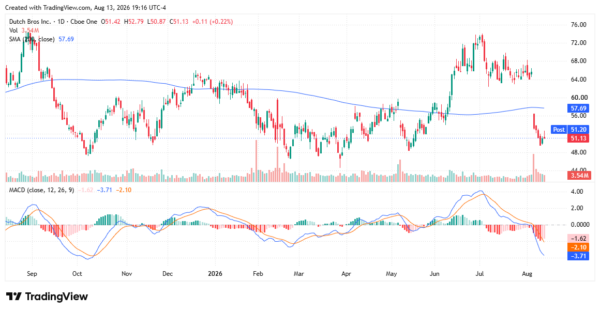
Dutch Bros, meanwhile, delivered a genuinely strong quarter but paired it with cautious guidance. Investors punished the stock hard, sending shares down more than 20% since the report. That reaction looks disproportionate given the underlying numbers.

It sets up an interesting valuation gap heading into the back half of the year. Coffee input costs are expected to ease over the coming months, which should help margins across the sector. That backdrop matters more for one of these stocks than the other. Here’s a side-by-side look at both companies and why one now looks like the better buy for investors chasing value in coffee stocks.

Starbucks Gets Credit for a Turnaround Story


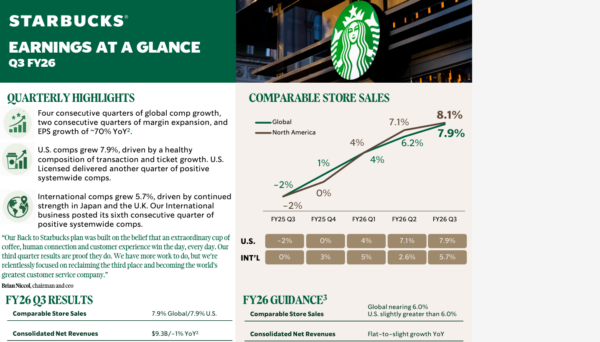
Starbucks reported fiscal Q3 revenue of $9.32 billion, down 1.4% year-over-year. That decline reflects the transfer of its China retail operations to a licensed joint venture. Adjusted earnings per share came in at 85 cents, up 70% from a year ago. Global comparable store sales rose 7.9%, driven mostly by transaction growth rather than price hikes. That’s a meaningful signal that customers are returning to stores.
coffee - StockEarnings

Investors appear to be buying the narrative that Niccol’s “Back to Starbucks” plan is taking hold. The China deal also removed a complicated, lower-margin business from the income statement. Management raised full-year guidance on the back of the results.

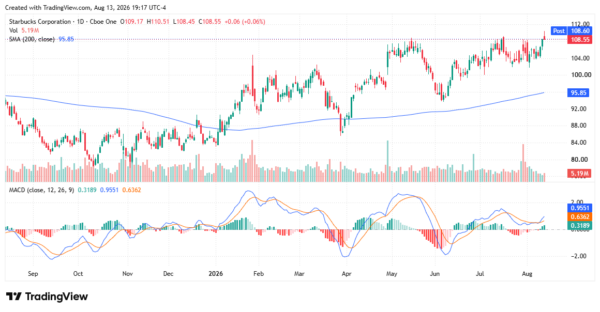
Yet the stock reaction has been muted. Shares are up only slightly since the report, suggesting the good news was already priced in. Starbucks trades near the top of its 52-week range. The stock’s valuation remains rich relative to its growth rate. A 2.28% dividend yield, backed by 15 straight years of increases, offers some downside cushion. But it’s not the kind of setup that screams “undervalued.”
coffee - StockEarnings

North America remains the core of the story, with segment revenue up 7% and operating margin expanding to 13.6%. Labor investments tied to the turnaround are still weighing on costs, though. Investors are betting those investments pay off over time. For now, that bet looks more like faith than fundamentals-driven conviction.

Dutch Bros Delivers Real Growth, Gets Punished Anyway

Dutch Bros posted second-quarter revenue of $550.9 million, up nearly 33% year-over-year. Adjusted EBITDA jumped to $113.7 million from $89 million a year earlier. Unlike Starbucks, Dutch Bros beat expectations on both revenue and earnings compared to the same quarter last year. That’s a genuine double beat, not one propped up by a divestiture or cost cuts.

Same shop sales climbed 5.8% systemwide, with company-operated locations up 8.3%. The chain added new units at a steady clip, ending the quarter with 1,225 total shops. The business is executing well on nearly every operational metric that matters.

The catch was guidance. Management’s outlook for the rest of 2026 came in more conservative than some investors wanted. That was enough to trigger a brutal selloff. BROS shares have fallen more than 20% since the report, an outsized reaction to what was otherwise a strong quarter of actual growth.
coffee - StockEarnings

Full-year guidance still calls for revenue between $2.1 billion and $2.13 billion. Adjusted EBITDA is expected to land between $385 million and $390 million. Same shop sales growth is guided at 5% to 6%, right in line with what the company just delivered. None of that guidance signals a business falling apart. It signals that a company is simply managing expectations amid a choppy consumer environment.

And the Winner Is… Dutch Bros

The market’s reaction to these two coffee stocks doesn’t match the underlying fundamentals. Starbucks missed on revenue and got rewarded. Dutch Bros beat on both lines and got punished for cautious guidance. That’s a classic case of perception diverging from reality, and it’s created an opportunity.

Dutch Bros now trades near the bottom of its 52-week range, while Starbucks sits near the top of its own. One stock is priced in near-perfection. The other is pricing in a growth slowdown that hasn’t yet shown up in the numbers. Coffee costs are expected to soften in the second half. Dutch Bros stands to benefit more, given its smaller size and faster unit growth trajectory.

Lower green coffee prices flow straight into margins for a company still scaling its store base. Starbucks will benefit too, but the impact is proportionally smaller across a 41,000-store global footprint. For investors weighing risk against reward, Dutch Bros offers more room to run from a lower starting valuation.

Weighing Both Coffee Stocks Before Q4

Neither Starbucks nor Dutch Bros is a bad business right now. Both are executing on their respective strategies, and both just posted quarters with real bright spots. The difference is in how each stock is priced relative to its own results. Starbucks trades near 52-week highs on a story that’s still unfolding. Dutch Bros trades near 52-week lows despite delivering a stronger quarter on paper.

That gap between perception and fundamentals is exactly where opportunity tends to show up. Investors willing to look past one cautious guidance print may find Dutch Bros offers the better setup heading into the fall. Cheaper coffee costs on the horizon should help the whole industry, but especially a growth story still scaling its footprint.


A former marketing copywriter turned freelance financial writer and market analyst. I have a passion for delivering insights to investors. I write regularly about stocks for StockEarnings and MarketBeat. Posts are not advice.

Join over 1.2M+ investors/traders who receive daily and weekly notable earnings alerts with predicted move