ajax loader

Loading...


Ride-the-Wave Strategy – Best for Stock Traders

Ride-the-Wave targets multi-day price momentum following a company’s earnings announcement (EA). With this strategy:

  1. Buy a stock one day post-EA if a stock reacts positively post-earnings:
    1. Near the close of trading the EA-day for a pre-market-EA
    2. Near the close of the following day for a post-market-EA
  2. Sell-to-close after 7-10 days, or possibly earlier if a desired price target is reached

Similarly,

  1. short a stock one day post-EA if a stock reacts negatively post-earnings:
    1. near the close of trading the EA-day for a premarket-EA
    2. near the close of the following day for a post-market-EA
  2. then buy-to-close after 7-10 days, or possibly earlier if a desired price target is reached

Important: Ride-the-Wave is predicated on significant price momentum triggered by an EA. The 7-10 day scenario is the maximum trade hold-time. If you see post EA-momentum is halted or reversed by a significant opposite move, re-evaluate your presence in the trade.

This popular StockEarnings screen below will give you a list of stocks that historically exhibit significant price momentum following an EA for the next seven days:

  1. Stocks exhibiting positive post-EA price moves are buy-candidates
  2. Stocks exhibiting negative post-EA price moves are sell/short-candidates

The screen includes those stocks whose Earnings just came out in last two days.

Screen criteria:

  1. Earnings Date Start Date : Current Date + -1 Day
  2. Earnings Date End Date : Current Date + -2 Days
  3. Predicted Move (Next Day) Max : 7%
  4. Predicted Move (On 7th Day) Min : 7%

Strategy Guideline:

  1. Buy the stock if stock has reacted positively. Short the stock if stock has reacted negatively (see above).
  2. Close the position in 7-10 days, or possibly earlier based on price move.

Volatility Crush Strategy - Best for Options Traders

The Volatility Crush strategy is used with stocks that typically experience relatively low-to-moderate price moves (≤4%) following their Earnings Announcements (EA). The basic trade idea is to sell put or call options right before the EA, collecting a credit when options premium is very high due to elevated implied volatility (IV). You then close the position right after the EA by buying the option back much cheaper due to the significant drop in IV that occurs after the mystery of the EA disappears. In assessing this trade, you need to do your homework to ensure you collect sufficient premium to make the trade worthwhile.

This trade is practical due to the low-to-moderate price-move after the EA, which generally won’t significantly affect the options price, unlike an “action” stock, which experience great price moves post-EA. With these symbols, if you’re on the right side of the price move, that’s a great thing. But if you’re on the wrong side of the move, not so great. Consequently, by minimizing the effect of the post-EA price move, you have a much better chance to profit from the reduction in IV without it being ruined by a violent price move.

For this trade, open the position either (1) the night before the EA when the company announces earnings or (2) during the EA day when it announces post-market, generally capturing IV at or close to its peak.

For this trade, open the position either (1) the night before the EA when the company announces earnings or (2) during the EA day when it announces post-market, generally capturing IV at or close to its peak.

This popular stockearnings screen will give you a list of stocks which do not react more than 4% fpost-EA. It includes only those stocks whose earnings are releasing next day.

Screen criteria:

  1. Earnings Date Start Date : Current Date + 1
  2. Earnings Date End Date : Current Date + 1
  3. Predicted Move (Next Day) Max : 4%
  4. Options Type: Weekly

Strategy Guideline:

  1. Options Strategy: Sell Call and Put
  2. Options Strike Price: Current Stock Price – (% Predicated Move x 2)
  3. Expiration Date: It should generally be the closest expiry immediately after the EA.
  4. Buy Insurance: Buying back Call and Put at Strike price which 10% lower than Sell Strike Price is optional but recommended.

Watch Video for More Detail

Volatility Rush Strategy - Best for Options Traders

The Volatility Rush takes advantage of increasing options premiums into earnings announcements (EA) caused by an anticipated rise in Implied Volatility (IV). With this strategy, Buy a Call and Put at-the-money (a long straddle) 2-3 weeks before the EA when IV is lower. Sell the position either (1) the night before the EA when the company announces earnings pre-market, or (2) during the EA day when it announces post-market, generally capturing IV at or close to its peak.

This popular screen will give you a list of stocks whose Options premiums tend to rise into Earnings. It includes only those stocks whose Earnings are at least two weeks away from today.

Screen criteria:

  1. Earnings Date Start Date : Current Date + 15 Days
  2. Earnings Date End Date : Current Date + 30 Days
  3. Predicted Move (Next Day) Min : 5%
  4. Options Type: Weekly or Monthly if that lines up with the two to three-week lead-time for entering the trade

Strategy Guideline:

  1. Buy a Straddle at or close to the money two to three weeks pre-EA.
  2. Sell the position either the night before the EA when the company announces earnings pre-market, or during the EA day when it announces post-market.
  3. Expiration date should generally be the closest expiry immediately after the EA.
  4. Straddle price should not be more 60% of predicted move.

Predicted Move (Volatility)

Similar to Implied Volatility in Options. Expected volatility % based on our Proprietary Volatility Predication Model. We are expecting that stock price will likely to reach % in either direction by the end of next trading session after Earnings are released and not necessarily the closing volatility %.

Why is it important?

    This indicator helps

  1. Knowing expected volatility in stocks after Earnings helps to decide trading stocks before Earnings Announcement.
  2. Taking Advantage of volatility collapse following Earnings Results by using Advance Options strategies such as Spread and Straddles.

Since Last Earnings

Change in share price since last Earnings release.

Why is it Important?

When share has gained more than 10% since it's last Earning release, it tends to over react to minor bad news and give up some gains if not all. So, it contains more downside volatility than upside When share has dropped more than 10% since it's last Earning release, it tends to over react to minor good news and recover some drops if not all. So, it contains more upside volatility than downside.

EPS Surprise (%)

Occurs when a company's reported quarterly or annual profits are above or below analysts' expectations. Here is the formula to derive % EPS Surprice:

Actual EPS - Estimated EPS
------------------------------------- x 100
Estimated EPS

Why is it Important?

Earnings surprises can have a huge impact on a company's stock price. Several studies suggest that positive earnings surprises not only lead to an immediate hike in a stock's price, but also to a gradual increase over time. Hence, it's not surprising that some companies are known for routinely beating earning projections. A negative earnings surprise will usually result in a decline in share price.

Next Day Price Change (%)

Next Regular trading session Closing price following Earnings result.

For After Market Close Earnings, It is a next trading day closing price. For Before Market Open Earnings, It is the same trading day closing price.

Why is it Important?

Next Day price change is a reaction of Earnings result.

Retail Earnings Season Just Got Real: 3 Crucial Reports to Watch

Posted on Aug 13, 2026 by Chris Markoch

Retail Earnings Season Just Got Real: 3 Crucial Reports to Watch

Retail earnings always get attention, but this earnings season feels different. The week of Aug. 17 brings reports from Walmart (NASDAQ: WMT), La-Z-Boy (NYSE: LZB), and Lowe’s (NYSE: LOW), and each one carries more weight than usual. It’s an overused line, but this may be one of the most important earnings seasons ever for retail stocks.

Here’s why. The stock market is not the economy. In the economy where most consumers actually live, inflation’s bite is real, especially for lower-income households.

The numbers back this up. Many retailers have posted solid headline results this year, but paired them with cautious guidance. That’s a signal that management teams are less certain about the consumer than the top-line growth suggests.

That gap matters for data-driven investors. Consumers often say one thing in surveys and do another with their wallets. Earnings season is where that disconnect gets tested against real transaction data, not sentiment.

Against that backdrop, three retailers reporting the week of Aug. 17 offer a useful cross-section: one is a mega-cap bellwether, one is a small-cap specialty name, and the other is a home-improvement giant. Walmart will show whether low-income shoppers are holding up. La-Z-Boy will show whether a single promotion is propping up demand. Lowe’s will show whether a beaten-down stock deserves a second look.

Each of these companies serves a different slice of the consumer, from budget-conscious grocery shoppers to homeowners weighing big-ticket purchases. Taken together, their reports should offer one of the clearest reads yet on how the K-shaped economy is playing out in real time. Here’s how to approach each one heading into earnings week.

Walmart Earnings: Guidance Could Matter More Than the Beat


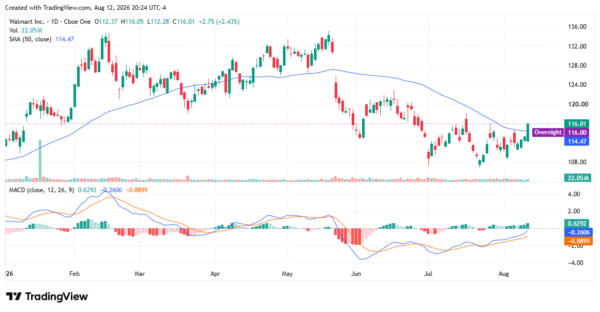
Walmart reports before the market opens on Aug. 20, and there’s little drama about the headline numbers. Walmart has built a track record of delivering, and this quarter should follow that pattern. The real question is guidance. Management’s tone on the health of lower-income shoppers will matter more than the beat itself.

Valuation is the sticking point. Walmart trades at roughly 40 times earnings, a premium that’s easy to justify in normal times. These aren’t entirely normal times. The stock is down about 4% in 2026 and sits roughly in the middle of its 52-week range, neither a screaming buy nor a clear warning sign.

That combination — a premium multiple, a stock going nowhere, and guidance that could swing sentiment either way — argues for patience. Walmart remains a core retail holding and a useful barometer for the broader consumer. But at 40 times earnings, investors are paying for perfection.

There’s also a signal-versus-noise issue here. Walmart’s scale means it captures trade-down shoppers from other retailers, which can flatter results even as the underlying consumer weakens. That makes the guidance language, not just the numbers, the piece worth reading closely. This looks like a Hold heading into the print, not a name to chase.
retail - StockEarnings

La-Z-Boy Earnings: Is the Furniture Rally Built to Last?

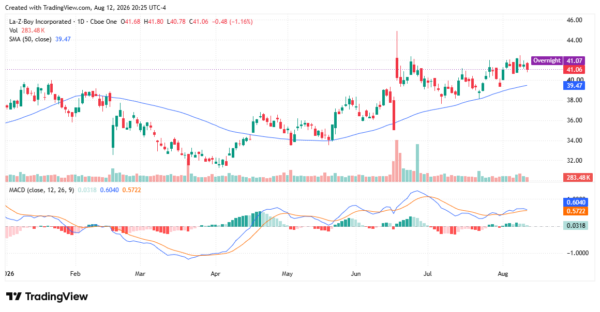
La-Z-Boy is up about 10% in 2026, a solid run for a small-cap furniture name. Shares trade around 16 times earnings, a real discount to the broader market. On paper, that combination of price momentum and reasonable valuation looks appealing heading into earnings.

But if you dig a little deeper, the picture gets more complicated. The stock has run past its own consensus price target, a sign that expectations have outpaced fundamentals. There are also questions about the source of recent revenue strength. The company has been relying on promotions to do much of the heavy lifting, rather than broad-based demand across the furniture business.

That’s a fragile setup. If the promotion is masking softer underlying trends, a disappointing report could hit a stock that’s already trading above where analysts think it belongs. Furniture is a discretionary, big-ticket category, and it tends to be one of the first areas consumers pull back on when budgets tighten.

La-Z-Boy may be priced for perfection right now. The dividend yield offers some cushion, but it doesn’t fully offset valuation risk if growth disappoints. Investors would be better served waiting for either a strong, promotion-independent report or a meaningful pullback in the share price before stepping in.
retail - StockEarnings

Lowe’s Earnings: A Low Bar Could Set Up a Stock Rebound

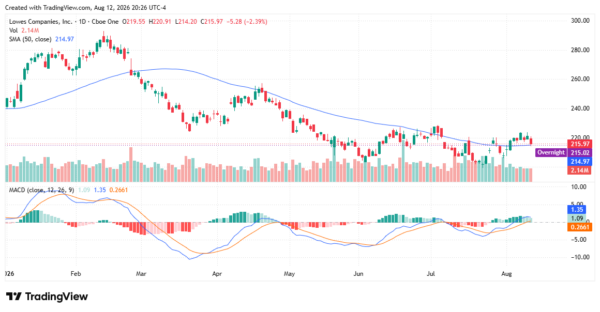
Lowe’s reports on Aug. 19, and expectations are notably subdued. The bar for this print looks low. That’s often the setup value investors want to see, especially when the stock’s recent performance already reflects the market’s pessimism.

The valuation case is compelling. Lowe’s trades around 18 times earnings and sits near the bottom of its 52-week range. As a Dividend King, it offers a rare combination for investors: a durable income stream alongside real upside potential if sentiment turns. Housing-related names have been under pressure, and Lowe’s has absorbed its share of that pain.

With concerns about higher interest rates fading, Lowe’s setup looks more favorable than the market currently gives it credit for. Lower rates tend to loosen up the housing market, which supports both big remodels and smaller repair-and-maintenance spending, Lowe’s bread and butter.

A modest beat, or even an in-line quarter with steady guidance, could be enough to clear a low bar. Of the three names reporting this week, Lowe’s may offer the most upside from here, making it the standout name for patient, income-minded investors willing to look past near-term noise.
retail - STockEarnings

Retail Earnings Bottom Line: Watch Guidance on the Consumer

Three retailers, three very different setups. Walmart looks like a Hold, priced for perfection at 40 times earnings with guidance as the real catalyst. La-Z-Boy’s rally may be running ahead of its fundamentals, partly driven by promotions. Lowe’s, trading near 52-week lows with a low bar to clear, looks like the group’s surprise opportunity.

The common thread across all three is that guidance will matter more than the headline beat. In an earnings season this consequential for retail, investors who read between the lines of management’s comments about the consumer will be better positioned than those chasing last quarter’s numbers alone.


A former marketing copywriter turned freelance financial writer and market analyst. I have a passion for delivering insights to investors. I write regularly about stocks for StockEarnings and MarketBeat. Posts are not advice.

Join over 1.2M+ investors/traders who receive daily and weekly notable earnings alerts with predicted move