ajax loader

Loading...


Ride-the-Wave Strategy – Best for Stock Traders

Ride-the-Wave targets multi-day price momentum following a company’s earnings announcement (EA). With this strategy:

  1. Buy a stock one day post-EA if a stock reacts positively post-earnings:
    1. Near the close of trading the EA-day for a pre-market-EA
    2. Near the close of the following day for a post-market-EA
  2. Sell-to-close after 7-10 days, or possibly earlier if a desired price target is reached

Similarly,

  1. short a stock one day post-EA if a stock reacts negatively post-earnings:
    1. near the close of trading the EA-day for a premarket-EA
    2. near the close of the following day for a post-market-EA
  2. then buy-to-close after 7-10 days, or possibly earlier if a desired price target is reached

Important: Ride-the-Wave is predicated on significant price momentum triggered by an EA. The 7-10 day scenario is the maximum trade hold-time. If you see post EA-momentum is halted or reversed by a significant opposite move, re-evaluate your presence in the trade.

This popular StockEarnings screen below will give you a list of stocks that historically exhibit significant price momentum following an EA for the next seven days:

  1. Stocks exhibiting positive post-EA price moves are buy-candidates
  2. Stocks exhibiting negative post-EA price moves are sell/short-candidates

The screen includes those stocks whose Earnings just came out in last two days.

Screen criteria:

  1. Earnings Date Start Date : Current Date + -1 Day
  2. Earnings Date End Date : Current Date + -2 Days
  3. Predicted Move (Next Day) Max : 7%
  4. Predicted Move (On 7th Day) Min : 7%

Strategy Guideline:

  1. Buy the stock if stock has reacted positively. Short the stock if stock has reacted negatively (see above).
  2. Close the position in 7-10 days, or possibly earlier based on price move.

Volatility Crush Strategy - Best for Options Traders

The Volatility Crush strategy is used with stocks that typically experience relatively low-to-moderate price moves (≤4%) following their Earnings Announcements (EA). The basic trade idea is to sell put or call options right before the EA, collecting a credit when options premium is very high due to elevated implied volatility (IV). You then close the position right after the EA by buying the option back much cheaper due to the significant drop in IV that occurs after the mystery of the EA disappears. In assessing this trade, you need to do your homework to ensure you collect sufficient premium to make the trade worthwhile.

This trade is practical due to the low-to-moderate price-move after the EA, which generally won’t significantly affect the options price, unlike an “action” stock, which experience great price moves post-EA. With these symbols, if you’re on the right side of the price move, that’s a great thing. But if you’re on the wrong side of the move, not so great. Consequently, by minimizing the effect of the post-EA price move, you have a much better chance to profit from the reduction in IV without it being ruined by a violent price move.

For this trade, open the position either (1) the night before the EA when the company announces earnings or (2) during the EA day when it announces post-market, generally capturing IV at or close to its peak.

For this trade, open the position either (1) the night before the EA when the company announces earnings or (2) during the EA day when it announces post-market, generally capturing IV at or close to its peak.

This popular stockearnings screen will give you a list of stocks which do not react more than 4% fpost-EA. It includes only those stocks whose earnings are releasing next day.

Screen criteria:

  1. Earnings Date Start Date : Current Date + 1
  2. Earnings Date End Date : Current Date + 1
  3. Predicted Move (Next Day) Max : 4%
  4. Options Type: Weekly

Strategy Guideline:

  1. Options Strategy: Sell Call and Put
  2. Options Strike Price: Current Stock Price – (% Predicated Move x 2)
  3. Expiration Date: It should generally be the closest expiry immediately after the EA.
  4. Buy Insurance: Buying back Call and Put at Strike price which 10% lower than Sell Strike Price is optional but recommended.

Watch Video for More Detail

Volatility Rush Strategy - Best for Options Traders

The Volatility Rush takes advantage of increasing options premiums into earnings announcements (EA) caused by an anticipated rise in Implied Volatility (IV). With this strategy, Buy a Call and Put at-the-money (a long straddle) 2-3 weeks before the EA when IV is lower. Sell the position either (1) the night before the EA when the company announces earnings pre-market, or (2) during the EA day when it announces post-market, generally capturing IV at or close to its peak.

This popular screen will give you a list of stocks whose Options premiums tend to rise into Earnings. It includes only those stocks whose Earnings are at least two weeks away from today.

Screen criteria:

  1. Earnings Date Start Date : Current Date + 15 Days
  2. Earnings Date End Date : Current Date + 30 Days
  3. Predicted Move (Next Day) Min : 5%
  4. Options Type: Weekly or Monthly if that lines up with the two to three-week lead-time for entering the trade

Strategy Guideline:

  1. Buy a Straddle at or close to the money two to three weeks pre-EA.
  2. Sell the position either the night before the EA when the company announces earnings pre-market, or during the EA day when it announces post-market.
  3. Expiration date should generally be the closest expiry immediately after the EA.
  4. Straddle price should not be more 60% of predicted move.

Predicted Move (Volatility)

Similar to Implied Volatility in Options. Expected volatility % based on our Proprietary Volatility Predication Model. We are expecting that stock price will likely to reach % in either direction by the end of next trading session after Earnings are released and not necessarily the closing volatility %.

Why is it important?

    This indicator helps

  1. Knowing expected volatility in stocks after Earnings helps to decide trading stocks before Earnings Announcement.
  2. Taking Advantage of volatility collapse following Earnings Results by using Advance Options strategies such as Spread and Straddles.

Since Last Earnings

Change in share price since last Earnings release.

Why is it Important?

When share has gained more than 10% since it's last Earning release, it tends to over react to minor bad news and give up some gains if not all. So, it contains more downside volatility than upside When share has dropped more than 10% since it's last Earning release, it tends to over react to minor good news and recover some drops if not all. So, it contains more upside volatility than downside.

EPS Surprise (%)

Occurs when a company's reported quarterly or annual profits are above or below analysts' expectations. Here is the formula to derive % EPS Surprice:

Actual EPS - Estimated EPS
------------------------------------- x 100
Estimated EPS

Why is it Important?

Earnings surprises can have a huge impact on a company's stock price. Several studies suggest that positive earnings surprises not only lead to an immediate hike in a stock's price, but also to a gradual increase over time. Hence, it's not surprising that some companies are known for routinely beating earning projections. A negative earnings surprise will usually result in a decline in share price.

Next Day Price Change (%)

Next Regular trading session Closing price following Earnings result.

For After Market Close Earnings, It is a next trading day closing price. For Before Market Open Earnings, It is the same trading day closing price.

Why is it Important?

Next Day price change is a reaction of Earnings result.

Cisco’s Q4 Orders Just Changed The AI Conversation

Posted on Aug 13, 2026 by Grayson Cavern

Cisco’s Q4 Orders Just Changed The AI Conversation

Cisco Systems (NASDAQ: CSCO) closed FY26 with a record $17.3 billion in Q4 revenue, up 18% year over year, while non-GAAP EPS climbed 23% to $1.22.  Those are backward-looking numbers, so the better read on where Cisco is headed comes from what customers are committing to now and whether those commitments can keep the company’s growth rate elevated over the coming quarters.

The company’s product orders jumped 35% in Q4, with networking product orders up 40%. Even excluding hyperscalers, product orders still grew 25%, while Enterprise orders rose 21%.

In fact, according to the earnings release, the company isn’t relying on a handful of hyperscalers to carry the entire AI story; enterprise customers are spending more, service providers are spending more, and the networking business itself is seeing sustained order growth.

AI is sitting underneath much of that spending, as customers build the infrastructure needed to connect increasingly large and distributed workloads, and Cisco is positioned across that stack rather than in just one corner of it.

The hyperscaler numbers show just how quickly that piece of the business is developing, and that’s where we need to look next.

A $9.3 Billion Business


The company booked $4 billion in hyperscaler AI infrastructure orders during Q4, taking the FY26 total to $9.3 billion, roughly 4.5 times what it booked in FY25. Management expects hyperscaler AI infrastructure revenue to reach $7.5 billion in FY27, compared with roughly $4 billion in FY26. 

That growth is coming through Cisco’s networking portfolio, particularly its Silicon One systems and Acacia optics, which together represented roughly 60% and 40% of FY26 hyperscaler AI orders, respectively. The company also secured three new hyperscaler design wins in Q4, including another Silicon One P200 system for scale-across workloads. 

I also like what is happening outside the hyperscaler bucket. Cisco took more than $400 million of AI infrastructure orders from neocloud, sovereign and enterprise customers in Q4, bringing FY26’s total to more than $1 billion. Enterprise Nexus switch orders tagged for AI deployments also rose more than 85% sequentially. 

So Cisco isn’t betting the entire AI opportunity on one customer type or one deployment model; the same networking demand is beginning to spread from giant cloud providers into enterprises and newer AI infrastructure operators. That gives the company a much broader runway than simply supplying hyperscalers with another wave of hardware.

But Cisco Is Paying For The AI Boom In Gross Margin

Cisco Systems’ AI opportunity is getting bigger, but the mix of business coming with it is putting some pressure on profitability, with non-GAAP product gross margin falling 270 basis points year over year to 64.8% as a higher hardware mix and memory costs weighed on the quarter. 

That trade-off is worth watching because Cisco is moving deeper into hardware-heavy AI infrastructure at the same time its networking business is accelerating, meaning more revenue does not automatically translate into the same level of gross profit. The good news is that the company isn’t letting that pressure flow straight through to the bottom line: non-GAAP operating margin rose to 35.9%, while EPS climbed 23%

Management also expects FY27 revenue of $72.2 billion to $73.4 billion, compared with $63.3 billion in FY26, alongside non-GAAP EPS of $5.05 to $5.11. 

That leaves Cisco with a fairly simple balancing act: keep the AI-driven hardware growth coming without allowing the lower-margin mix to eat away at the operating leverage that made this quarter so strong.

Cisco’s Chart Hasn’t Broken The Bull Case

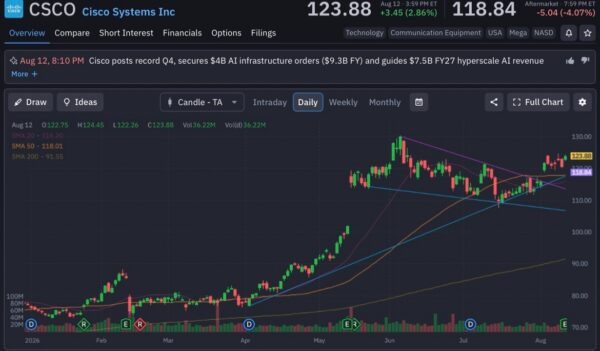
Cisco Systems closed the regular session at $123.88, up 2.86%, before slipping in after-hours trading, but the broader setup still leaves room for the bulls. Shares had pushed above the $116.20 20-day and $118.01 50-day moving averages, leaving the recent June high around $130 as the obvious hurdle. A move through that area would give the earnings reaction more credibility, especially after the stock spent much of the summer consolidating beneath it.

The other thing I’d watch is whether the $118 area can hold if the initial earnings excitement fades, because that zone now sits around the 50-day moving average and could become the line between a healthy consolidation and a failed breakout. With Cisco’s order growth running ahead of reported revenue, I wouldn’t be surprised to see buyers take another shot at $130 if the stock can stay above that support.
cisco-StockEarnings

The Business Is Moving In A Direction I Like

I’m not ready to call Cisco Systems an AI rocket ship, but the business is moving in a direction I like: orders are accelerating, hyperscaler AI infrastructure is scaling quickly, and management is guiding to another year of revenue and EPS growth. FY27 revenue is expected to reach $72.2 billion–$73.4 billion, while non-GAAP EPS is guided to $5.05-$5.11, giving investors a fairly clear benchmark for whether this AI-driven acceleration is actually making its way into the financials. 

But like I said, there is still the gross-margin issue to watch, particularly with product margins already feeling the weight of the heavier hardware mix and memory costs. But CSCO finished FY26 with $15.9 billion in cash, $5.4 billion of quarterly operating cash flow and $12.7 billion returned to shareholders, so this isn’t a business that needs the AI boom to survive. 

If the company can keep converting those orders into revenue while protecting its operating leverage, $130 may end up looking less like a ceiling and more like the next stop.


Join over 1.2M+ investors/traders who receive daily and weekly notable earnings alerts with predicted move