ajax loader

Loading...


Ride-the-Wave Strategy – Best for Stock Traders

Ride-the-Wave targets multi-day price momentum following a company’s earnings announcement (EA). With this strategy:

  1. Buy a stock one day post-EA if a stock reacts positively post-earnings:
    1. Near the close of trading the EA-day for a pre-market-EA
    2. Near the close of the following day for a post-market-EA
  2. Sell-to-close after 7-10 days, or possibly earlier if a desired price target is reached

Similarly,

  1. short a stock one day post-EA if a stock reacts negatively post-earnings:
    1. near the close of trading the EA-day for a premarket-EA
    2. near the close of the following day for a post-market-EA
  2. then buy-to-close after 7-10 days, or possibly earlier if a desired price target is reached

Important: Ride-the-Wave is predicated on significant price momentum triggered by an EA. The 7-10 day scenario is the maximum trade hold-time. If you see post EA-momentum is halted or reversed by a significant opposite move, re-evaluate your presence in the trade.

This popular StockEarnings screen below will give you a list of stocks that historically exhibit significant price momentum following an EA for the next seven days:

  1. Stocks exhibiting positive post-EA price moves are buy-candidates
  2. Stocks exhibiting negative post-EA price moves are sell/short-candidates

The screen includes those stocks whose Earnings just came out in last two days.

Screen criteria:

  1. Earnings Date Start Date : Current Date + -1 Day
  2. Earnings Date End Date : Current Date + -2 Days
  3. Predicted Move (Next Day) Max : 7%
  4. Predicted Move (On 7th Day) Min : 7%

Strategy Guideline:

  1. Buy the stock if stock has reacted positively. Short the stock if stock has reacted negatively (see above).
  2. Close the position in 7-10 days, or possibly earlier based on price move.

Volatility Crush Strategy - Best for Options Traders

The Volatility Crush strategy is used with stocks that typically experience relatively low-to-moderate price moves (≤4%) following their Earnings Announcements (EA). The basic trade idea is to sell put or call options right before the EA, collecting a credit when options premium is very high due to elevated implied volatility (IV). You then close the position right after the EA by buying the option back much cheaper due to the significant drop in IV that occurs after the mystery of the EA disappears. In assessing this trade, you need to do your homework to ensure you collect sufficient premium to make the trade worthwhile.

This trade is practical due to the low-to-moderate price-move after the EA, which generally won’t significantly affect the options price, unlike an “action” stock, which experience great price moves post-EA. With these symbols, if you’re on the right side of the price move, that’s a great thing. But if you’re on the wrong side of the move, not so great. Consequently, by minimizing the effect of the post-EA price move, you have a much better chance to profit from the reduction in IV without it being ruined by a violent price move.

For this trade, open the position either (1) the night before the EA when the company announces earnings or (2) during the EA day when it announces post-market, generally capturing IV at or close to its peak.

For this trade, open the position either (1) the night before the EA when the company announces earnings or (2) during the EA day when it announces post-market, generally capturing IV at or close to its peak.

This popular stockearnings screen will give you a list of stocks which do not react more than 4% fpost-EA. It includes only those stocks whose earnings are releasing next day.

Screen criteria:

  1. Earnings Date Start Date : Current Date + 1
  2. Earnings Date End Date : Current Date + 1
  3. Predicted Move (Next Day) Max : 4%
  4. Options Type: Weekly

Strategy Guideline:

  1. Options Strategy: Sell Call and Put
  2. Options Strike Price: Current Stock Price – (% Predicated Move x 2)
  3. Expiration Date: It should generally be the closest expiry immediately after the EA.
  4. Buy Insurance: Buying back Call and Put at Strike price which 10% lower than Sell Strike Price is optional but recommended.

Watch Video for More Detail

Volatility Rush Strategy - Best for Options Traders

The Volatility Rush takes advantage of increasing options premiums into earnings announcements (EA) caused by an anticipated rise in Implied Volatility (IV). With this strategy, Buy a Call and Put at-the-money (a long straddle) 2-3 weeks before the EA when IV is lower. Sell the position either (1) the night before the EA when the company announces earnings pre-market, or (2) during the EA day when it announces post-market, generally capturing IV at or close to its peak.

This popular screen will give you a list of stocks whose Options premiums tend to rise into Earnings. It includes only those stocks whose Earnings are at least two weeks away from today.

Screen criteria:

  1. Earnings Date Start Date : Current Date + 15 Days
  2. Earnings Date End Date : Current Date + 30 Days
  3. Predicted Move (Next Day) Min : 5%
  4. Options Type: Weekly or Monthly if that lines up with the two to three-week lead-time for entering the trade

Strategy Guideline:

  1. Buy a Straddle at or close to the money two to three weeks pre-EA.
  2. Sell the position either the night before the EA when the company announces earnings pre-market, or during the EA day when it announces post-market.
  3. Expiration date should generally be the closest expiry immediately after the EA.
  4. Straddle price should not be more 60% of predicted move.

Predicted Move (Volatility)

Similar to Implied Volatility in Options. Expected volatility % based on our Proprietary Volatility Predication Model. We are expecting that stock price will likely to reach % in either direction by the end of next trading session after Earnings are released and not necessarily the closing volatility %.

Why is it important?

    This indicator helps

  1. Knowing expected volatility in stocks after Earnings helps to decide trading stocks before Earnings Announcement.
  2. Taking Advantage of volatility collapse following Earnings Results by using Advance Options strategies such as Spread and Straddles.

Since Last Earnings

Change in share price since last Earnings release.

Why is it Important?

When share has gained more than 10% since it's last Earning release, it tends to over react to minor bad news and give up some gains if not all. So, it contains more downside volatility than upside When share has dropped more than 10% since it's last Earning release, it tends to over react to minor good news and recover some drops if not all. So, it contains more upside volatility than downside.

EPS Surprise (%)

Occurs when a company's reported quarterly or annual profits are above or below analysts' expectations. Here is the formula to derive % EPS Surprice:

Actual EPS - Estimated EPS
------------------------------------- x 100
Estimated EPS

Why is it Important?

Earnings surprises can have a huge impact on a company's stock price. Several studies suggest that positive earnings surprises not only lead to an immediate hike in a stock's price, but also to a gradual increase over time. Hence, it's not surprising that some companies are known for routinely beating earning projections. A negative earnings surprise will usually result in a decline in share price.

Next Day Price Change (%)

Next Regular trading session Closing price following Earnings result.

For After Market Close Earnings, It is a next trading day closing price. For Before Market Open Earnings, It is the same trading day closing price.

Why is it Important?

Next Day price change is a reaction of Earnings result.

Is Yum! Brands Stock a Buy After the Pizza Hut Sale?

Posted on Jun 17, 2026 by Chris Markoch

Is Yum! Brands Stock a Buy After the Pizza Hut Sale?

Yum! Brands (NYSE: YUM) just made its most consequential strategic move in years. The company announced a $2.7 billion sale of Pizza Hut — offloading a brand that has lost ground for years. What remains is a leaner, more profitable enterprise anchored by Taco Bell and KFC. Yum! Brands stock rose nearly 2% on the news, but the real question is whether the rally has legs. Is this a turning point for long-term investors, or has the easy money already been made?

Pizza Hut Was the Problem. Now It’s Gone.


Pizza Hut has been the weakest link in Yum!’s portfolio. U.S. same-store sales fell 4% in Q1 2026. The division’s operating profit fell 14% year over year. Pizza Hut’s market share in the U.S. pizza segment shrank from 19.4% in 2019 to 15.5% by late 2025.

The strategic review launched in November 2025 concluded with a two-part deal. LongRange Capital acquires Pizza Hut outside of mainland China for approximately $1.5 billion. Yum China Holdings acquires the mainland China operations for approximately $1.2 billion. Yum! expects roughly $2.3 billion in net proceeds after taxes and transaction costs. The deals are expected to close in Q3 2026.

What the Remaining Business Looks Like

Strip out Pizza Hut, and Yum!’s profile improves significantly. Taco Bell posted 8% U.S. same-store sales growth in Q1 2026 — well ahead of the broader QSR industry. KFC grew unit count 7% globally, with many international markets growing system sales by double digits. The two divisions combined generated over $664 million in operating profit in Q1 alone.

The company also reported a record digital sales mix of 63%, with digital system sales approaching $11 billion. That’s not a fast-food company — that’s a tech-enabled franchise business with global scale.

YUM Stock Valuation Looks Attractive After the Sale

At roughly 23x forward earnings, Yum! is trading at a discount to the S&P 500’s current multiple. For a business with durable brand equity, a capital-light franchise model, and a long-term algorithm targeting at least 8% core operating profit growth, that’s arguably cheap.

The $4 billion share repurchase authorization announced alongside the Pizza Hut sale adds another layer. Management is signaling confidence in the stock at current prices. Options traders appear to agree: the $185 call strike for the June 18 expiration holds 140 contracts of open interest, and Morgan Stanley has a standing $185 price target with an Overweight rating. That’s roughly 17% upside from current levels near $157.

The Bear Case: Is Yum! Already Priced for Good News?

There are legitimate reasons to pump the brakes. The company’s negative price-to-book ratio reflects years of leveraged buybacks and franchise refranchising. Long-term debt stood at $10.2 billion as of March 31. The balance sheet runs with a shareholders’ deficit — a structural reality, not an anomaly, for franchise-heavy businesses, but worth understanding.

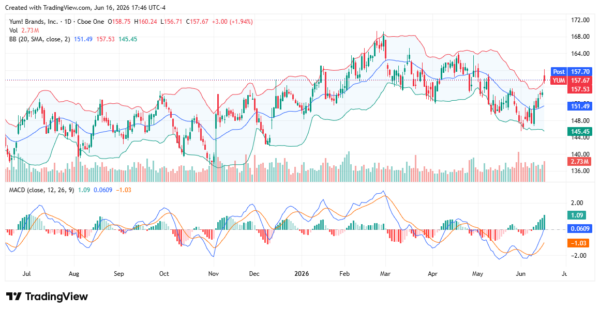
More importantly, the stock has already moved. YUM hit highs near $170 in early 2026 before pulling back. The chart shows the stock reclaiming its 20-day SMA (~$151) and pushing toward its Bollinger Band midline near $157. The MACD has crossed bullish on the daily chart, with the MACD line at 1.09 above the signal line — a constructive signal. But the upper Bollinger Band sits near $163. A sustained move toward $185 requires more than one good quarter.
Yum! - StockEarnings

The Pizza Hut sale will generate one-time separation costs of approximately $85 million. Investors should also note that Pizza Hut contributed meaningful system sales, and its removal will initially compress top-line growth figures.

Long-Term Tailwinds Still Intact

Yum!’s long-term algorithm — 5% unit growth, 7% system sales growth ex-FX, and at least 8% core operating profit growth — doesn’t rely on Pizza Hut. KFC’s international momentum and Taco Bell’s domestic execution are doing the heavy lifting. The company also opened 1,030 gross new units in Q1 alone. That’s annualized unit growth that keeps the royalty engine running.

Add in AI and tech investments through the company’s proprietary Byte by Yum! platform, and this is a business investing in durable competitive advantages — not just cutting costs.

Is Yum! Brands Stock a Buy for 2026 and Beyond?

Yum! Brands is a better business without Pizza Hut. The Q1 earnings report proved the core franchises are healthy. The divestiture removes a drag and unlocks capital for buybacks and reinvestment. At 23x earnings with a bullish technical setup, the stock offers a credible path toward analyst targets in the $185 range.

The risks are real: a leveraged balance sheet, near-term transition costs, and a valuation that already reflects a good deal of the good news. But for investors with a 12- to 18-month horizon, Yum! deserves a spot on the watchlist — if not the portfolio.


A former marketing copywriter turned freelance financial writer and market analyst. I have a passion for delivering insights to investors. I write regularly about stocks for StockEarnings and MarketBeat. Posts are not advice.

Join over 1.2M+ investors/traders who receive daily and weekly notable earnings alerts with predicted move