ajax loader

Loading...


Ride-the-Wave Strategy – Best for Stock Traders

Ride-the-Wave targets multi-day price momentum following a company’s earnings announcement (EA). With this strategy:

  1. Buy a stock one day post-EA if a stock reacts positively post-earnings:
    1. Near the close of trading the EA-day for a pre-market-EA
    2. Near the close of the following day for a post-market-EA
  2. Sell-to-close after 7-10 days, or possibly earlier if a desired price target is reached

Similarly,

  1. short a stock one day post-EA if a stock reacts negatively post-earnings:
    1. near the close of trading the EA-day for a premarket-EA
    2. near the close of the following day for a post-market-EA
  2. then buy-to-close after 7-10 days, or possibly earlier if a desired price target is reached

Important: Ride-the-Wave is predicated on significant price momentum triggered by an EA. The 7-10 day scenario is the maximum trade hold-time. If you see post EA-momentum is halted or reversed by a significant opposite move, re-evaluate your presence in the trade.

This popular StockEarnings screen below will give you a list of stocks that historically exhibit significant price momentum following an EA for the next seven days:

  1. Stocks exhibiting positive post-EA price moves are buy-candidates
  2. Stocks exhibiting negative post-EA price moves are sell/short-candidates

The screen includes those stocks whose Earnings just came out in last two days.

Screen criteria:

  1. Earnings Date Start Date : Current Date + -1 Day
  2. Earnings Date End Date : Current Date + -2 Days
  3. Predicted Move (Next Day) Max : 7%
  4. Predicted Move (On 7th Day) Min : 7%

Strategy Guideline:

  1. Buy the stock if stock has reacted positively. Short the stock if stock has reacted negatively (see above).
  2. Close the position in 7-10 days, or possibly earlier based on price move.

Volatility Crush Strategy - Best for Options Traders

The Volatility Crush strategy is used with stocks that typically experience relatively low-to-moderate price moves (≤4%) following their Earnings Announcements (EA). The basic trade idea is to sell put or call options right before the EA, collecting a credit when options premium is very high due to elevated implied volatility (IV). You then close the position right after the EA by buying the option back much cheaper due to the significant drop in IV that occurs after the mystery of the EA disappears. In assessing this trade, you need to do your homework to ensure you collect sufficient premium to make the trade worthwhile.

This trade is practical due to the low-to-moderate price-move after the EA, which generally won’t significantly affect the options price, unlike an “action” stock, which experience great price moves post-EA. With these symbols, if you’re on the right side of the price move, that’s a great thing. But if you’re on the wrong side of the move, not so great. Consequently, by minimizing the effect of the post-EA price move, you have a much better chance to profit from the reduction in IV without it being ruined by a violent price move.

For this trade, open the position either (1) the night before the EA when the company announces earnings or (2) during the EA day when it announces post-market, generally capturing IV at or close to its peak.

For this trade, open the position either (1) the night before the EA when the company announces earnings or (2) during the EA day when it announces post-market, generally capturing IV at or close to its peak.

This popular stockearnings screen will give you a list of stocks which do not react more than 4% fpost-EA. It includes only those stocks whose earnings are releasing next day.

Screen criteria:

  1. Earnings Date Start Date : Current Date + 1
  2. Earnings Date End Date : Current Date + 1
  3. Predicted Move (Next Day) Max : 4%
  4. Options Type: Weekly

Strategy Guideline:

  1. Options Strategy: Sell Call and Put
  2. Options Strike Price: Current Stock Price – (% Predicated Move x 2)
  3. Expiration Date: It should generally be the closest expiry immediately after the EA.
  4. Buy Insurance: Buying back Call and Put at Strike price which 10% lower than Sell Strike Price is optional but recommended.

Watch Video for More Detail

Volatility Rush Strategy - Best for Options Traders

The Volatility Rush takes advantage of increasing options premiums into earnings announcements (EA) caused by an anticipated rise in Implied Volatility (IV). With this strategy, Buy a Call and Put at-the-money (a long straddle) 2-3 weeks before the EA when IV is lower. Sell the position either (1) the night before the EA when the company announces earnings pre-market, or (2) during the EA day when it announces post-market, generally capturing IV at or close to its peak.

This popular screen will give you a list of stocks whose Options premiums tend to rise into Earnings. It includes only those stocks whose Earnings are at least two weeks away from today.

Screen criteria:

  1. Earnings Date Start Date : Current Date + 15 Days
  2. Earnings Date End Date : Current Date + 30 Days
  3. Predicted Move (Next Day) Min : 5%
  4. Options Type: Weekly or Monthly if that lines up with the two to three-week lead-time for entering the trade

Strategy Guideline:

  1. Buy a Straddle at or close to the money two to three weeks pre-EA.
  2. Sell the position either the night before the EA when the company announces earnings pre-market, or during the EA day when it announces post-market.
  3. Expiration date should generally be the closest expiry immediately after the EA.
  4. Straddle price should not be more 60% of predicted move.

Predicted Move (Volatility)

Similar to Implied Volatility in Options. Expected volatility % based on our Proprietary Volatility Predication Model. We are expecting that stock price will likely to reach % in either direction by the end of next trading session after Earnings are released and not necessarily the closing volatility %.

Why is it important?

    This indicator helps

  1. Knowing expected volatility in stocks after Earnings helps to decide trading stocks before Earnings Announcement.
  2. Taking Advantage of volatility collapse following Earnings Results by using Advance Options strategies such as Spread and Straddles.

Since Last Earnings

Change in share price since last Earnings release.

Why is it Important?

When share has gained more than 10% since it's last Earning release, it tends to over react to minor bad news and give up some gains if not all. So, it contains more downside volatility than upside When share has dropped more than 10% since it's last Earning release, it tends to over react to minor good news and recover some drops if not all. So, it contains more upside volatility than downside.

EPS Surprise (%)

Occurs when a company's reported quarterly or annual profits are above or below analysts' expectations. Here is the formula to derive % EPS Surprice:

Actual EPS - Estimated EPS
------------------------------------- x 100
Estimated EPS

Why is it Important?

Earnings surprises can have a huge impact on a company's stock price. Several studies suggest that positive earnings surprises not only lead to an immediate hike in a stock's price, but also to a gradual increase over time. Hence, it's not surprising that some companies are known for routinely beating earning projections. A negative earnings surprise will usually result in a decline in share price.

Next Day Price Change (%)

Next Regular trading session Closing price following Earnings result.

For After Market Close Earnings, It is a next trading day closing price. For Before Market Open Earnings, It is the same trading day closing price.

Why is it Important?

Next Day price change is a reaction of Earnings result.

3 Down-and-Out Consumer Stocks To Buy on Sector Rotation

Posted on Jun 16, 2026 by Grayson Cavern

3 Down-and-Out Consumer Stocks To Buy on Sector Rotation

For the better part of two years, investors barely needed to look beyond a handful of AI stocks to outperform the market. Capital followed performance, performance attracted more capital, and one of the most powerful momentum trades in recent memory took hold.

Meanwhile, a different opportunity quietly developed elsewhere.

As investors focused on AI, several consumer stocks continued generating billions in revenue, strengthening operations, and rebuilding investor confidence while expectations drifted lower. That’s where I’m looking today.

Nike Is Reclaiming Ground


Few companies command the kind of global brand recognition Nike (NYSE: NKE) does. Professional athletes wear its products. Amateur athletes train in them. Consumers across every major market recognize the swoosh instantly. That kind of brand equity takes decades to build and billions of dollars to replicate.

No wonder why Nike generated $11.3 billion in revenue during its latest fiscal 2026 third quarter, including $11.0 billion from the Nike brand itself, while wholesale revenue reached $6.5 billion. Management spent the last several quarters reducing inventory, rebuilding wholesale relationships, and sharpening product execution after a period that tested investor patience.

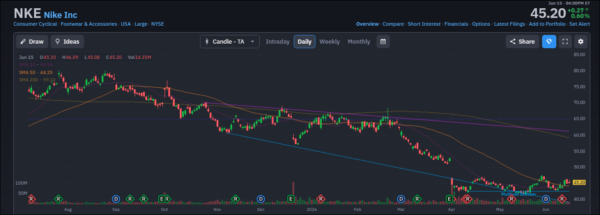
The stock chart now shows those efforts beginning to gain traction.

Shares recently traded at $45.20, above the 20-day moving average of $44.54 and the 50-day moving average of $44.25 after spending months building a base in the low-$40 range. Trading volume remains elevated at roughly 14.35 million shares a day while the stock continues working toward its 200-day moving average of $59.23.

Revenue, inventory progress, and improving price action now point in the same direction. The share price still sits far below levels investors once considered normal for Nike, creating a setup not only where operational improvement carries the potential to matter far more than it would during periods of peak optimism, but also a buying opportunity for the bulls.
consumer stocks-StocksEarnings

Starbucks Continues To Benefit From Scale

Starbucks (NASDAQ: SBUX) built one of the most recognizable consumer brands in the world by turning a daily habit into a global business. More than 40,000 stores now serve customers across dozens of countries, creating a footprint few restaurant companies can match.

Starbucks produced approximately $229.9 million in operating income during its latest quarter 2 2026 earnings while maintaining an operating margin of 40.5%. Those figures reflect a business that continues generating meaningful profits despite facing the same consumer pressures affecting much of the industry.

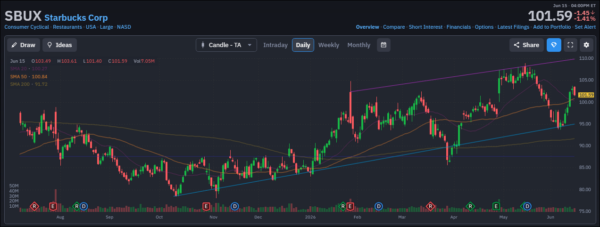
Shares recently traded at $101.59, above the 20-day moving average of $100.28, the 50-day moving average of $100.84, and the 200-day moving average of $91.72. Roughly 7.05 million shares change hands daily while the stock continues building on a recovery that began earlier this year.

Price action often reveals where capital is moving before headlines catch up. Investors spent months discussing slowing traffic, China concerns, and operational challenges. The stock spent the same period climbing above every major moving average.

Scale, profitability, and strengthening momentum rarely travel together by accident.

Starbucks already possesses the store network, customer loyalty ecosystem, pricing power, and brand recognition required to benefit when investor attention broadens beyond technology.
consumer stocks-StocksEarnings

Target Quietly Rebuilt Momentum

Target (NYSE: TGT) spent the last several years navigating shifting consumer behavior, inventory challenges, inflation pressures, and changing spending patterns. Investors responded by pushing the stock into one of the steepest drawdowns among large retail names.

The business continued producing results.

Target earned $1.71 per share during its quarter 1 2026 earnings and a revenue beat of $25.44 billion. Those figures came from a retailer operating thousands of locations, maintaining nationwide brand recognition, and generating billions of dollars in annual revenue.

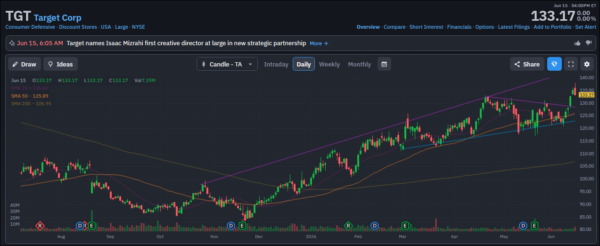
The stock currently trades at $133.17, comfortably above the 20-day moving average of $126.60, the 50-day moving average of $125.89, and the 200-day moving average of $106.95. Average daily volume sits near 7.29 million shares while the stock continues building a higher-high, higher-low structure after climbing from the mid-$80 range reached last year.

Investors searching for consumer exposure don’t need to imagine a turnaround scenario or project aggressive growth assumptions. The company already generates earnings, already generates cash flow, and already possesses the infrastructure required to participate in a stronger consumer environment.
consumer stocks-StocksEarnings

Why This Shift Into Consumer Stocks Matters

The strongest opportunities rarely emerge from the most crowded trade on Wall Street.

Granted, AI deserved much of the capital it attracted. Revenue growth, infrastructure spending, and demand for computing power created one of the most compelling investment themes of the decade. Investors recognized that early and benefited accordingly.

At the same time, capital concentration creates opportunities elsewhere.

Nike generated $11.3 billion in quarterly revenue while rebuilding technical momentum above key moving averages.

Starbucks produced substantial operating income, maintained a global footprint exceeding 40,000 stores, and pushed above its 20-day, 50-day, and 200-day moving averages.

Target generated $22.44 billion in revenue while climbing more than 50% from last year’s lows and establishing one of the strongest charts in the retail sector.

What you’re seeing are figures that best describe businesses executing in the real world while capital remains focused elsewhere.

Eventually, stock prices and business performance find each other.

Nike, Starbucks, and Target already possess the scale, financial resources, and improving technical setups required to benefit if capital begins searching beyond the market’s most crowded trade. The companies continue generating revenue. The earnings reports continue arriving. The charts continue improving.

Wall Street won’t ignore those combinations forever.

Join over 1.2M+ investors/traders who receive daily and weekly notable earnings alerts with predicted move