After two years of false starts, sector rotation appears to be moving away from technology stocks. There are reasons to believe biopharma stocks may benefit. Specifically, investors are hunting for earnings visibility, durable pipelines, and growing dividends, and are landing on two names: AbbVie (NYSE: ABBV) and Johnson & Johnson (NYSE: JNJ). Both are catching a bid and deserve a close look. But they are not the same trade.
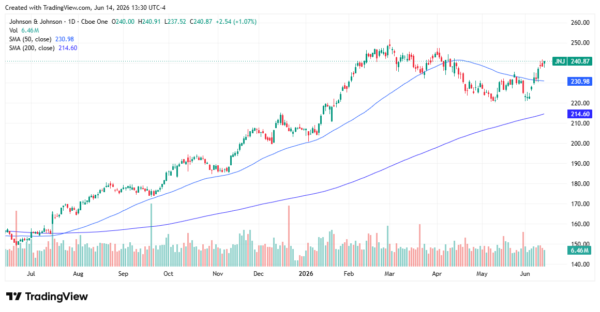
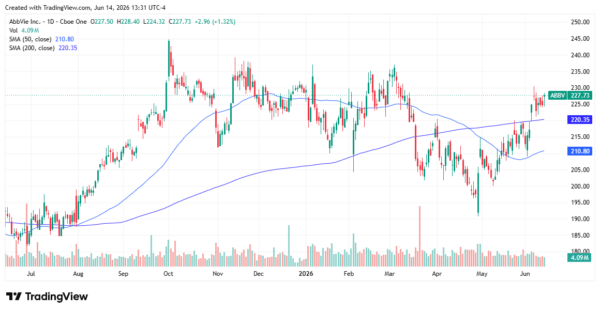
JNJ is outperforming ABBV year-to-date, and the gap is not trivial. Johnson & Johnson is up roughly 17% in 2026. AbbVie is flat for the year as of June 12, but has been rallying. On the surface, that makes JNJ the obvious choice. But surface readings in biopharma are dangerous. The underlying growth rates, pipeline trajectories, and acquisition strategies tell a more complicated story — one that could favor AbbVie if investors are willing to look past short-term price action.
JNJ is a diversified healthcare conglomerate operating across Innovative Medicine and MedTech. It is approaching $100 billion in annual revenue and has 64 consecutive years of dividend increases. The company has become a more defined biopharma investment since its divestment of Kenvue (NYSE: KVUE) in 2023.
AbbVie is a more concentrated bet: a biopharma pure-play that survived the Humira patent cliff by spending aggressively on acquisitions and building a next-generation immunology franchise around Skyrizi and Rinvoq.
The questions investors need to answer are straightforward. Does JNJ’s diversification justify a premium over AbbVie’s superior revenue growth rate? And does AbbVie’s acquisition-heavy balance sheet carry risks that JNJ’s more conservative posture avoids? What follows is a direct comparison of both companies across the metrics that matter most in a rotation trade.
Two Giants, Different Architectures
Johnson & Johnson delivered Q1 2026 reported sales growth of 9.9% to $24.1 billion, with adjusted EPS of $2.70, and raised its full-year 2026 guidance to estimated reported sales of $100.8 billion — a 7% increase at the midpoint. The company currently has 28 platforms or products generating at least $1 billion in annual revenue and is projecting double-digit growth by the end of the decade.
The MedTech segment provides something no pure-play pharma can replicate: a structural hedge against drug-cycle risk, with exposure to electrophysiology, orthopedics, and surgical robotics that generates revenue regardless of what happens in any single pipeline.
AbbVie’s architecture is narrower, but its growth rate is faster. Q1 2026 worldwide net revenues reached $15.0 billion, an increase of 12.4% on a reported basis, with the immunology portfolio rising 16.4% to $7.29 billion. Full-year 2026 adjusted EPS guidance stands at $14.37 to $14.57, reflecting another year of robust growth following record net sales in 2025. The company has fully cleared the Humira cliff — the drug that once generated more than $20 billion annually has been replaced, not propped up.
The Acquisition Scorecards
Both companies have been active acquirers, but the scale and philosophy differ sharply. JNJ’s latest move is surgical. On June 8, 2026, Johnson & Johnson entered into a definitive agreement to acquire Firefly Bio, Inc. for $1 billion in cash. Firefly Bio is advancing its proprietary Firelink degrader antibody-conjugate platform, focused on KRAS-driven tumors.
The Firelink DAC platform is designed to deliver a selective protein degrader to tumor cells while avoiding healthy cells. Rather than buying a commercial product, JNJ is acquiring a platform—one that could yield multiple oncology candidates targeting a historically undruggable mutation. The deal is modest in dollar terms but meaningful as a signal of where JNJ sees the next wave of cancer therapy heading.
AbbVie has taken a different approach: serial, large-scale acquisitions designed to diversify entirely away from any single therapeutic area. The 2020 acquisition of Allergan created leadership positions in immunology and neuroscience, as well as a global aesthetics franchise built around Botox and Juvederm.
That was followed by two transformative 2024 deals: the $8.7 billion acquisition of Cerevel Therapeutics, adding a neuroscience pipeline targeting psychiatric and neurological disorders, and the $10.1 billion acquisition of ImmunoGen, bringing in ELAHERE, a first-in-class antibody-drug conjugate approved for platinum-resistant ovarian cancer. The cumulative M&A spend over five years exceeds $60 billion. The payoff is a genuinely diversified revenue base. The cost is a leveraged balance sheet that requires execution to justify.
The Growth Picture
AbbVie’s near-term story runs through two drugs. Skyrizi sales grew 29.2% year over year to $4.48 billion in Q1 2026, while Rinvoq generated $2.12 billion, up 20.2%. AbbVie now expects full-year Skyrizi revenues of approximately $21.6 billion and Rinvoq revenues of approximately $10.2 billion, with the two drugs projected to deliver combined growth of more than 20% in 2026. Management believes the sell-side is still underestimating the ceiling — CEO Robert Michael stated that consensus peaks Skyrizi at $33 billion in 2031, while AbbVie expects to exceed that figure.
JNJ’s growth is broader but more measured. Innovative Medicine worldwide operational sales grew 7.4%, driven primarily by DARZALEX, CARVYKTI, ERLEADA, and RYBREVANT in oncology, TREMFYA in immunology, and SPRAVATO in neuroscience, partially offset by biosimilar pressure on STELARA. The diversification that limits upside also limits downside — no single product failure is capable of derailing the enterprise.
Which Biopharma Stock Wins From Here?
JNJ’s 2026 outperformance reflects its defensive characteristics. Low beta, two business segments, and a balance sheet that carries JNJ through litigation cycles — including ongoing talc liability — make it the natural first landing spot when investors exit high-multiple growth stocks. That trade has played out this year.
But defensive leadership rarely persists indefinitely. AbbVie’s immunology engines are still accelerating, its neuroscience and oncology acquisitions are beginning to contribute, and its 2026 adjusted EPS guidance implies a valuation that looks reasonable relative to its growth rate. If rotation into healthcare broadens from defensive positioning into genuine growth-seeking, AbbVie’s superior top-line momentum becomes a more compelling argument.
Both biopharma stocks are on the radar of investors waiting for the sector to catch a bid. JNJ is the anchor trade; AbbVie is the growth lever. Which wins in the second half of 2026 depends largely on whether this rotation stays defensive or gets aggressive.