ajax loader

Loading...


Ride-the-Wave Strategy – Best for Stock Traders

Ride-the-Wave targets multi-day price momentum following a company’s earnings announcement (EA). With this strategy:

  1. Buy a stock one day post-EA if a stock reacts positively post-earnings:
    1. Near the close of trading the EA-day for a pre-market-EA
    2. Near the close of the following day for a post-market-EA
  2. Sell-to-close after 7-10 days, or possibly earlier if a desired price target is reached

Similarly,

  1. short a stock one day post-EA if a stock reacts negatively post-earnings:
    1. near the close of trading the EA-day for a premarket-EA
    2. near the close of the following day for a post-market-EA
  2. then buy-to-close after 7-10 days, or possibly earlier if a desired price target is reached

Important: Ride-the-Wave is predicated on significant price momentum triggered by an EA. The 7-10 day scenario is the maximum trade hold-time. If you see post EA-momentum is halted or reversed by a significant opposite move, re-evaluate your presence in the trade.

This popular StockEarnings screen below will give you a list of stocks that historically exhibit significant price momentum following an EA for the next seven days:

  1. Stocks exhibiting positive post-EA price moves are buy-candidates
  2. Stocks exhibiting negative post-EA price moves are sell/short-candidates

The screen includes those stocks whose Earnings just came out in last two days.

Screen criteria:

  1. Earnings Date Start Date : Current Date + -1 Day
  2. Earnings Date End Date : Current Date + -2 Days
  3. Predicted Move (Next Day) Max : 7%
  4. Predicted Move (On 7th Day) Min : 7%

Strategy Guideline:

  1. Buy the stock if stock has reacted positively. Short the stock if stock has reacted negatively (see above).
  2. Close the position in 7-10 days, or possibly earlier based on price move.

Volatility Crush Strategy - Best for Options Traders

The Volatility Crush strategy is used with stocks that typically experience relatively low-to-moderate price moves (≤4%) following their Earnings Announcements (EA). The basic trade idea is to sell put or call options right before the EA, collecting a credit when options premium is very high due to elevated implied volatility (IV). You then close the position right after the EA by buying the option back much cheaper due to the significant drop in IV that occurs after the mystery of the EA disappears. In assessing this trade, you need to do your homework to ensure you collect sufficient premium to make the trade worthwhile.

This trade is practical due to the low-to-moderate price-move after the EA, which generally won’t significantly affect the options price, unlike an “action” stock, which experience great price moves post-EA. With these symbols, if you’re on the right side of the price move, that’s a great thing. But if you’re on the wrong side of the move, not so great. Consequently, by minimizing the effect of the post-EA price move, you have a much better chance to profit from the reduction in IV without it being ruined by a violent price move.

For this trade, open the position either (1) the night before the EA when the company announces earnings or (2) during the EA day when it announces post-market, generally capturing IV at or close to its peak.

For this trade, open the position either (1) the night before the EA when the company announces earnings or (2) during the EA day when it announces post-market, generally capturing IV at or close to its peak.

This popular stockearnings screen will give you a list of stocks which do not react more than 4% fpost-EA. It includes only those stocks whose earnings are releasing next day.

Screen criteria:

  1. Earnings Date Start Date : Current Date + 1
  2. Earnings Date End Date : Current Date + 1
  3. Predicted Move (Next Day) Max : 4%
  4. Options Type: Weekly

Strategy Guideline:

  1. Options Strategy: Sell Call and Put
  2. Options Strike Price: Current Stock Price – (% Predicated Move x 2)
  3. Expiration Date: It should generally be the closest expiry immediately after the EA.
  4. Buy Insurance: Buying back Call and Put at Strike price which 10% lower than Sell Strike Price is optional but recommended.

Watch Video for More Detail

Volatility Rush Strategy - Best for Options Traders

The Volatility Rush takes advantage of increasing options premiums into earnings announcements (EA) caused by an anticipated rise in Implied Volatility (IV). With this strategy, Buy a Call and Put at-the-money (a long straddle) 2-3 weeks before the EA when IV is lower. Sell the position either (1) the night before the EA when the company announces earnings pre-market, or (2) during the EA day when it announces post-market, generally capturing IV at or close to its peak.

This popular screen will give you a list of stocks whose Options premiums tend to rise into Earnings. It includes only those stocks whose Earnings are at least two weeks away from today.

Screen criteria:

  1. Earnings Date Start Date : Current Date + 15 Days
  2. Earnings Date End Date : Current Date + 30 Days
  3. Predicted Move (Next Day) Min : 5%
  4. Options Type: Weekly or Monthly if that lines up with the two to three-week lead-time for entering the trade

Strategy Guideline:

  1. Buy a Straddle at or close to the money two to three weeks pre-EA.
  2. Sell the position either the night before the EA when the company announces earnings pre-market, or during the EA day when it announces post-market.
  3. Expiration date should generally be the closest expiry immediately after the EA.
  4. Straddle price should not be more 60% of predicted move.

Predicted Move (Volatility)

Similar to Implied Volatility in Options. Expected volatility % based on our Proprietary Volatility Predication Model. We are expecting that stock price will likely to reach % in either direction by the end of next trading session after Earnings are released and not necessarily the closing volatility %.

Why is it important?

    This indicator helps

  1. Knowing expected volatility in stocks after Earnings helps to decide trading stocks before Earnings Announcement.
  2. Taking Advantage of volatility collapse following Earnings Results by using Advance Options strategies such as Spread and Straddles.

Since Last Earnings

Change in share price since last Earnings release.

Why is it Important?

When share has gained more than 10% since it's last Earning release, it tends to over react to minor bad news and give up some gains if not all. So, it contains more downside volatility than upside When share has dropped more than 10% since it's last Earning release, it tends to over react to minor good news and recover some drops if not all. So, it contains more upside volatility than downside.

EPS Surprise (%)

Occurs when a company's reported quarterly or annual profits are above or below analysts' expectations. Here is the formula to derive % EPS Surprice:

Actual EPS - Estimated EPS
------------------------------------- x 100
Estimated EPS

Why is it Important?

Earnings surprises can have a huge impact on a company's stock price. Several studies suggest that positive earnings surprises not only lead to an immediate hike in a stock's price, but also to a gradual increase over time. Hence, it's not surprising that some companies are known for routinely beating earning projections. A negative earnings surprise will usually result in a decline in share price.

Next Day Price Change (%)

Next Regular trading session Closing price following Earnings result.

For After Market Close Earnings, It is a next trading day closing price. For Before Market Open Earnings, It is the same trading day closing price.

Why is it Important?

Next Day price change is a reaction of Earnings result.

190 Million New Users Couldn’t Save Adobe’s Stock

Posted on Jun 12, 2026 by Grayson Cavern

190 Million New Users Couldn’t Save Adobe’s Stock

Adobe Inc (NASDAQ: ADBE) delivered the kind of quarter 2 earnings results most companies would gladly take. Revenue climbed 11% year-over-year to a record $5.87 billion. Adjusted earnings per share rose 13% to $5.06. The company raised its full-year outlook. Management authorized another $25 billion share repurchase program. And perhaps most surprisingly, Adobe added roughly 190 million new monthly active users across its products over the past year. Then the stock fell more than 6% after earnings, wiping billions off Adobe’s market value in a single session. Indicating that the market continues to treat the company as if its best days are behind it. 

If 190 million new users, higher guidance, and a fresh $25 billion buyback authorization aren’t enough to impress Wall Street, what exactly is the market worried about?

Who Are The 190 Million Users?


The headline figures were genuinely difficult to criticize: revenue of $6.62 billion, $2.17 billion in operating cash flow, a 44.5% non-GAAP operating margin, Digital Media ARR grew to $18.09 billion, expanded its user base by roughly 190 million people, and authorized another $25 billion in share repurchases. Companies do not announce repurchase programs of that scale when they believe the business is deteriorating but when they believe the market is pricing in a scenario worse than what they see internally.

You’d agree with me that the user growth should have been the headline moment. 190 million new monthly active users in a single year, driven by Firefly, Express, Acrobat, and a broadening generative AI ecosystem pulling creators into Adobe’s orbit who wouldn’t have engaged with the platform previously. For most software businesses, that kind of funnel expansion would dominate the post-earnings conversation and trigger a re-rating of the long-term monetization opportunity.

Instead, investors barely reacted to it, because Wall Street wasn’t focused on how many users Adobe added. It was focused on who those users are and whether they will ever generate revenue at the level the multiple requires.

Is The Moat Eroding?

For decades, Adobe operated behind one of the most durable competitive moats in enterprise software, built not from network effects or switching costs alone but from something harder to replicate: deep workflow embedding. Creative professionals spent years mastering Photoshop, Illustrator, Premiere Pro, and After Effects, entire careers were built around fluency in Adobe’s ecosystem, and companies hired specifically for that expertise. That kind of entrenchment doesn’t disappear overnight, and anyone arguing Adobe’s moat has already collapsed is overstating the current competitive reality.

But the concern the market is pricing is more subtle and more interesting than a straightforward competitive threat. As we speak, the worry is not that Canva or Figma displaces Adobe’s professional base tomorrow, it is that AI is gradually changing the economics of creative work in ways that reduce the premium attached to deep tool mastery over time.

Consider this; if generative AI makes certain creative tasks faster, cheaper, and more accessible to non-professionals, the next generation of creators may place less value on building expertise inside Adobe’s ecosystem than the generation that built the moat in the first place. That is a slow-moving structural risk, difficult to quantify and impossible to disprove in a single quarter, which is exactly why it hangs over the stock regardless of what the near-term results look like.

How Uncertainty Re-Rated The Stock

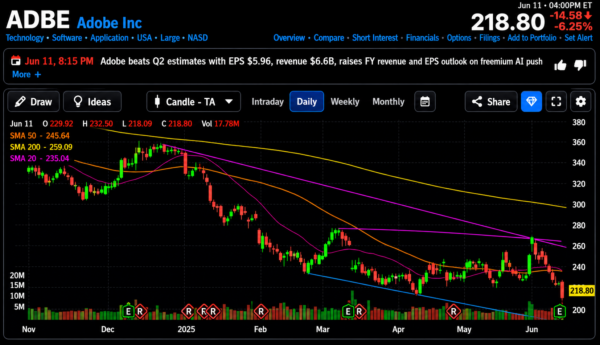
Adobe closed around $218.80 following the selloff, sitting below its 20-day moving average near $235, below its 50-day near $246, and well below its 200-day near $259. That technical positioning tells me the market is not rewarding current execution and neither is it punishing the stock for failing. It didn’t.

Instead, it is discounting future uncertainty, and until Adobe provides clearer evidence of how those 190 million new users convert into revenue at scale, the price action will continue reflecting that unresolved question rather than the income statement.

In 2021, investors valued Adobe at nearly 19 times sales. Today, the stock trades closer to 4 times sales despite generating substantially more revenue, more cash flow, and serving a dramatically larger user base in this quarter.
adobe-StockEarnings

I Don’t See A Broken Company

I understand why the market is skeptical.

AI is changing the creative software industry. Competition is increasing. And investors want proof that Adobe can convert all those new users into meaningful long-term revenue. Those concerns are legitimate. But I also think the market may be underestimating how deeply embedded Adobe remains inside professional creative workflows.

Maybe Wall Street is right and those 190 million users never become as valuable as management hopes.

But when I see a business still growing, still generating cash, still attracting users, and still buying back stock aggressively while trading far below its historical highs, I don’t see a broken company.

I see a company trying to prove that its next chapter will be bigger than its last.

Join over 1.2M+ investors/traders who receive daily and weekly notable earnings alerts with predicted move