ajax loader

Loading...


Ride-the-Wave Strategy – Best for Stock Traders

Ride-the-Wave targets multi-day price momentum following a company’s earnings announcement (EA). With this strategy:

  1. Buy a stock one day post-EA if a stock reacts positively post-earnings:
    1. Near the close of trading the EA-day for a pre-market-EA
    2. Near the close of the following day for a post-market-EA
  2. Sell-to-close after 7-10 days, or possibly earlier if a desired price target is reached

Similarly,

  1. short a stock one day post-EA if a stock reacts negatively post-earnings:
    1. near the close of trading the EA-day for a premarket-EA
    2. near the close of the following day for a post-market-EA
  2. then buy-to-close after 7-10 days, or possibly earlier if a desired price target is reached

Important: Ride-the-Wave is predicated on significant price momentum triggered by an EA. The 7-10 day scenario is the maximum trade hold-time. If you see post EA-momentum is halted or reversed by a significant opposite move, re-evaluate your presence in the trade.

This popular StockEarnings screen below will give you a list of stocks that historically exhibit significant price momentum following an EA for the next seven days:

  1. Stocks exhibiting positive post-EA price moves are buy-candidates
  2. Stocks exhibiting negative post-EA price moves are sell/short-candidates

The screen includes those stocks whose Earnings just came out in last two days.

Screen criteria:

  1. Earnings Date Start Date : Current Date + -1 Day
  2. Earnings Date End Date : Current Date + -2 Days
  3. Predicted Move (Next Day) Max : 7%
  4. Predicted Move (On 7th Day) Min : 7%

Strategy Guideline:

  1. Buy the stock if stock has reacted positively. Short the stock if stock has reacted negatively (see above).
  2. Close the position in 7-10 days, or possibly earlier based on price move.

Volatility Crush Strategy - Best for Options Traders

The Volatility Crush strategy is used with stocks that typically experience relatively low-to-moderate price moves (≤4%) following their Earnings Announcements (EA). The basic trade idea is to sell put or call options right before the EA, collecting a credit when options premium is very high due to elevated implied volatility (IV). You then close the position right after the EA by buying the option back much cheaper due to the significant drop in IV that occurs after the mystery of the EA disappears. In assessing this trade, you need to do your homework to ensure you collect sufficient premium to make the trade worthwhile.

This trade is practical due to the low-to-moderate price-move after the EA, which generally won’t significantly affect the options price, unlike an “action” stock, which experience great price moves post-EA. With these symbols, if you’re on the right side of the price move, that’s a great thing. But if you’re on the wrong side of the move, not so great. Consequently, by minimizing the effect of the post-EA price move, you have a much better chance to profit from the reduction in IV without it being ruined by a violent price move.

For this trade, open the position either (1) the night before the EA when the company announces earnings or (2) during the EA day when it announces post-market, generally capturing IV at or close to its peak.

For this trade, open the position either (1) the night before the EA when the company announces earnings or (2) during the EA day when it announces post-market, generally capturing IV at or close to its peak.

This popular stockearnings screen will give you a list of stocks which do not react more than 4% fpost-EA. It includes only those stocks whose earnings are releasing next day.

Screen criteria:

  1. Earnings Date Start Date : Current Date + 1
  2. Earnings Date End Date : Current Date + 1
  3. Predicted Move (Next Day) Max : 4%
  4. Options Type: Weekly

Strategy Guideline:

  1. Options Strategy: Sell Call and Put
  2. Options Strike Price: Current Stock Price – (% Predicated Move x 2)
  3. Expiration Date: It should generally be the closest expiry immediately after the EA.
  4. Buy Insurance: Buying back Call and Put at Strike price which 10% lower than Sell Strike Price is optional but recommended.

Watch Video for More Detail

Volatility Rush Strategy - Best for Options Traders

The Volatility Rush takes advantage of increasing options premiums into earnings announcements (EA) caused by an anticipated rise in Implied Volatility (IV). With this strategy, Buy a Call and Put at-the-money (a long straddle) 2-3 weeks before the EA when IV is lower. Sell the position either (1) the night before the EA when the company announces earnings pre-market, or (2) during the EA day when it announces post-market, generally capturing IV at or close to its peak.

This popular screen will give you a list of stocks whose Options premiums tend to rise into Earnings. It includes only those stocks whose Earnings are at least two weeks away from today.

Screen criteria:

  1. Earnings Date Start Date : Current Date + 15 Days
  2. Earnings Date End Date : Current Date + 30 Days
  3. Predicted Move (Next Day) Min : 5%
  4. Options Type: Weekly or Monthly if that lines up with the two to three-week lead-time for entering the trade

Strategy Guideline:

  1. Buy a Straddle at or close to the money two to three weeks pre-EA.
  2. Sell the position either the night before the EA when the company announces earnings pre-market, or during the EA day when it announces post-market.
  3. Expiration date should generally be the closest expiry immediately after the EA.
  4. Straddle price should not be more 60% of predicted move.

Predicted Move (Volatility)

Similar to Implied Volatility in Options. Expected volatility % based on our Proprietary Volatility Predication Model. We are expecting that stock price will likely to reach % in either direction by the end of next trading session after Earnings are released and not necessarily the closing volatility %.

Why is it important?

    This indicator helps

  1. Knowing expected volatility in stocks after Earnings helps to decide trading stocks before Earnings Announcement.
  2. Taking Advantage of volatility collapse following Earnings Results by using Advance Options strategies such as Spread and Straddles.

Since Last Earnings

Change in share price since last Earnings release.

Why is it Important?

When share has gained more than 10% since it's last Earning release, it tends to over react to minor bad news and give up some gains if not all. So, it contains more downside volatility than upside When share has dropped more than 10% since it's last Earning release, it tends to over react to minor good news and recover some drops if not all. So, it contains more upside volatility than downside.

EPS Surprise (%)

Occurs when a company's reported quarterly or annual profits are above or below analysts' expectations. Here is the formula to derive % EPS Surprice:

Actual EPS - Estimated EPS
------------------------------------- x 100
Estimated EPS

Why is it Important?

Earnings surprises can have a huge impact on a company's stock price. Several studies suggest that positive earnings surprises not only lead to an immediate hike in a stock's price, but also to a gradual increase over time. Hence, it's not surprising that some companies are known for routinely beating earning projections. A negative earnings surprise will usually result in a decline in share price.

Next Day Price Change (%)

Next Regular trading session Closing price following Earnings result.

For After Market Close Earnings, It is a next trading day closing price. For Before Market Open Earnings, It is the same trading day closing price.

Why is it Important?

Next Day price change is a reaction of Earnings result.

Can Nike Reclaim Its Brand Power Before It’s Too Late? 

Posted on Jun 12, 2026 by Chris Markoch

Can Nike Reclaim Its Brand Power Before It’s Too Late? 

Earnings season is being talked about in the past tense. That’s fitting, because one of the stragglers left to report is Nike Inc. (NYSE: NKE). Like earnings season, many investors have taken to talking about Nike in the past tense. There are reasons for that, and it’s a shame. 

Nike reports earnings on June 30, and it’s doubtful the company will tell investors anything they want to hear. 

But does that merit NKE trading at 2015 levels?  

That’s a question that investors will answer. We don’t invest in an efficient market. In better days, NKE stock was worth what investors were willing to pay, which was enough for Nike to split its stock seven times since going public in 1983.  

Today, Nike is seeing the other shoe drop. The company is in the middle of a turnaround, but right now, that sounds like a company playing defense. A better strategy might be for the company to go on offense.  

I love analyzing and writing about stocks. But before that, I spent a lot of time in marketing, and I believe that Nike has a marketing problem. So, if I were to write an open letter to Nike management, here’s what I’d say: 

Please, Nike. Just Do It.  


An open letter to the swoosh — from an investor who still wants to believe 

Dear Nike, 

Let me take you back to a simpler time. 

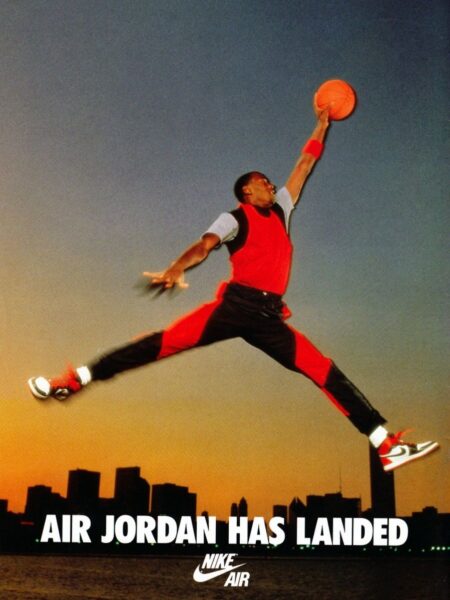
It’s 1992. Michael Jordan is in the air — literally.  

He’s palming a basketball with one hand, his tongue out, legs spread like he owns the stratosphere.  

The logo below him doesn’t even need a name. You know exactly whose shoe it is. 

You know exactly whose company it is. And you know, without question, who runs the athletic footwear world. 

That was you, Nike. That was all you. 

I’ll be honest — I was a Reebok kid. I liked being the underdog. I liked the rebellion.  

But I respected Nike the way you respect a champion you can’t quite beat. You were Coca-Cola (NYSE: KO). Reebok was Pepsi (NASDAQ: PEP). And no matter how good the challenger tasted, the original was still the original. 

So what happened? 

You Got Lost on the Way to the Trophy Case 

Your quarterly earnings report is coming up on June 30. And to be honest, the numbers aren’t going to matter. Investors know it’s going to be a meh print. 

Free cash flow has compressed dramatically — down from $3.27 billion in fiscal 2025 to a trailing twelve-month figure around $1 billion today. Gross margins are getting eaten alive by tariffs, down 130 basis points to 40.2% last quarter. Net income fell 35% year-over-year in Q3.  

None of those is likely to be much better in the quarter just ended.  

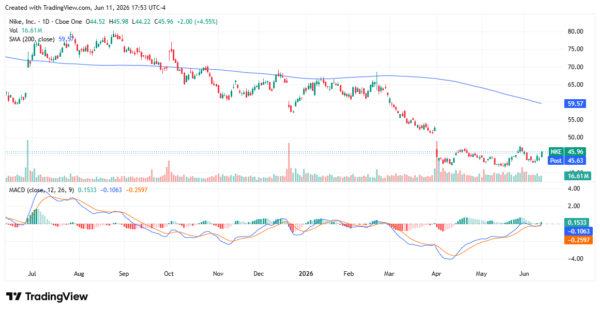
Your stock is trading near 2015 levels, around $46, well below its 200-day moving average, which has been pointing south for a year. 
nike - StockEarnings

And yet, here’s what I’d argue: the market has overcorrected. At roughly 30x earnings, your stock isn’t dramatically expensive by historical standards. You don’t have a broken business. You have a distracted one. 

The Reebok lesson should have stuck. There will always be an Adidas (OTCMKTS: ADDDF), an On Running, a Hoka nipping at your heels. You can’t win by trying to be everything. The agile competitor never sleeps. The only antidote is to be so good at what you do best that the challenger never lands a clean hit. 

Somewhere along the way, you drifted. You went deep into the equipment. You expanded aggressively into apparel. The sneaker game — the thing that made Nike a religion — got complicated. You chased growth in every direction, and in doing so, you gave the competition room to breathe. 

The World Cup Is Your Open Door 

Here’s the thing about the 2026 FIFA World Cup happening right now on home soil: Adidas is the official tournament sponsor. They’re everywhere. The branding, the match balls, the pavilions. They bought the headline. 

But you outfit Team USA. 

And let me tell you something about the American sports fan. We are, almost entirely, World Cup casuals. We’ll watch Team USA play, and we won’t watch much else. There’s a reason most Americans still call it soccer.  

That’s not a knock; it’s an opportunity. Because the casual American viewer watching the U.S. national team isn’t already loyal to Adidas. They’re watching American athletes in American colors — and you dress them. 

Be the boss. Be the brand that doesn’t apologize. You have done this before. You have made counterprogramming look like leadership. 

Run the campaign. Make it loud. Make it feel like 1992 again — hungry, confident, a little dangerous. Don’t let Adidas own the summer while you quietly wait for the noise to die down. This is a moment. Take it. 

The Marketing Problem Is Real — But So Is the Fix 

The deeper issue is identity. Nike has, almost without realizing it, become a challenger brand. You’re playing defense against On Running and HOKA on performance, against New Balance and Adidas on lifestyle and retro appeal. That’s not a position you play well, and it’s not a position Nike should be in. 

The path back is not complicated, even if it requires courage. 

Bring Jordan back. 

Not the Jordan brand as a sub-label — the man himself. Go nostalgia. Tap into the cultural nostalgia economy that has made everything from vintage jerseys to 1980s movie franchises bankable again. Gen Z and Gen Alpha don’t remember the first Air Jordan era. Show them what they missed. Make them feel like they’re discovering something. You have arguably the greatest marketing asset in the history of sports sitting in North Carolina. Use him. 

And on the product side — get back to the shoe. Run the retros. Do the heritage drops. But also create the next Air Max moment. The next Pegasus. The next shoe that a teenager will remember wearing when they were fifteen. 
nike - StockEarnings

The Hard Stuff: Tariffs and Manufacturing 

Let’s be real about the headwinds. Tariffs are cutting into margins with no near-term relief. Nearly all of Nike’s production is outsourced to contract manufacturers across more than 30 countries, and reshoring — even partially — would take years and cost billions. Management knows this. Investors know this. 

What the June 30 earnings call needs to deliver is not a miracle. It’s a credible plan. Show investors that the restructuring is working. Show that inventory discipline is holding — it is, with inventories down 1% year-over-year. Show that North America is stabilizing — wholesale revenue was up 5% last quarter. And show that the marketing machine is coming back online in time to capture the World Cup moment. 

Cash and short-term investments still total $8.1 billion. That’s not a company in crisis. That’s a company with choices. Choose wisely.

Back to the Locker Room 

So here it is, Nike. The speech before the game. 

You are not a startup figuring out who you are. You are not a brand searching for a story. You have Michael Jordan. You have the Swoosh. You have over 20 consecutive years of dividend growth. You have the world’s biggest sporting event happening in your home country right now. 

Yes, the stock chart looks ugly. Yes, the margins are under pressure. Yes, the doubters are loud. 

But this is not the moment to play cautious. 

This is the moment to remind everyone — investors, consumers, and competitors alike — exactly who built this industry. Stop managing the decline. Start chasing the comeback. 

You already have the slogan. 

Just Do It. 

A former marketing copywriter turned freelance financial writer and market analyst. I have a passion for delivering insights to investors. I write regularly about stocks for StockEarnings and MarketBeat. Posts are not advice.

Join over 1.2M+ investors/traders who receive daily and weekly notable earnings alerts with predicted move