ajax loader

Loading...


Ride-the-Wave Strategy – Best for Stock Traders

Ride-the-Wave targets multi-day price momentum following a company’s earnings announcement (EA). With this strategy:

  1. Buy a stock one day post-EA if a stock reacts positively post-earnings:
    1. Near the close of trading the EA-day for a pre-market-EA
    2. Near the close of the following day for a post-market-EA
  2. Sell-to-close after 7-10 days, or possibly earlier if a desired price target is reached

Similarly,

  1. short a stock one day post-EA if a stock reacts negatively post-earnings:
    1. near the close of trading the EA-day for a premarket-EA
    2. near the close of the following day for a post-market-EA
  2. then buy-to-close after 7-10 days, or possibly earlier if a desired price target is reached

Important: Ride-the-Wave is predicated on significant price momentum triggered by an EA. The 7-10 day scenario is the maximum trade hold-time. If you see post EA-momentum is halted or reversed by a significant opposite move, re-evaluate your presence in the trade.

This popular StockEarnings screen below will give you a list of stocks that historically exhibit significant price momentum following an EA for the next seven days:

  1. Stocks exhibiting positive post-EA price moves are buy-candidates
  2. Stocks exhibiting negative post-EA price moves are sell/short-candidates

The screen includes those stocks whose Earnings just came out in last two days.

Screen criteria:

  1. Earnings Date Start Date : Current Date + -1 Day
  2. Earnings Date End Date : Current Date + -2 Days
  3. Predicted Move (Next Day) Max : 7%
  4. Predicted Move (On 7th Day) Min : 7%

Strategy Guideline:

  1. Buy the stock if stock has reacted positively. Short the stock if stock has reacted negatively (see above).
  2. Close the position in 7-10 days, or possibly earlier based on price move.

Volatility Crush Strategy - Best for Options Traders

The Volatility Crush strategy is used with stocks that typically experience relatively low-to-moderate price moves (≤4%) following their Earnings Announcements (EA). The basic trade idea is to sell put or call options right before the EA, collecting a credit when options premium is very high due to elevated implied volatility (IV). You then close the position right after the EA by buying the option back much cheaper due to the significant drop in IV that occurs after the mystery of the EA disappears. In assessing this trade, you need to do your homework to ensure you collect sufficient premium to make the trade worthwhile.

This trade is practical due to the low-to-moderate price-move after the EA, which generally won’t significantly affect the options price, unlike an “action” stock, which experience great price moves post-EA. With these symbols, if you’re on the right side of the price move, that’s a great thing. But if you’re on the wrong side of the move, not so great. Consequently, by minimizing the effect of the post-EA price move, you have a much better chance to profit from the reduction in IV without it being ruined by a violent price move.

For this trade, open the position either (1) the night before the EA when the company announces earnings or (2) during the EA day when it announces post-market, generally capturing IV at or close to its peak.

For this trade, open the position either (1) the night before the EA when the company announces earnings or (2) during the EA day when it announces post-market, generally capturing IV at or close to its peak.

This popular stockearnings screen will give you a list of stocks which do not react more than 4% fpost-EA. It includes only those stocks whose earnings are releasing next day.

Screen criteria:

  1. Earnings Date Start Date : Current Date + 1
  2. Earnings Date End Date : Current Date + 1
  3. Predicted Move (Next Day) Max : 4%
  4. Options Type: Weekly

Strategy Guideline:

  1. Options Strategy: Sell Call and Put
  2. Options Strike Price: Current Stock Price – (% Predicated Move x 2)
  3. Expiration Date: It should generally be the closest expiry immediately after the EA.
  4. Buy Insurance: Buying back Call and Put at Strike price which 10% lower than Sell Strike Price is optional but recommended.

Watch Video for More Detail

Volatility Rush Strategy - Best for Options Traders

The Volatility Rush takes advantage of increasing options premiums into earnings announcements (EA) caused by an anticipated rise in Implied Volatility (IV). With this strategy, Buy a Call and Put at-the-money (a long straddle) 2-3 weeks before the EA when IV is lower. Sell the position either (1) the night before the EA when the company announces earnings pre-market, or (2) during the EA day when it announces post-market, generally capturing IV at or close to its peak.

This popular screen will give you a list of stocks whose Options premiums tend to rise into Earnings. It includes only those stocks whose Earnings are at least two weeks away from today.

Screen criteria:

  1. Earnings Date Start Date : Current Date + 15 Days
  2. Earnings Date End Date : Current Date + 30 Days
  3. Predicted Move (Next Day) Min : 5%
  4. Options Type: Weekly or Monthly if that lines up with the two to three-week lead-time for entering the trade

Strategy Guideline:

  1. Buy a Straddle at or close to the money two to three weeks pre-EA.
  2. Sell the position either the night before the EA when the company announces earnings pre-market, or during the EA day when it announces post-market.
  3. Expiration date should generally be the closest expiry immediately after the EA.
  4. Straddle price should not be more 60% of predicted move.

Predicted Move (Volatility)

Similar to Implied Volatility in Options. Expected volatility % based on our Proprietary Volatility Predication Model. We are expecting that stock price will likely to reach % in either direction by the end of next trading session after Earnings are released and not necessarily the closing volatility %.

Why is it important?

    This indicator helps

  1. Knowing expected volatility in stocks after Earnings helps to decide trading stocks before Earnings Announcement.
  2. Taking Advantage of volatility collapse following Earnings Results by using Advance Options strategies such as Spread and Straddles.

Since Last Earnings

Change in share price since last Earnings release.

Why is it Important?

When share has gained more than 10% since it's last Earning release, it tends to over react to minor bad news and give up some gains if not all. So, it contains more downside volatility than upside When share has dropped more than 10% since it's last Earning release, it tends to over react to minor good news and recover some drops if not all. So, it contains more upside volatility than downside.

EPS Surprise (%)

Occurs when a company's reported quarterly or annual profits are above or below analysts' expectations. Here is the formula to derive % EPS Surprice:

Actual EPS - Estimated EPS
------------------------------------- x 100
Estimated EPS

Why is it Important?

Earnings surprises can have a huge impact on a company's stock price. Several studies suggest that positive earnings surprises not only lead to an immediate hike in a stock's price, but also to a gradual increase over time. Hence, it's not surprising that some companies are known for routinely beating earning projections. A negative earnings surprise will usually result in a decline in share price.

Next Day Price Change (%)

Next Regular trading session Closing price following Earnings result.

For After Market Close Earnings, It is a next trading day closing price. For Before Market Open Earnings, It is the same trading day closing price.

Why is it Important?

Next Day price change is a reaction of Earnings result.

AXON Stock: The Gap Between Price and Reality Is Hard to Ignore

Posted on Jun 19, 2026 by Chris Markoch

AXON Stock: The Gap Between Price and Reality Is Hard to Ignore

Axon Enterprise (NASDAQ: AXON) has had a rough 2026. The stock has fallen roughly 50% from its 52-week high of $886, and currently trades around $450. That’s well below a Wall Street consensus price target north of $670, which is a 45% to 50% discount to where analysts collectively think the stock should be. That raises an uncomfortable question: is the market seeing something the analysts aren’t, or is this a setup that contrarian investors should be paying closer attention to?

The answer, as with most things in investing, is both. But the weight of the evidence tilts toward opportunity.

Why the Stock Got Here


To understand the bull case, you first have to understand the sell-off. The stock’s decline isn’t a single-cause story. It’s a pile-up of several pressures hitting at once, some macro, some company-specific, and some more noise than signal.

Early 2026 saw a broad rotation out of software-as-a-service (SaaS) stocks. Investors, spooked by fears that AI commoditization would hollow out subscription software pricing power, dumped SaaS names indiscriminately. Axon, which generates an increasing share of revenue from cloud-based evidence management and AI-powered tools, got swept into that basket.

The more substantive concern is profitability. Axon’s GAAP operating income turned negative in 2025. Stock-based compensation totaled $610 million last year — nearly 60% higher than 2024 — and management has guided for another $590 million to $620 million in 2026. That kind of dilution is hard to ignore, and the market is right to hold it against the stock. At roughly 53 times forward earnings, AXON is not a cheap stock by conventional measures, even after the pullback.

What the Market Appears to Be Underpricing

Here is where the contrarian case gets interesting. While the stock has been in freefall, the underlying business has not missed a beat.

Q1 2026 was, by Axon’s own description, its strongest first quarter on record:

  • Revenue came in at $807 million, up 34% year over year, marking the company’s ninth consecutive quarter of growth above 30%.
  • Software and Services revenue grew 35% to $355 million.
  • Connected Devices — the segment containing TASER hardware and body cameras — grew 33% to $453 million. Both segments are firing, and neither is showing deceleration.

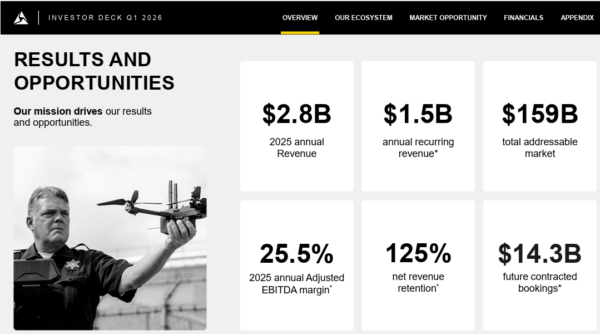
Annual recurring revenue reached $1.5 billion, up 35% year over year. Net revenue retention came in at 125%, meaning existing customers are spending meaningfully more each year. That figure has been remarkably consistent and is a strong indicator of the platform’s stickiness. When customers don’t churn and consistently expand their spend, the revenue base compounds quietly and durably.

The number that may be most underappreciated is Axon’s future contracted bookings, which hit $14.3 billion in Q1 — up 44% year over year. To put that in context: a company with a market capitalization of around $36 billion is sitting on $14.3 billion in contracted future revenue. That level of forward visibility is unusual for a growth company and provides a meaningful floor of demand that doesn’t show up in trailing earnings multiples.
axon - StockEarnings

New Growth Vectors That Weren’t in the Original Thesis

Many investors still think of Axon primarily as the TASER company. That framing is at least five years out of date.

Axon’s AI product revenue grew more than 700% year over year in Q1 — admittedly from a small base, but the trajectory is real. Products like DraftOne, Axon Assistant, and Axon Vision are gaining rapid adoption, and management noted on the Q1 earnings call that nearly all large domestic law enforcement agencies are now including AI tools in their purchases. AI bookings rose 140% year over year. The AI Era Plan, Axon’s bundled AI subscription offering, is pulling through additional software revenue on top of existing contracts.

Counter-drone technology is a second emerging vector. Axon’s Dedrone acquisition is contributing meaningfully and ahead of expectations, with Q1 bookings up 500% year over year and revenue up more than 300%. The market for drone detection and mitigation is expanding well beyond the law enforcement context into infrastructure protection, military support, and commercial security — markets Axon is now positioned to serve.

International revenue more than doubled in Q1, now representing 20% of total revenue. Geographic diversification matters here because it reduces dependence on U.S. federal and local government budgets, which remain a legitimate risk given ongoing scrutiny of discretionary spending.

The Honest Risks

A contrarian thesis has to be honest about what the bears are seeing. The valuation is the first issue. Even with the pullback, Axon trades at a premium that requires continued strong execution. A miss on margins or a meaningful slowdown in ARR growth would likely cause further multiple compression.

Government budget constraints are a real consideration. Axon’s core customers are law enforcement agencies funded by municipal and federal budgets, and any significant austerity push could delay contract cycles or compress upgrade timelines.

On the question of insider activity: several executives have sold shares in recent months, though it is worth noting that many of these transactions were executed under pre-scheduled Rule 10b5-1 trading plans, which are set up in advance and do not necessarily reflect a bearish view of the stock’s near-term direction.

The more telling signal may be the absence of meaningful insider buying at these levels. With the stock trading nearly 50% below analyst targets, one might expect executives to take advantage of the discount. The fact that they have not is not necessarily alarming, but it is a data point worth tracking.

The Valuation Math on a Forward Basis

Current trailing metrics make AXON look expensive. But the story changes when you look forward. Analysts are forecasting earnings per share of roughly $7.86 for 2026 and approximately $10.77 for 2027, compared to a trailing EPS in the neighborhood of $2.57. If those estimates prove out, the stock is trading at roughly 42 times 2027 earnings — still a premium, but one that looks far more defensible for a company compounding revenue at 30%-plus annually with $14 billion in future contracted bookings and a dominant position in an underpenetrated market.

The price-to-sales ratio has also compressed dramatically. Axon traded near 30 times sales at its 2025 peak. It now sits below 10 times for the first time since 2023. That is still not “value” territory, but it reflects a meaningful re-rating that may have overshot the fundamentals.

The Contrarian Read

AXON is not a value stock. It likely never will be. The argument here is not that the shares are cheap in absolute terms — it is that the gap between the operational reality of the business and the current market price has become unusually wide, driven by forces that are largely external to the core thesis.

Nine straight quarters of 30%-plus revenue growth. A $14.3 billion contracted backlog. A 125% net revenue retention rate. AI and counter-drone segments are inflecting rapidly. International revenue is doubling. These are not the characteristics of a business that deserves a 50% haircut from its highs.

The market is asking Axon to prove that its revenue growth translates into durable GAAP margins. That is a fair ask. But investors willing to give the company a quarter or two to show that proof — and comfortable with the still-premium valuation — are looking at a stock priced well below where the analyst community collectively thinks it should be, with a business executing at a high level. That combination does not come around often.


A former marketing copywriter turned freelance financial writer and market analyst. I have a passion for delivering insights to investors. I write regularly about stocks for StockEarnings and MarketBeat. Posts are not advice.

Join over 1.2M+ investors/traders who receive daily and weekly notable earnings alerts with predicted move