ajax loader

Loading...


Ride-the-Wave Strategy – Best for Stock Traders

Ride-the-Wave targets multi-day price momentum following a company’s earnings announcement (EA). With this strategy:

  1. Buy a stock one day post-EA if a stock reacts positively post-earnings:
    1. Near the close of trading the EA-day for a pre-market-EA
    2. Near the close of the following day for a post-market-EA
  2. Sell-to-close after 7-10 days, or possibly earlier if a desired price target is reached

Similarly,

  1. short a stock one day post-EA if a stock reacts negatively post-earnings:
    1. near the close of trading the EA-day for a premarket-EA
    2. near the close of the following day for a post-market-EA
  2. then buy-to-close after 7-10 days, or possibly earlier if a desired price target is reached

Important: Ride-the-Wave is predicated on significant price momentum triggered by an EA. The 7-10 day scenario is the maximum trade hold-time. If you see post EA-momentum is halted or reversed by a significant opposite move, re-evaluate your presence in the trade.

This popular StockEarnings screen below will give you a list of stocks that historically exhibit significant price momentum following an EA for the next seven days:

  1. Stocks exhibiting positive post-EA price moves are buy-candidates
  2. Stocks exhibiting negative post-EA price moves are sell/short-candidates

The screen includes those stocks whose Earnings just came out in last two days.

Screen criteria:

  1. Earnings Date Start Date : Current Date + -1 Day
  2. Earnings Date End Date : Current Date + -2 Days
  3. Predicted Move (Next Day) Max : 7%
  4. Predicted Move (On 7th Day) Min : 7%

Strategy Guideline:

  1. Buy the stock if stock has reacted positively. Short the stock if stock has reacted negatively (see above).
  2. Close the position in 7-10 days, or possibly earlier based on price move.

Volatility Crush Strategy - Best for Options Traders

The Volatility Crush strategy is used with stocks that typically experience relatively low-to-moderate price moves (≤4%) following their Earnings Announcements (EA). The basic trade idea is to sell put or call options right before the EA, collecting a credit when options premium is very high due to elevated implied volatility (IV). You then close the position right after the EA by buying the option back much cheaper due to the significant drop in IV that occurs after the mystery of the EA disappears. In assessing this trade, you need to do your homework to ensure you collect sufficient premium to make the trade worthwhile.

This trade is practical due to the low-to-moderate price-move after the EA, which generally won’t significantly affect the options price, unlike an “action” stock, which experience great price moves post-EA. With these symbols, if you’re on the right side of the price move, that’s a great thing. But if you’re on the wrong side of the move, not so great. Consequently, by minimizing the effect of the post-EA price move, you have a much better chance to profit from the reduction in IV without it being ruined by a violent price move.

For this trade, open the position either (1) the night before the EA when the company announces earnings or (2) during the EA day when it announces post-market, generally capturing IV at or close to its peak.

For this trade, open the position either (1) the night before the EA when the company announces earnings or (2) during the EA day when it announces post-market, generally capturing IV at or close to its peak.

This popular stockearnings screen will give you a list of stocks which do not react more than 4% fpost-EA. It includes only those stocks whose earnings are releasing next day.

Screen criteria:

  1. Earnings Date Start Date : Current Date + 1
  2. Earnings Date End Date : Current Date + 1
  3. Predicted Move (Next Day) Max : 4%
  4. Options Type: Weekly

Strategy Guideline:

  1. Options Strategy: Sell Call and Put
  2. Options Strike Price: Current Stock Price – (% Predicated Move x 2)
  3. Expiration Date: It should generally be the closest expiry immediately after the EA.
  4. Buy Insurance: Buying back Call and Put at Strike price which 10% lower than Sell Strike Price is optional but recommended.

Watch Video for More Detail

Volatility Rush Strategy - Best for Options Traders

The Volatility Rush takes advantage of increasing options premiums into earnings announcements (EA) caused by an anticipated rise in Implied Volatility (IV). With this strategy, Buy a Call and Put at-the-money (a long straddle) 2-3 weeks before the EA when IV is lower. Sell the position either (1) the night before the EA when the company announces earnings pre-market, or (2) during the EA day when it announces post-market, generally capturing IV at or close to its peak.

This popular screen will give you a list of stocks whose Options premiums tend to rise into Earnings. It includes only those stocks whose Earnings are at least two weeks away from today.

Screen criteria:

  1. Earnings Date Start Date : Current Date + 15 Days
  2. Earnings Date End Date : Current Date + 30 Days
  3. Predicted Move (Next Day) Min : 5%
  4. Options Type: Weekly or Monthly if that lines up with the two to three-week lead-time for entering the trade

Strategy Guideline:

  1. Buy a Straddle at or close to the money two to three weeks pre-EA.
  2. Sell the position either the night before the EA when the company announces earnings pre-market, or during the EA day when it announces post-market.
  3. Expiration date should generally be the closest expiry immediately after the EA.
  4. Straddle price should not be more 60% of predicted move.

Predicted Move (Volatility)

Similar to Implied Volatility in Options. Expected volatility % based on our Proprietary Volatility Predication Model. We are expecting that stock price will likely to reach % in either direction by the end of next trading session after Earnings are released and not necessarily the closing volatility %.

Why is it important?

    This indicator helps

  1. Knowing expected volatility in stocks after Earnings helps to decide trading stocks before Earnings Announcement.
  2. Taking Advantage of volatility collapse following Earnings Results by using Advance Options strategies such as Spread and Straddles.

Since Last Earnings

Change in share price since last Earnings release.

Why is it Important?

When share has gained more than 10% since it's last Earning release, it tends to over react to minor bad news and give up some gains if not all. So, it contains more downside volatility than upside When share has dropped more than 10% since it's last Earning release, it tends to over react to minor good news and recover some drops if not all. So, it contains more upside volatility than downside.

EPS Surprise (%)

Occurs when a company's reported quarterly or annual profits are above or below analysts' expectations. Here is the formula to derive % EPS Surprice:

Actual EPS - Estimated EPS
------------------------------------- x 100
Estimated EPS

Why is it Important?

Earnings surprises can have a huge impact on a company's stock price. Several studies suggest that positive earnings surprises not only lead to an immediate hike in a stock's price, but also to a gradual increase over time. Hence, it's not surprising that some companies are known for routinely beating earning projections. A negative earnings surprise will usually result in a decline in share price.

Next Day Price Change (%)

Next Regular trading session Closing price following Earnings result.

For After Market Close Earnings, It is a next trading day closing price. For Before Market Open Earnings, It is the same trading day closing price.

Why is it Important?

Next Day price change is a reaction of Earnings result.

These Stocks Could Benefit as Tropical Storm Threats Return

Posted on Jun 17, 2026 by Ian Cooper

These Stocks Could Benefit as Tropical Storm Threats Return

The 2026 Atlantic hurricane season is barely underway, and investors are already getting a reminder of why storm-related stocks deserve attention.

A tropical system that developed near the Texas Gulf Coast has become Tropical Storm Arthur, the first named storm of the 2026 Atlantic hurricane season. Forecasters warn the storm could dump as much as 20 inches of rain across parts of Texas, Louisiana, Mississippi, Alabama, and portions of the Southeast, raising concerns about flash flooding and infrastructure damage.

The storm arrives just weeks after the official start of hurricane season on June 1, and it serves as an early reminder that weather-related risks can quickly create opportunities for certain sectors of the market.

As we saw in 2025, hurricane season remained active, producing 13 named storms. This year could be another busy one. Early forecasts from Colorado State University and AccuWeather call for 11 to 16 named storms, four to seven hurricanes, and two to four major hurricanes. With Gulf waters remaining unusually warm, meteorologists expect favorable conditions for tropical development throughout the summer and fall.

For investors, that could create opportunities in companies tied to storm preparation, infrastructure repair, emergency response, and backup power demand.

Generac: A Leader in Backup Power Demand


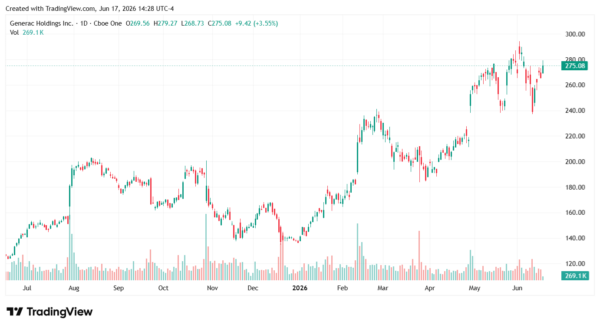
One of the most popular hurricane-season trades has been Generac Holdings (NYSE: GNRC).

The company is a leading manufacturer of residential standby generators and mobile power systems. Historically, demand for generators tends to rise as hurricanes threaten populated regions and homeowners prepare for potential power outages.

The stock has shown a strong tendency to rally during the tropical storm season. In late May 2025, shares traded near $122 before climbing to roughly $200 by August. Similar seasonal moves occurred in 2024 and 2023 as investors anticipated increased generator demand.

Beyond hurricanes, Generac is also benefiting from growing concerns about aging electrical infrastructure, grid reliability, and extreme weather events. As storms become more frequent and severe, more households and businesses are investing in backup power solutions before outages occur.
tropical storm-StockEarnings

Home Depot and Lowe’s: Retail Winners in Storm Recovery

Home improvement retailers can also see a boost when storms approach.

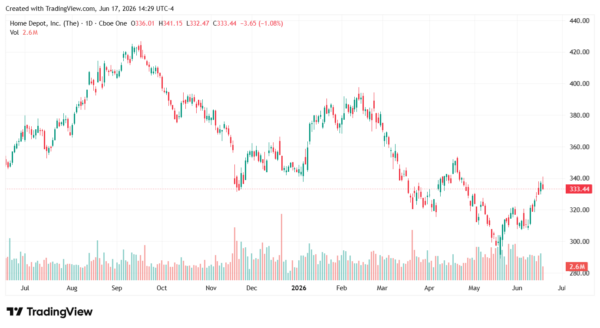
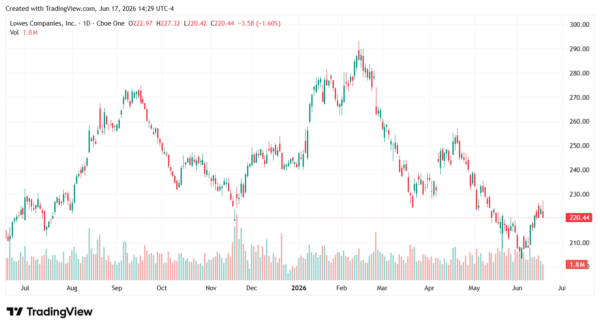
Historically, both Home Depot (NYSE: HD) and Lowe’s (NYSE: LOW) have benefited from increased demand for plywood, roofing materials, tools, generators, tarps, cleaning supplies, and other products needed before and after major storms.

According to Morgan Stanley, the home improvement sector is “naturally positively exposed” to both hurricane preparation and recovery efforts. Following major storms, rebuilding activity can support sales for months as homeowners and contractors repair damaged properties.

Seasonal performance reflects that trend. Home Depot climbed from approximately $350 in May 2025 to about $425 later in the season. Lowe’s advanced from roughly $220 to $270 during the same period.

With another active hurricane season expected, investors may once again turn to these names as storm-related spending accelerates.
tropical storm-StockEarnings

Xylem: Flood Management and Water Infrastructure Play

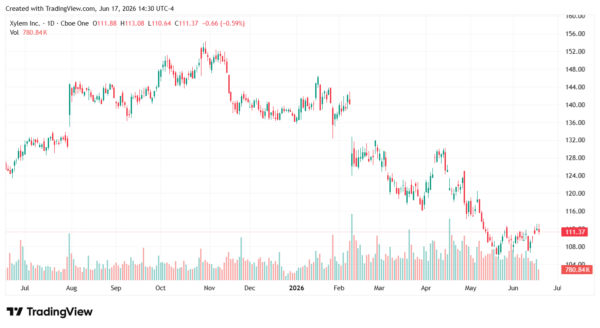
Another hurricane play is Xylem (NYSE: XYL).

The company specializes in water infrastructure, flood management, pumping systems, and emergency response equipment. Xylem works with municipalities, counties, and private organizations to prepare for and respond to natural disasters.

As coastal communities face heavier rainfall and increased flooding risks, demand for water management solutions continues to grow. That trend could be especially important this year as Tropical Storm Arthur highlights the flood risks posed by even relatively weak tropical systems. Forecasters say rainfall, rather than wind, may be the storm’s most dangerous threat.

The stock has historically performed well during hurricane season, climbing from $121 to $155 in 2025 and posting seasonal gains in both 2024 and 2023.
tropical storm-StockEarnings

Key Takeaways for Investors in Hurricane Season 2026

No investment is guaranteed to rise simply because hurricane season is active. However, history shows that certain companies often benefit when storms increase demand for generators, home repair materials, emergency equipment, and water infrastructure solutions.

With Tropical Storm Arthur already bringing flooding concerns to the Gulf Coast and forecasters calling for another potentially active Atlantic season, investors may want to keep companies such as Generac, Home Depot, Lowe’s, and Xylem on their radar. If storm activity accelerates in the months ahead, these hurricane-season stocks could continue to benefit.


Over the last 26 years, he’s taught thousands of investors how to trade news flow and herd mentality using a unique blend of technical and fundamental analysis. Cooper was among the few analysts to spot the financial crisis of 2008, the top of subprime and Alt-A, the death of Lehman Brothers, Bear Stearns, and New Century Financial, and even the Dow’s collapse to 6,500, as well as its recovery. He even called for gold to rally well above $1.500 when it traded under $600. At the moment, Cooper makes use of technical, fundamental and news analysis, to help individual investors grow their wealth. He’s a firm believer that hard work and thorough research will lead to investment success.

Join over 1.2M+ investors/traders who receive daily and weekly notable earnings alerts with predicted move