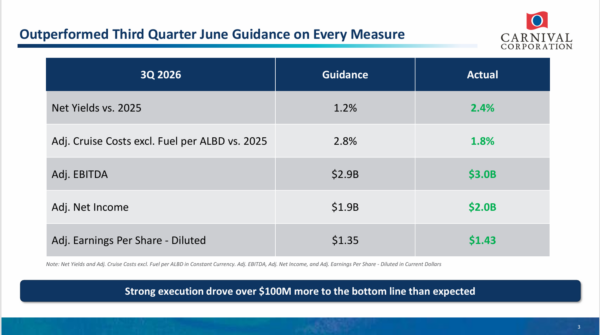
Carnival Corporation (NYSE: CCL) delivered a Q3 earnings report that sent the stock soaring. CCL closed the Sept. 29 session up 13.42%, one of the strongest days of the year. The company beat guidance on the top and bottom lines and posted record revenues, net yields, and net income. Revenue came in at $8.44 billion, up from $8.15 billion a year ago. Adjusted net income was $2 billion.
The most encouraging sign from the earnings report came from what Carnival said about future bookings. Carnival stated that customer deposits came in at a record third-quarter level of $7.6 billion. For a cruise line, a deposit is money customers have already committed to future cruises. That makes it a reliable signal of forward demand. Management added that 2027 booked occupancy and pricing are both at record levels.
It was a bright spot on an otherwise weak day for stocks. That raises the question of whether the rally will hold. In extended trading on Sept. 29, CCL was down a fraction. That doesn’t suggest a reversal of the post-earnings rally, but when a stock makes a strong move in one session, history says it can be tough to sustain.
The Chart Says the Rally Has Work to Do
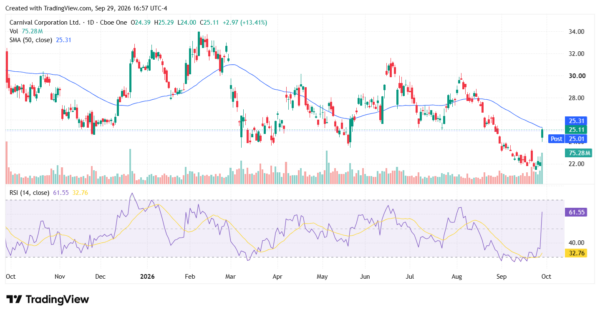
The chart gives reasons for caution. CCL closed at $25.11, just below its 50-day simple moving average (SMA) of $25.31. That average has been sloping lower since early August. Stocks that can’t reclaim a falling 50-day line often stall there.
Overhead supply is another hurdle. The $24 to $25 range acted as a floor in March and May. CCL broke below it in September and bottomed near $22. Former support often becomes resistance. Investors who bought in that range may use the rally to get out at break-even.
There are positives. Volume was about 75 million shares, well above the recent average. The Relative Strength Index (RSI) jumped from near the oversold line of 30 to about 62. But the bigger picture shows lower highs since February. A close above the 50-day SMA would be the first step toward changing that.
Why “Sacrosanct” Vacations Favor Cruises
Carnival chief executive officer (CEO), Josh Weinstein said the results show that “vacations are sacrosanct,” and imply that consumers continue to prioritize travel “in good times and in bad.” There are two takeaways from that statement.
First, it supports what many travel-oriented companies have reported during this earnings season. That is, while consumers may be cutting back on many things, they continue to prioritize travel and leisure.
Second, investors are always better off watching what consumers do, as opposed to what they say. As the calendar heads into October, most consumers’ specific complaints about the economy focus on gas prices.
That’s the strongest argument for a cruise. The vacation takes place on the ship. Of course there are purchases that happen on the cruise, but part of the attraction is that most of your vacation is already paid for.
There’s an irony here. Fuel is Carnival’s problem, too. The company said operational improvements of more than $150 million offset a similar hit from higher fuel prices. Management now expects full-year adjusted EPS of about $2.24. At Tuesday’s close, that puts CCL at roughly 11x earnings.
Deposits Are a Promise, Not a Payment
Carnival’s numbers don’t lie and are another part of the broader market bull case. But they may not be telling the whole story. Let me explain. The company’s deposits for 2027 and into 2028 are real. And once consumers make that commitment, they are likely to follow through. I’m not suggesting otherwise.
That said, intention doesn’t equal commitment. Carnival’s policy (as is true of most cruise lines) does allow for refunds. On standard fares, customers can cancel before final payment without penalty.
That refund may not always take the form of cash. In some cases, such as the Early Saver fares, consumers may get a future cruise credit equal to the deposit minus a $50 per person fee. That credit must be used on a new booking within 12 months, and any unused amount is forfeited.
Carnival’s own filings acknowledge this. Its quarterly report notes that the deposit balance includes refundable deposits, and that refunds are one of the factors that move it. The company does not disclose how many bookings are canceled.
There’s no certainty that this will happen. It will take more time to play out. But it’s something to be aware of if you have or are looking to take a long position in CCL.
Which Side of the K Does Carnival Sail With?
When a company like Viking Holdings (NYSE: VIK) reports strong future demand, investors can point to Viking’s target audience, which consists of the Baby Boomers and Gen-X travelers who are looking for a travel experience without casinos or young children. In the current situation, those customers are firmly on the upper leg of the K-shaped economy.
That’s not where the bulk of Carnival customers live. According to one industry profile, Carnival’s core consumer has a household income of roughly $60,000 to $110,000 a year. It also cites Carnival as carrying over 1 million children annually, the most in the industry. This would seem to be the group of consumers most impacted by the current economy.
That said, many 30-, 40- and even 50-year-olds receive some form of financial assistance from their Boomer-generation parents. That could free up money for a cruise.
Carnival’s guidance hints at the tension. Net yields rose 2.7% in the first quarter and 2.2% in the second. Management expects about 1.7% in the fourth quarter. That’s still growth, but it’s slowing growth.
I don’t pretend to know, and I’m not being a contrarian just to be a contrarian. But when sentiment shifts so rapidly to tell one story, I tend to look at possible plot twists.
This is clearly a case where two things can be true. Carnival’s numbers are telling one story, and the daily headlines are telling another. Which story more accurately reflects the consumer will set the course for CCL stock.